What do you do when you have a challenging child, and the parenting advice out there just doesn’t seem to cut it? There are many families dealing with parenting challenges that make them feel alone or broken. Unfortunately, our society, schools, and families make us believe we’re the only ones dealing with this kind of behavior.
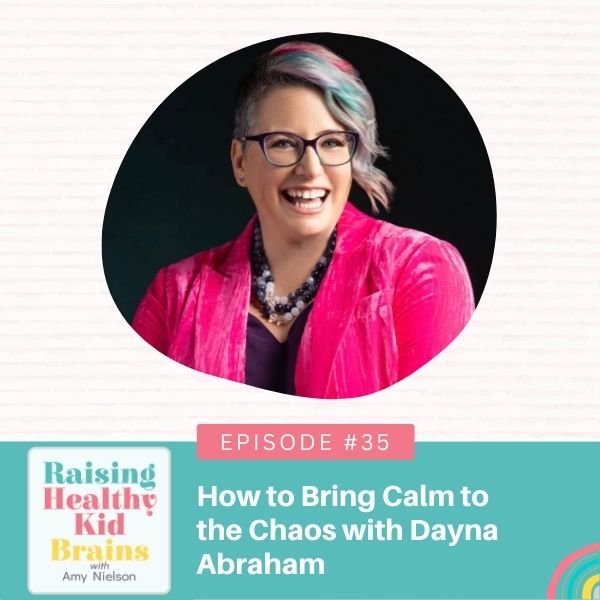
Dayna Abraham is a national board-certified educator, best-selling author, and parent to three neurodivergent children. She has helped desperate parents around the world find peace and meet their children where they’re at when conventional parenting tools have failed them. Her newest book, Calm the Chaos, provides a fail-proof roadmap for parenting even the most challenging kids, and she’s here to share her wisdom with us.
Tune in this week to hear Dayna’s framework for parents raising kids in the modern world. She’s sharing the power of taking imperfect action, how to shift your language when your child is demonstrating challenging behaviors, and her top tips for beginning to cultivate trust and collaboration with your children.
To thank you for being a listener here, we made you a special freebie. It’s an amazing alphabet activity you can begin using with your kiddos that is so fun, so get started by clicking here to grab it!
Today I’m talking with my friend and author Dayna Abraham, who is the bestselling author of The Super Kids Activity Guide to Conquering Every Day and Sensory Processing 101. She has just written a new book called Calm the Chaos with her amazing framework and out of the box perspective to parents raising kids in the modern world. She is a National Board Certified educator, a parent of three neurodivergent children herself, and she is the founder of the popular parenting website Lemon Lime Adventures, which has accumulated more than 41 million viewers in less than seven years.
Her compassionate framework, Calm the Chaos, has helped millions of desperate parents around the world find peace and meet their children where they’re at when conventional parenting tools have failed them. On a personal note, Dayna is a friend of mine and has been for years. I have watched her work through some of this stuff. We’ve had late night, middle of the night parenting conversations. And she is amazing at what she does. I think you will find this very interesting and super helpful if you have really challenging children or even just building a good framework for your children in your life. Listen in on our conversation coming up right after this.
Welcome to the Raising Healthy Kid Brains podcast where moms and teachers come to learn all about kids’ brains, how they work, how they learn, how they grow and simple tips and tricks for raising the most resilient, kind, smart, compassionate kids we can. All while having lots of grace and compassion for ourselves because you know what? We all really need and deserve that too. I am your host, Amy Nielson. Let’s get ready to start the show.
Amy: Dayna, welcome to the show. I’m so happy to have you here today?
Dayna: I am so excited to be here today.
Amy: This is so fun because Dayna and I have known each other for years and years. And have just done some fun things together. And have had parenting conversations actually late at night at events. And so I just, I’m so thrilled that this book came out. It’s such a game changer and I’m so excited to talk to you about it today and just get to kind of point out some of the things I’ve learned and get to share a little bit about it with our listeners.
Dayna: Thank you. I am so excited to have this chat. And like you said, we’ve talked about parenting on a professional level and then on a friend level. And so, and I’m sure there will be many more to come, so yeah, this should be fun.
Amy: I’m so excited. Okay, so you have a book. It’s coming out in August, yes?
Dayna: August 15th.
Amy: Calm the Chaos and tell me just a little bit about the background of why you wrote this book, where this book came from and how it helps all of us.
Dayna: So the origin of this book, the book itself has been in the making for the last four years, but the concepts in the book have been in the making, I feel like my whole life. I was born as a sibling to an older brother who’s bipolar. So he was extremely explosive and I had to deal with a lot of his ‘storms’ really early on and how to navigate those and how to help him and navigate his behaviors and how he acted.
And then when I was a teacher in the classroom, I taught in inner city Chicago and I had a lot of kids. My favorite kids were the ones who came with that paper trail behind them and were constantly getting in trouble in other people’s classes and the ones that were too much or not enough for other teachers, those were my favorites. And I still have really close friendships with a lot of their parents, even. And so then when I became a parent, I kind of had this feeling like I got this, I can do this.
But my kid, he taught me all kinds of new things about education and about parenting and about what I thought I knew about kids. And so when he was in preschool, he got kicked out of preschool, he was the biter. And then in kindergarten, he was the rough-houser or the class clown so he was getting in trouble a lot. But he was academically way ahead of where the other kids were, so they kept saying, “We’re not worried, he’ll grow into it.” By first grade, though, he was the one crawling on the floor.
He was the one shouting out. He was the one running in the halls, not walking in the halls. And so he was really struggling with that more structured approach by first grade. So he was starting to get in trouble a lot. And then by second grade, he was getting suspended because these behaviors were getting bigger and bigger. And he was starting to run away. He was starting to explode. He was starting to throw things. I mean it was starting to get pretty bad. And so by second grade was when it just became really clear that he needed a different approach.
And so I ended up bringing him home. I started my blog at the same time, just kind of sharing what I was going through, the ups and the downs because everything looked picture perfect online. And so I just wanted to know that I wasn’t alone. That was really, it was kind of a selfish reason for starting. And then over the years, I shared what was working, what wasn’t. And I started to kind of teach other parents the things that I was learning. And I never set out to be a parenting expert. So now it’s kind of funny, Amy, when people introduce me as, “Dayna Abraham, parenting expert.” I’m like, “Oh, that word ‘expert’.”
I believe that every parent is an expert in their own kid. And I think that parents have been misguided into believing that experts are better than them with their kids. One thing that I can say is that I’ve had the honor of working with hundreds of thousands of parents around the world, all different ages, all different challenges, all different cultures. And so you do start to see some trends. You do start to see some generalizations that you can kind of put in place. And when I started teaching this to parents, I wanted something that was adaptable to every child, which seems like a really tall order.
You hear all the time, “Well, there’s no parenting manual.” And I’m like, “But there is now, now there is.” Because it’s not like, okay, your kid is hitting, here’s exactly what to do and say. Instead it’s, here is how to approach, here is the why behind it, so there is that theory. But it’s also tactical, practical of here’s a way to look at it. Here’s a place to start. And then here’s how to adapt it to your unique family.
And so that’s how this came about is creating a framework that I’ve taught online now for five years. And we’ve tweaked and iterated it. We’ve had more than 5,000 parents use this framework in our full program and more than 5,000 be in our memberships and things like that. And so this has been used around the world. And we’ve seen where parents fall in traps and where they get stuck. And every time that happened, we went back to the framework and we started kind of tweaking it and adjusting it.
And so what we have here now really is the culmination of that 10 years of work, both 10 years online and then the 12 years in the classroom. And then the years growing up as an undiagnosed ADHD child and a sibling of a bipolar brother. It’s all kind of combined into this one framework that I hope is a step-by-step guide for parents so that they don’t feel shame. They don’t feel blame. They don’t feel that guilt of am I doing this wrong? Is something wrong with my kid ?
And instead, no, you’re exactly the parent you need to be. Your kid is exactly who they’re designed to be. We might just need a different perspective. You might just need a different strategy to go at it, but you’re not doing anything wrong, you’re not failing here.
Amy: I love that so much and I love your story. And like I said, we’ve been friends and kind of worked through some of our different struggles together because I have some kids that have unique challenges as well. What I loved about this book, I felt like it was such a guide and I felt like you broke it down so beautifully and just kind of leading people through. And it’s so encouraging and so functional, which is what we all need because when we have kids that are challenging, we’re kind of already a little bit overwhelmed, which you speak to in the book.
And so I wanted to just kind of briefly go over for people just a little bit, you talk about five stages of kind of working through this. And I thought we could kind of just touch on that a little bit and then send everybody the book to get all the details and the step-by-step instructions because they’re so good. So can you tell me just a little bit about, yeah, your framework and these five stages?
Dayna: Yeah. So what we found is that there’s a framework and then there’s these stages and they work together really well. And the framework is like baking a cake. You need these basic ingredients and if you leave out the eggs, you’re going to get a weird cake. And so at every stage you need these same four elements, but they look a little different. And in education, you call the scaffolding, but you need these same four ingredients.
And then as you progress in the stages, you can start to get a little bit more advanced or a little more complex but you need something so basic that you can access it when you’re in the worst of your days and in the burnout and in the overwhelm and in the stress of your day-to-day. And so that’s where the roadmap comes in, is that it starts out at riding the storm, just let’s get through this. Let’s create our emergency plan almost of how am I going to ride this out without adding more to an already volatile situation.
Then a stage that almost everyone wants to skip and tries to skip and that is the time and energy plan. And that’s all about creating your own time and energy reserves with teeny, tiny habits that can be done in less than five minutes a day. so we’re not talking about completely upheaving everything you’ve ever done. We’re not talking about spa days. We’re talking about one tiny habit, like removing something that drains you or adding something that boosts you, just really small habits that can give you a little bit more battery in your tank and a little bit more fuel to be able to handle whatever comes at you.
And then the third stage is that diffusing stage of what to say and do and how to show up in the heat of the moment. So when you have an argument with your kid, when your kids’ not putting away their toys, when your kid is refusing to eat the dinner that they just asked for, whatever that is. It’s in that moment when you feel yourself boiling, you see they’re getting agitated. It’s how to really interact in the heat of the moment.
Once we have that solid now we can go to the fourth stage, which is getting ahead of the chaos and that’s the first stage that you actually start talking with your kids. And I find that a lot of parenting books, a lot of resources start at this stage, stage four and five. We have a ton of people that come to us and they say, “No wonder I’m struggling to put all these awesome theories into place, I haven’t had the foundation of stage one, two and three.” And so stage four is where we start talking about collaborating with our kids, connecting with our kids in between moments and one-on-one connection.
A lot of stuff that your listeners probably have heard before, but we have some strategies that are a little unique in how to adapt them to your kid and how to spiral out behavior. So you can really see where the challenge is coming from. And then the last stage is kind of that [inaudible], where we all want to be is that beautiful family, that family we dreamt of when we became parents. And that family where everyone’s working together, you’re a family team. You’re advocating for each other. You’re listening to each other, and you’re solving problems together.
And so that’s that last stage that we really hit and like I said, a lot of parenting books, that’s what you get is best case scenario and it’s here’s what you should be doing. Here’s what it should look like. And if you get anything outside of this then you might have something wrong with you or your kid. And so by adding these other four stages before you ever even get to family team, you’ve built a foundation of trust and collaboration and compassion and empathy and understanding so that your family can work together and it runs smoothly. And every stage is based on these same four key elements.
Amy: I love it so much and just going through it, it was so interesting to kind of see the pieces where I feel are things I’ve learned already or have learned from people we’ve had as guests on the podcast or have just learned through going through my own challenges. But then also getting some new pieces that I was like, “Oh, I’m going to work on this one a little bit.” Because you had some really, really good stuff in there that I could pull out and work on. And I like to pull out one or two things and start there.
But some of the ones I loved from stage one and you talking about all behavior is communication. And I love that because I think so often, yeah, we think, oh, my goodness, my kid is doing this thing and does that make them a bad kid and whatever. And instead of that, just looking at it is, and I think you had a phrase there instead of the words like my child is switching that to my child needs or something like that.
Dayna: That’s a huge one. And we find that if you can make that shift in all behaviors, not just my kid is whiny because they’re tired. My kid doesn’t sleep. That one’s pretty easy for most parents. And if we think back to raising infants, we’re like, “Okay, my kid needs their diaper changed.” So it’s a little easier when we can look at it that way. But when our kid hits their brother on the head because their brother has a toy, we assume that it’s because they’re mean or it’s because they just wanted that thing. And instead there’s so much more going on.
If we can just take a step back, zoom out and say, “Okay, instead of my kid is so mean, my kid is awful, my kid is the worst.” And we all say it. None of us want to admit these things and I know it can be triggering to hear someone say this about kids. But the truth is, is that even if we’re not saying it out loud, we all feel it sometimes like, “Oh my gosh, why is my kid so hard? Why is my kid so challenging.” And instead, my kid needs me. My kid needs to feel safe. My kid needs control. My kid needs a plan.
There are so many reasons why the behavior could be happening and when we can think with curiosity, one we can’t be triggered. You can’t be curious and triggered at the same time. And so it allows us to respond with empathy and compassion, but at the same time, it really does take that blame and shame and resentment out. It makes it so hard to show up for our kids.
Amy: I love that and I think too we model it for our children. And when we’re getting curious instead of triggered, I think it shows them to get curious about their own behavior, why am I feeling this way? Why am I doing this? And help them kind of be able to self-analyze which allows them to kind of then we can work through that together and help them not feel like a bad kid. And instead feel like I have something going on. Maybe I should look into that some more. So I loved that. I actually in my 10 pages of notes that I took from your book that is in there, I thought, that’s so good. I love that.
Dayna: I love that. I’m so glad it’s helpful. And then to take that concept of the roadmap, that concept is throughout the whole book. That’s one of those understanding pieces. That’s one of the elements is understanding our kids and their behavior and challenges at a deeper level. And so that’s the most basic level. And then if we take that understanding too in the moment then it’s like, but what are those things? What’s a quick little like Litmus test or checklist we can use?
Well, let’s understand it ahead of the moment. Now I can get some more details, I can zoom out. So what was really leading up to this? That my child needs or the needs weren’t getting met beforehand? And then when you expand it all the way to family team, it’s what is under the surface and makes each member of our family tick. So that it’s not dad and brother are oil and water. Instead it’s dad really dislikes loud noises and you are a very loud person. And so how can we find a plan that works for both of you?
Amy: Yes. It’s so good. It’s so good. I love this book. So then moving on to stage two, there’s so many pieces. I’m like, “I have so many ideas now.” Stage two, when we talk about the energy. I just want to just say yes and amen to everything you say in here because I think this is one of those things that we just want to give everything, everything to our kids and we just feel like we just have to give and give and give and we do. But at the same time, you just have nothing else to give if you’re not taking care of yourself. And this is something I’m hearing over and over and over again and found for myself to be true.
And so I love that you break it down and make it, I think simple. And what I love about it too is that again, I think everything that we’re doing, we’re modeling for our kids. And so when we show them that we are focusing on doing something, something for ourselves, that we’re paying attention to our own needs. Then again, we’re having them pay attention to their needs. And then we’re doing something about it and coming up with a plan to take care of our needs. And again, we’re modeling that for them.
And so we’re trying to do this process that you’re teaching us to do. But then I think in the process of doing stage two, we’re kind of modeling for them some of that exact action.
Dayna: 100%. In those early stages when you’re not really involving your kid, you’re still involving your kid because you’re not learning all this in isolation. So it’s not like you put your kids in another home while you learn this and get [inaudible]. They are still there. They’re still interacting with you. And when you have more fuel in your tank, more battery in your reserves, whatever you want to say here, you can then show up for your kids differently, when you have something for yourself, even if it’s just a moment.
Lately I’ve been knitting again. I haven’t knit in 10 years. But I’ve found that it really helps my really busy brain and my hands. Otherwise I will, because I can hyperfocus with the book coming out. I could work from six in the morning until way late in the evening. And I’ve found that if I stop and I knit, then I give myself permission to stop and just sit near my kids. They can do whatever they want to do while I sit near them and just knit.
And I’ve noticed that they are all starting to pick up things that they enjoy because they see mom picking up something that she’s enjoying. And then they see the fruits of my labor. They see my bag and they see my jacket, my scarf and they’re like, “Ooh, those are really cool, you made that?” My 17 turning 18 year old came in the other day and he was like, “Where did you get that bag?” I said, “I made it.” He was like, “You made it?” And he inspected the whole thing. And he’s like, “This is so cool.” He was like, “Wait a second, did you sew it?” I’m like, “No, I crocheted the whole thing.”
But when we have that joy, when we have something that gives us energy, we then share that joy with our kids. And so I always tell people, I say, “Look, you would never start your day with your phone on zero battery. You charge it overnight so that when you start your day, your phone has full juice.” But we start as parents every day with no juice in our battery and we just go about our day and then get mad at ourselves when we can’t stay calm, when we have no energy, when we can’t make decisions, when we forget things.
And we don’t realize that our brain is actually just red alert going red alert, red alert, red alert. I don’t have enough energy to do all the things you’re asking me to do. So you’re so right, that stage is, when you get the book, if you’re listening to this and you get the book, you’re going to be tempted to skip this stage. Do not skip it, do not skip it.
Amy: It is so important and especially when we have kids that have ongoing challenges. Sometimes I feel like there’s little phases and we can get through them fairly quickly. And then sometimes they’re kind of more ongoing and. And either way, I feel like having the energy to show up well in those moments is going to help get through the harder things faster right now, but also maybe potentially prevent some additional things later on. So it’s super valuable, yes.
And some of mine, I have found for me, my number one thing is going to the gym and I couldn’t go to the gym during the day, I would try, just would not happen. And so I started getting up early and going to the gym. But I also love reading or listening to podcasts, it’s one of my favorite things. And so I just found a way to combine them. So I go to the gym and I listen to my favorite podcast or my favorite book or whatever and I can do those two things together. And I come home just so much more energized, even though I start sometimes at 5:00 in the morning or 4:30 in the morning or whatever.
But that’s when I can do it for now and that might change as things go on. But I think just finding your thing, whatever it is, and it can be small. And I point out to my kids too, I try to encourage them to do this in their hard stuff. So when they’re having a really hard time in school or having a hard time emotionally or something, and I’ll say, “Okay, you have to make sure that you’re putting things into your day because you know that this hard stuff is coming.” But you can be also really intentional about putting happy, nice things into your day, but if you can just plan those, then you know they’re coming. It’s kind of nice.
Dayna: Yeah, I just had this image of those video games, and right now, I can’t picture the video game that it was, but it’s something from Nintendo in the 80s. But basically, I feel like I’m getting this picture of you know how you have to get a boost before you go over this really challenging part, to get over the fire or whatever. You have to do this boost ahead of time and that’s what we’re kind of doing here is we’re building momentum to be able to get through the friction.
Amy: Which leads so much, I think into the next part, which is when you’re in the middle of it, and it can look like a tantrum at the grocery store or it can look like a kid just sitting down and refusing to walk and go somewhere, I’ve tried that, just different things. And then trying to find a way to kind of bring some calmness to that moment. And then one of the things that you said that I thought was interesting, and it was less words in that moment, to just minimize the number of words. Tell me a little bit about that.
Dayna: So the idea here is if your child is yelling, refusing doing any of these things, that is a sign that they are dysregulated. That is a sign that they are not able to emotionally have a conversation. And so I like to think of this as putting on a scratchy sweater when you’re already sunburnt. And that feeling, just imagine that. That’s what your words are doing to their body, to their nervous system, because they already are overloaded. They already are frustrated, are upset about whatever it is. And you adding in words does not make it better.
And it’s hard, this just happened the other night. My daughter had been gone all weekend, she’s 10, first weekend away with her cousin. They went to the lake, she came home obviously exhausted, just a big, big weekend. And so she kind of stayed to herself until it was time for bed. And I somehow missed that it was 10:00 o’clock at night. So we are way past bedtime at this point. And so I was like, “Hey, honey, we’re about to go to bed.” And she goes, “No.” Now, my daughter really doesn’t do this very often, this is really rare.
And I was like, “Okay, that’s a clear sign that she is definitely overtired.” And I was like, “Well, I hear that you don’t want to go to bed, but it is after 10:00, you’ve had a long weekend and I’m tired so I’m going to be going upstairs. So I’m going to gather the stuff and you can have a few minutes.” And she’s like, “I don’t want to.” And she was super angry. And I remember just being like, “I am not going to talk to her. I’m just going to be like, “Hey, she can’t listen right now.””
So, what I do is I go into the kitchen and I’ll be like, “Oh, should I grab some water? And I grab, I’m going to grab water for myself. I wonder if I should grab water for her.” And she’d come in and go, “Water.” And then she’d walk out. And so I grab water for her. And then I’m like, “I wonder where Laura’s phone is, I haven’t seen it.” And she’d be like, “It’s dead anyway.” I was like, “Okay, well, it’s dead, that must mean that I need to find a charger.” So I’m talking to myself and there’s long stretches of silence.
And so I just kept my words super minimum and she just ends up following me up the stairs and then going to bed with her dad and all the things that she needed and I had gathered them all. But if I had said, “Don’t you dare talk to me like that. What is wrong with you? What are you thinking? I’m just trying to help, don’t bite me, I didn’t do anything wrong.” Those are all the things that were going through my head. I was like, “I missed you, you were gone all weekend and now you’re just yelling at me.” That’s what I wanted to say, it wasn’t going to help.
Amy: Right. And I love that you talk in the book about not taking it personally. I feel this one in my soul. When they are dysregulated and sometimes words or actions come out that do not feel the kindest and you have to just remember, just remove it a step from yourself and say. “This is not about me. This is not a reflection of how they feel about me.”
Dayna: Yeah, it’s no different than a dog barking. Yeah, it’s no different than any of that. It’s kind of not equating your kids to dogs but you have to remove the emotion somehow. And for my kid, I used to think of one of those little machines, in the minions they have those little, I think they’re fart guns, but anyway, they have these little gun machine. But I thought of it as I would actually picture his words going in of, “I hate you.” And then it would go and then out would come, “I need you.” And I’d be like, “Okay, this isn’t about me. This isn’t about me.”
That was such a huge game changer for me because when I thought it was about me, I could only remain calm so long before my own fight, flight or freeze system went off and was red alert, you’re dealing with someone who is trying to attack you. And when you think someone’s trying to attack you or that you’re in danger, and in danger can look different for all of us. If we were ignored as kids and our kids are ignoring us, our alert system is going to be like alert, alert, you’re being ignored again.
When kids talk back to us and we have always been talked over as kids and growing up and we feel like our voice is never heard. And then our kids are talking back to us, then we’re going to take it super personally. And so we have to really be aware, that’s what I mean when I say this is adaptable because you have to know your past is going to affect what triggers you. I can’t sit here and say, “Don’t let it affect you that your kid is talking back to you.” I get it. It’s going to affect some of you more than it’s going to affect the others.
Amy: So interesting, yes. There’s so many things. I loved the six causes of behavior challenges. I have this one marked all over in my notes and just kind of going through that list. And I mean, we don’t have to go through all of it, get the book, you guys. It’s amazing. And there’s just this great little funnel and you can just go down, check, check, check. But making sure that they’re meeting all of the needs.
And I thought it was so interesting, you told the story in your book about your cute little five year old and not wanting her brother to come to her birthday party. And you were feeling a little concerned about that. Tell me a little bit about that because I love the story.
Dayna: Yeah. So that one was, she was five years old and she wanted a birthday party. And she’s like, “But I don’t want my brother there.” And I just was hurt. We were at this family team stage or so I thought. And here she is, all this work we’ve done and she doesn’t want her brother at her party.
And so I didn’t make it about me. And so I said, “That’s interesting. Can you tell me more?” And afterwards what she said was just mind blowing to me. She goes, “Well, I know that Eli”, that’s my oldest who’s autistic, has ADHD and sensory processing and all the things.
She goes, “Well, I know that Eli can’t handle loud noises and he doesn’t like a lot of people. And so I don’t want him to be hurt by going to my birthday party.” And I was like, “Wow. Okay, that’s really aware.” She’s five. I was like, “So I wonder if there’s a way you can have a birthday party and also be aware of your brother’s feelings and his sensory preferences.” And she goes, “Well, that’s going to be hard because I want to go to Chuck E. Cheese. Chuck E. Cheese has pizza and ice-cream and games and music and people. And I don’t know how to have a birthday party there without it overwhelming him.”
And I said, “Well, I remember a couple of years ago they did these sensory Sundays. Let me give them a call and see if they still have something.” I gave a call and they were like, “You can book a birthday party at 8:00am.” I went, “What” They’re like, “Yeah, you can book a birthday party at 8:00am. You have the whole place. We turn half the lights off. We’ll turn half the sounds off. We won’t have the music playing. We won’t have the show going and it will just be your group.”
And I was like, “And we’d still have pizza and ice-cream?” And they were like, “Yeah.” And I was like, “Okay.” I didn’t say, Let’s do it.” But I took it to my daughter and gave her the option. I said, “Now, you know some of your friends might not be able to come because it’s 8:00 am and eat an ice-cream at 8:00am.” And she goes, “I’m willing to try it.” And so we did it 8:00 am and it was the best birthday party I’ve ever given my kids. And I’ve done 18 years’ worth of three kids’ birthday parties.
It was so relaxed, so easy, all the parents were like, “This feels so good on my senses.” Because there weren’t all the sounds. There weren’t all the noises. So no kids cried, no kids whined, no kids got overwhelmed. I mean it was beautiful.
Amy: I just, I love it so much. So yeah, and these last two stages where you kind of start working through your plan together and having buy-in from the children and having them help you create the plan, which I think is so powerful for them. And then working on your family team where you are together and planning it together. It’s so beautiful and watching your kids kind of look out for each other. And I’ve noticed this as I’ve really worked with my kids on this and having them really looking out for each other’s needs.
And you being able to come together and there’s so much, I think respect, mutual respect for each other and compassion and yes, working together. And it being, assuming maybe best intent, we’re not just arguing because we don’t like each other. It’s maybe because we’re having strong feelings about something. Anyway, and having been able to communicate that. So I just love everything about this and our time is up, but I just, is there anything I should have asked you that I didn’t ask that you wanted to share?
Dayna: I mean I think the only thing I want to share is this sounds good in theory as we talk through this. But I’m still human. My kids still argue. My kids don’t always get along. My kids still, one just graduated and one is a high schooler and one, we’re going to end up homeschooling one because she didn’t go to school half the year last year because of social anxiety. And so I still have my challenges. So I’m not promising butterflies and rainbows with this book, but I am promising that it is failproof.
And what I mean by that is, it’s about taking imperfect action and it’s about seeing where you’re at and taking one more step. And if you do that, you’re not failing. And I want every single parent to know if they’re listening to this, that you’re not failing, that you’re not broken. Your family is not broken. And that you’re not alone, there are so many families out there who are dealing with everyday parenting challenges and also these more advanced challenges that feel like you’re the only one dealing with it.
And society, schools, relatives will make you believe you are the only one dealing with this behavior, which then leaves you to feel like it’s your fault and that’s just not the case. That’s the biggest thing I want to share.
Amy: I love it. It’s so inspiring. Thank you for all of your amazing wisdom. Get the book, you guys. It is so good and it’s really, I just think very practical and I loved that about it. I felt like it was so step-by-step and easy to follow. And there’s really cool little drawings in it that actually were really, just I love pictures. And so that was really helpful too. So anyway, it’s a great book, go grab it. It’s amazing. And Dayna, thank you again for coming on, I so appreciate it.
Dayna: Thank you very much. And they can go to calmthechaosbook.com and we’ve got some special pre-order bonuses for them as well if they go and grab the book over there.
Amy: Amazing. And we will have links for that in the show notes, of course. So fantastic, you’re amazing.
Dayna: Thank you. Thank you.
Don’t you just love all the fun things we’re learning on the show together? Well, we wanted to give you a chance to practice a little bit of it at home. And so we made you a special freebie just for being a listener here. And you can grab it at planningplaytime.com\special-freebie. That is planningplaytime.com\special-freebie.
So what this freebie is I’ll tell you, is an amazing alphabet activity that you can start using with your kiddos. And it is based in play and is so fun. You can use dot markets with it. You can use Q-Tip painting. You could use circle cereals. There’s all kinds of options, but you can print it out today and get started. Just head over to planningplaytime.com\special-freebie and we’ll send that to you right away.
Thank you for hanging out with me today for this fun chat on Raising Healthy Kid Brains. If you want to see more of what we’re doing to support kiddos and their amazing brains, come visit us on our website, planningplaytime.com. See you next week.
6 Responses
Loved the podcast!!! If you preorder the book, how long after the release date of aug 15 does it take to get a mailed to you ?
Thanks Tessa
Hi Tessa, I’m glad you loved this episode. Dayna is amazing! Typically the book arrives within just a few days.
ENJOY!
I can’t wait to read this book. I feel like it will be an amazing resource.
You will not be dissapointed in the book!
This Podcast was very interesting and helped me get mentally prepared for the up coming school year. I will be having more challenging behaviors entering my class. Our program believed that if I worked with the specific group over the summer I would be more prepared but in truth it put me in a self survival mind set. I no longer was focusing on how I can help the child but how was I going to make it through the day. I started counting down the hours. After over 30 years of teaching I finally felt the burn out. I did not really like it. I have now listened to this twice and each time I don’t feel alone. Thank you I can not wait to read your book.
I am so glad you enjoyed the episode! Dayna is amazing and we know you will love her book as much as we did!
Also, I hope you are feeling less burn out and ready to take on the new year with a fresh mindset!