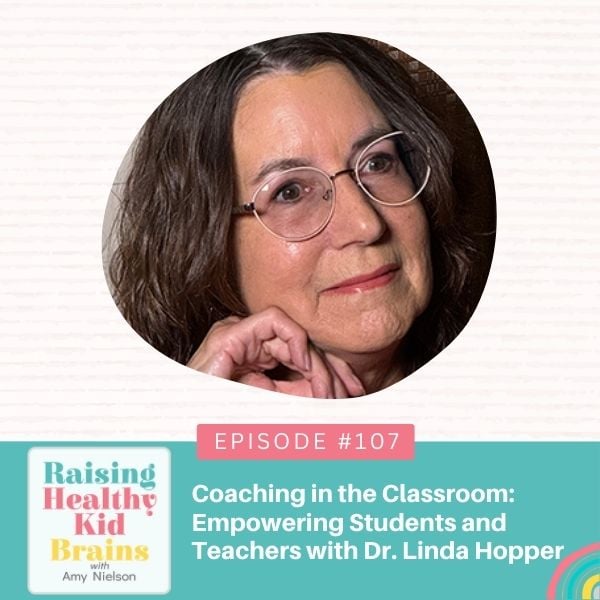
Ep #107: Coaching in the Classroom: Empowering Students and Teachers with Dr. Linda Hopper
The traditional education model we’ve been using since the 1940s was designed for assembly line workers: students learning the same thing, at the same time, in the same way. But this system is failing to prepare kids for real life. It keeps teachers from nurturing the skills students truly need: emotional intelligence, self-awareness, stress management, and decision-making.
This week, I’m talking to Dr. Linda Hopper, a former business coach turned classroom teacher, who turned the system upside down by bringing coaching principles into the classroom. After spending 14 years teaching middle and high school students, Dr. Hopper found that asking the right questions – rather than just giving the right answers – is the key to helping kids grow and learn.
Join us today as Dr. Hopper shows us how we, as educators and parents, can empower kids to become experts on themselves. Her approach shifts the focus away from standardized tests and helps students build skills that last a lifetime – like self-awareness, reflection, and emotional intelligence.
To thank you for being a listener here, we made you a special freebie. It’s an amazing alphabet activity you can begin using with your kiddos that is so fun, so get started by clicking here to grab it!
What You’ll Learn:
Why the traditional education system isn’t preparing kids for life and what we can do to change that.
The difference between coaching and teaching or parenting mindsets.
The simple weekly practice of tracking emotions that creates space between feeling and reacting.
How asking kids the right questions helps them take back control.
The key to helping kids identify their strengths instead of focusing on their weaknesses.
How to help kids develop emotional intelligence.
Practical ways to integrate social-emotional learning without adding to teacher overwhelm.
What if the way we’re teaching kids is actually holding them back? In this episode, we’re peeling back the layers of our current traditional education system and revealing a powerful approach that flips the script.
Dr. Linda Hopper is my guest today, and she joins us to explore why asking the right questions instead of just giving the right answers might be the most important shift we can make as parents and educators. From emotional intelligence practices to bridging the gap between test scores and real-life learning, this conversation is packed with strategies you can take and use today.
To just give you a little bit of background on Dr. Hopper, she is a former business coach and started in the business world and then transitioned into being a classroom teacher, which is kind of different than a lot of times we see. And so she started integrating coaching principles into her classroom. She holds a PhD in coaching and human development and is the author of the book, Coaching in the Classroom: A Guide for Empowering Students and Teachers.
Just to give you a little bit of a taste of what we covered today, we talked about why teaching to the test might be costing our kids more than we realize. We talked about the difference between coaching and teaching – very interesting. And we talked about how asking the right questions creates more independent, confident learners. We talked about Dr. Hopper’s once-a-week practice, a very simple practice you can implement immediately that really makes a difference in boosting emotional intelligence in your classroom and home. Prepares these kids for life. It’s amazing.
And then we talked about how teachers can kind of bridge that gap between meeting the academic standards they’re required to and yet still nurturing those real-world skills without creating more burnout. We talked about the magic of showing options and not telling answers. So much goodness in this episode. It’s coming up right after this.
Welcome to the Raising Healthy Kid Brains podcast, where moms and teachers come to learn all about kids’ brains, how they work, how they learn, how they grow, and simple tips and tricks for raising the most resilient, kind, smart, compassionate kids we can. All while having lots of grace and compassion for ourselves, because, you know what? We all really need and deserve that, too. I am your host, Amy Nielson, let’s get ready to start the show.
Linda, welcome to the show. I’m so excited to have you on today.
Dr. Linda Hopper: Well, thank you, Amy. I’m happy to be here.
Amy: So I’m so excited about this conversation because I came from a very non-traditional education background. And so, like changing things up just a little bit, I’m interested in this concept and this idea, and I think your background is really interesting. Can you give me just like, tell our listeners a little bit about this background you have with business coaching and bringing that to the classroom and just kind of give us a little bit of how that happened?
Linda: Sure. Well, I started out in business, of course. I was a commercial loan officer, and then went into my own business – coaching, consulting, and training. At the same time, of course, I was raising a family, and I became very interested in education. I was very involved as a parent. I started a district organization to deal with district issues. I was on the Chamber of Commerce Education Committee. Of course, I was very involved in my children’s schools.
So that actually led me to a job working with the Illinois Learning Partnership, which worked with school districts all over Illinois. And after three years, when the funding ran out, I went back into my business and was working with both education and business clients.
Two things happened that really spurred me to go into the classroom. Well, three really. One was my oldest son dropped out of high school. The economy was changing. This was in 2007, so jobs were drying up.
Amy: Yes.
Linda: And they opened up a master’s degree in education. I thought, this is my chance. I’m going in the classroom. I had clients asking me, why don’t we have coaching in schools? I could have probably saved myself a lot of heartache.
So I thought, well, I’m going to go in the classroom, you know, and see what I can do with coaching in the classroom. And I did do various things throughout the years, but really it was after – the year after the pandemic that I just went full-blown on it because it was so needed. So, and then I retired. I spent 14 years in the classroom, seven years middle school, seven years high school. And then retired and wrote the book, my book, so that I could share it with other teachers.
Amy: I love it. Oh, I’m so excited to talk about this today. Okay. So, let’s just talk about this because you’re talking about bringing kind of coaching into the classroom versus what is currently there. So let’s talk about what’s there. You kind of have talked about in your book and we’ve kind of talked about this idea that what we currently have in classrooms is kind of still modeled after what we had in the 1940s. Can you tell me a little bit about that?
Linda: Yeah, we basically have two things going on in education. One is we’re based on a model from the 1940s. And if you think about the 1940s, we were gearing up for manufacturing, assembly line workers. So basically, we are funneling children into a cattle pen of assembly line learning, where they’re learning the same thing at the same time in the same way, and it’s pretty much – the end result is a college readiness test. So, I mean, that’s the whole focus.
And that’s the second piece. The whole focus is on a college readiness test. I don’t think that really prepares students for post-graduation. And even if you are going to college, because the stakes are so high and there’s so much pressure put on educators and students to achieve on this test, you aren’t getting the skills that you need when you get to college, like how to handle stress, how to take care of yourself, how to learn about yourself, you make better decisions. And I think teachers are frustrated and students are frustrated both with that because you just don’t have time. Your focus is on that test.
Amy: The testing. Well, and it almost feels like a series of testing. So my perspective on this looks different, right? Because I only completed one grade of public school, and it was kindergarten. So I like, I graduated kindergarten, guys. I’m doing great. But, you know, my family just moved all over the country all the time. And I would spend sometimes a couple months in a public school, and then the rest of the time I was at home, learning from home, until the point where I kind of applied to get into college when I was 15 and was accepted and started when I was 16 years old into university.
Linda: That’s awesome.
Amy: So I didn’t, I wasn’t in that system completely.
Linda: You weren’t on the assembly line.
Amy: Well, I dipped my toes, you know, right? Because I got a little bit of it when I would be in there for little portions of the time, right? But that wasn’t what my education looked like. And now I have kind of another perspective of seeing my children and then having been in the school systems a little bit and kind of seeing what this looks like. And yes, it feels like, you know, I have high schoolers now and kids into college, right? And watching them train towards tests, and it feels like we’re missing some things.
We also know we’ve had experts on the show talking about how teaching towards testing is literally like the worst way to try to put information into a child’s brain. It’s the worst way to store memory and put it in there. And so I’m so curious around how we do this differently. And then the challenge, the friction between, there’s these requirements that teachers have, right? Where the schools, you know, sometimes funding is based on these testing scores or their grades.
Linda: It is based on – .
Amy: For these schools. So all this stuff is based on these tests, like going all the way up.
Linda: Yes
Amy: So what do we do about all that? So we’re going to get into all this. We have a really good question. So do you feel like standardized testing has kind of reshaped the purpose of learning? Would you say?
Linda: 100%. 100%. I mean, I know growing up, I had teachers who were a big influence on me in terms of helping me understand who I was and pointing out my strengths and giving me tools to use to be successful, not just in school, but in life. And we have totally gotten away from that. And I think teachers are frustrated with that because I have never met a teacher who said, “I got into education so I could make, help kids pass a test.”
Amy: A test. Yeah, I’ve never heard that either.
Linda: So they go in because they want to see students reach their full potential. Well, that is exactly aligned with a coach. That’s why they make natural coaches, but we are leaving that on the table. We’re leaving that skill on the table with teachers because they don’t have time.
[crosstalk]
Linda: They don’t have time, and that’s not the focus, even though we have social-emotional learning in schools, I think it’s difficult for teachers to really embrace it unless they have a lot of support in the school system. And that, unfortunately, is not the case for many teachers.
Amy: I feel like we’re like at the beginning of maybe some awareness around it. We’re kind of trying to shift, but it’s like this very slow, like letting go of something we’ve been doing for almost 100 years. And then we’re wanting to make sure that people don’t get left behind. And is it unfair if we’re trying to meet people where they’re at if everyone’s not in the same space? And there’s all these different challenging questions, I think we’re dealing with. And then the process of getting anything changed at that level is just very –
Linda: But that’s why I think teachers and parents need to join together on that and have a very loud voice on it. That’s how it’s going to change.
Amy: That’s how it changes. Okay, so let’s – let’s talk. So if we’re doing like – starting right now and something I can do right now, because changing the whole world feels really overwhelming when we already have so much going on.
So if we’re talking like to someone who’s in a classroom right now or even someone who’s home with children, what does this look like? You talk about asking questions or empowering students through questions. So talk to me about that. That’s something that feels tangible that we could take away and like do today. So tell me about that. What does that mean, empowering students through questions?
Linda: First of all, let me just make a discernment here. Coaching mindset is very different from a teaching or a parent mindset. So you have to kind of put your hat on differently when you’re coaching. And when you’re asking questions, you are not asking leading questions. Your purpose in asking questions is self-discovery for the person you’re asking questions of, their self-awareness.
So any questions that you ask about self-awareness, like, how are you feeling? Why did you decide to do that? What thoughts were going through your head? How could you do this differently? What’s a different perspective you could have on this? There’s a million questions to get them to think about themselves. What’s your strength in this? What did you do really well here? What would you like to improve on?
Just asking questions. They’re the experts, right? What gives you a sense of accomplishment? So they’re the experts. I’m not. I’m only asking the questions for self-awareness, right? And then paired with that is self-reflection because that’s the only way we change is through self-reflection.
Amy: So self-awareness and self-reflection are kind of the things that you would say are differentiated between coaching questions versus like teaching.
Linda: Yes, because in teaching, I’m looking for a specific answer, or I may be looking for a specific thought process. But when I’m coaching, I’m not the expert. I’m not looking for anything. I’m asking the questions so that you can figure it out, so that you get some insights.
Amy: Okay, so can you give me an example of what that could look like? And a lot of our listeners are working with younger children. So if you could like go at it from that perspective and give us like an example, say we’re trying to learn the concept of, we’ll say multiplication. That one’s kind of a little bit later on than some of our listeners, but just that idea. So what would that look like?
Linda: Is it okay with you if I use an example from my teaching? Because math is not it.
Amy: Oh, okay. Yes, do that. Perfect. Okay.
Linda: So for example, with Spanish, right? So I taught Spanish. And so what we would do is I would show them multiple ways, and this is how coaching is integrated into teaching. I would show them multiple ways of memorizing because you have to memorize in Spanish. And then I would have them practice. Which ones work for you? Why did it work for you? What makes it connect for you? Can you use that information somewhere else? How can it help you outside of school?
So those are the questions and that’s where you kind of direct it. And so I had students who came up with maybe two or three methods that worked for them. And they also translated it into using it on other classes that they needed to memorize in, or to memorize whatever they needed to know. But that was a skill that they then made their own, if that makes sense.
But I think, and I’m just going to jump in here that I think one of the things that we’re missing huge in the education system right now, and this is where social-emotional learning comes in. Have you heard of the book, Emotional Intelligence by Dan Goleman?
Okay. So that book came out 30 years ago, right? So we’ve had 30 years of research on emotional intelligence, and we now know that a greater indicator of success is your high emotional intelligence, higher than IQ. That’s a better indicator of success. Yet we’re still testing IQ. We’re not testing EQ. And social-emotional learning is the education form of emotional intelligence.
And that’s so easy to do in the classroom. Just having kids focus on what they’re feeling and what other people are feeling. Like one of the things that I did is I said, okay, so first I showed them why emotional intelligence was important, and then I just asked them, keep track, put a timer on your phone, and then just jot down what you’re feeling in that moment. Just observe it. You’re not making any judgments about it. When you create that space between observing and feeling, you now create a space to have a different reaction. So just doing that is very powerful.
But going further then, start, you know, what were the thoughts that connected to that feeling? You know, just getting them to understand themselves better. So I think we’re doing a huge disservice by not preparing children for emotional intelligence when the workplace is all about emotional intelligence.
Amy: Really, all of life is super-related to relationships, everything that makes life like worth living, plus your, you know, being able to live, you know, with finances, all of it’s so related. So, I love one of the things you said, right? When we can look at it – and it’s been so interesting as I’ve learned more about this – you know, I remember reading Emotional Intelligence back when I was a brand, I don’t even know if I was a mom yet. I think I was maybe a brand new mom. It was a long time ago. I have a 20-year-old, so it’s been a minute.
But I remember reading that and just being kind of blown away when I read it a long time ago. And then having just learned ever since then more and more and more. Anyway, so as I’ve learned and, you know, grown with my kids and kind of started implementing some of these things and doing it on myself.
And that was of course, you know, like one of the secret targets of this podcast, right, is as we’re trying to learn to help our children, we’re helping ourselves because we weren’t raised with all of this stuff, probably most of us. And so we can do it on ourselves and we can actually help ourselves like figure out some of this stuff, which is so healthy for us and our kids and everybody.
Anyway, so I love this idea of distance from something and having perspective. And it still happens to me in the space where I’m at and just having this like emotion just hit you like out of the blue. And you’re like, “Oh my gosh, I have all the feelings.” And then you’re like, “I don’t even know if I have a good reason for having this feeling right now. It’s kind of weird.”
But being able to give it a name and just say, “Oh, my word, I think I feel really disappointed.” I think that’s what this feeling is. And then just giving it a name is like, okay, I feel disappointed. Okay, well that’s interesting. And getting curious about it and saying, “I wonder why I feel disappointed,” instead of like, “I’m so mad at so-and-so because they made me feel blah, blah, blah, or whatever.”
And then you’re like, it actually really has nothing to do with them at all. I think I’m disappointed because I built this thing in my head and then I don’t actually know how to like, I don’t know, whatever, right? And you’re working through this whole thing, but that perspective and just being able to name it and step back a little and without that judgment and just saying, I have a feeling that it’s this and I don’t – that’s interesting. I wonder why.
But teaching kids to kind of look at it from that way, because I think, I think we were raised to be like, I was raised to never be angry. Being angry was a bad emotion.
Linda: Yes, yes, yes, yes.
Amy: And so, yeah, I think that’s so so healthy. Getting curious is where we get, where there’s so much good learning.
Linda: Right. Exactly. The other thing I would say that I think is an important thing, and you talked about teachers or parents getting the same value from it, that’s the beauty of coaching because coaching is co-collaborative. I’m learning from you. I’m not the expert. I’m only the expert on me. So I can learn in my relationship with you. And that’s really key.
And so I would practice the same things that my students that I was asking them to do. Oh, let’s do breathing exercises to calm our central nervous system down. When I taught middle school, I was lucky. I was able to do that at the beginning of every class. And yes, at the beginning, they’re giggling and they’re making inappropriate noises and they’re opening one eye to see if everybody else is doing it. You know, all the things, but they settled down into it, once it becomes a habit.
And I have a student, a former student, who’s a young man with a family now, who told me, “That set me up for meditation. I use that all the time.”
So I think these are the skills that we need to teach students. You know, how to handle the stress, how to handle different life experiences.
Amy: Absolutely. And one of the things I go to then is how do we bring this to teachers who have these requirements to make sure that these kids are doing these things, but is there some kind of crossover? Like when I create a play-based curriculum, right? I know that teachers have to have kids learning these things, so how do we bring play into it? How do we integrate these two things to help them kind of start shifting back to where we want to be, but also meeting all their requirements?
And so the thought that came to me – very interesting that we’re talking about coaching because I have had a lot of business coaching. So I’ve kind of been in the coaching world a little bit now and I get to now do some business coaching and so it’s really cool to see that side of it.
One of the things I found so interesting about it is it is so much about questions. Coaching is a lot less about telling you and much more about asking you really good questions and drawing the things out of you that you already kind of know or at least leading you and then giving you things to kind of help lead you in the direction that you’re choosing. So I’m trying to think about how can we bring that and kind of help it, bridge it between what we’re doing and make that work cohesively.
And it was interesting, it made me think of the book, Make it Stick. I’m not sure if you’ve read that one, but it talks about one of the best ways to help children learn the science, the research they’ve done, is to ask questions first. So they’ll do now like pre-testing and they’ll test to see what you know. And I think it’s kind of to show progress, but it also actually helps kids learn better to kind of have them just test to see what they know already. And then they find out what they don’t know.
And oh my goodness, they get a bad grade on this test. And it’s okay because it’s fine. It’s just information for you of what you don’t know yet. So then we’re going to go learn and they’re already kind of like trying to figure through and solve. They were already trying to figure it out before they even knew the different ways to solve that problem, right?
And so I kind of like that we’re – I’m seeing some of the shifting already, but if we can kind of be aware of it and kind of bring in better language around that, that’s like growth mindset. That’s emotional resilience. That’s allowing yourself to fail and to have it actually be really healthy because it’s information and all these things.
Linda: And that’s the way the classroom should be anyway? Is not school the place that you should learn resilience, how to overcome adversity, how to to handle all these situations before you get out in the real world?
Amy: Yes.
Linda: And we’re not doing that because we’re focused on a test. And this is why I think it’s very easy for teachers. It’s not a big time commitment because you’re not responsible. And I basically set it up as an extra credit. You can’t force students to do it. Either they felt like they wanted to do it, to participate, or not. But they’re still getting the benefit of hearing and understanding what you’re talking about. So again, it takes very little time. You introduce it, you ask the questions, you have them reflect.
Amy: Interesting. So you’re kind of just bringing it in as like an additional thing kind of on the side. Do you feel like when you do that, because I think we have so many teachers that are trying to do some of these things or wanting to do it, aren’t really sure how or don’t have the time and are trying to figure out how to, you know, bridge these things. So you’re saying your method is kind of doing it a little bit on the side, which is, you know, just taking a few minutes, which I think can pay dividends by the way to just spend invest a little bit of time on this. I think it pays major dividends.
But what I love about that is then it’s bringing in the language and the concepts that then you can tie into all of the things that you’re already doing. Would you agree with that?
Linda: Right. And – oh, 100%. And if you teach English literature or you’re teaching history, there’s so many opportunities to talk about those things. How would that person, if they handled it differently, how would that have changed the course of history? I mean, things like that. You just ask those questions to get kids thinking about it. And again, what I did is I did a weekly – I did a weekly focus.
So if we focused on emotional intelligence, which I then kept reiterating it throughout the year, because to me that was one of the most important. But I would just give them some background on it, and then ask the questions, have them spend a week observing their own emotions, and then they reflect on it. And the thing that’s really cool is I got to understand my students at a much deeper level because what they’re putting on those reflections, you never know otherwise.
To me, I loved it. I love seeing their progression. I love seeing them make the connections. And if you have a building, it doesn’t matter if you’re just doing a little bit. If a building, you have a third of the teachers doing it, they’re hearing this year after year after year. It’s impactful. And every teacher, every teacher has their own strengths to bring to this. So if I can’t reach a student, you can.
Amy: Oh, I love that. I think it’s interesting too, because one of the things that I keep hearing in different podcasts and from different experts or whatever is this idea of we’re getting to a point where we have a really, really hard time just sitting alone in a quiet space with our own brains. I think we’re being enabled to even like not do that because we don’t even stand in line in quiet space anymore or talking to other humans. We have our phone and we’re scrolling or we’re playing a game or whatever, right?
And so reflection, I think is so valuable in so many ways and just taking that quiet time and space to kind of just think. And yet we’ve been kind of removing that from our lives because of, you know, like it’s kind of unintentional, but it’s happening.
And yet that being so critical and we’re trying to bring in, you know, back meditation. We – there’s so much research on how healthy that can be, journaling, all those things. But I feel like a lot of those pieces are in this like just little reflective space that you’re talking about and being able to just take a few minutes and do that, builds that practice for them, which I think is so healthy because that can go lots of different places later on.
Linda: Right. The other thing is is by asking them questions all the time, eventually they start asking themselves the questions. That is a skill for a lifetime because you’re setting up that practice. And so I think that’s also very effective.
Amy: Well, you’re building a habit and there’s the research that shows that questions are contagious. So the more questions we ask children, the more they ask us back, and the more they’re going to ask themselves. And one of the most important things – I get to use AI in my business. It’s kind of scary and also incredibly like powerful and beautiful the things it can do. But one of the really interesting things about AI is that its ability to help you is very, very largely based on your ability to ask questions, on your ability to ask it and feed it the right information to help you.
And isn’t that so true in life too? Your ability to communicate, to know what you need, to have processed and reflected on what you need, and to be able to ask for it in relationships. Like, aren’t you more likely to get what you need if you know what it is and you can communicate that in a helpful way?
Linda: Exactly.
Amy: Right? All over the place.
Linda: I don’t know if you saw this, but last year, there were some articles that came out from the business community that basically said, “We’re having a hard time hiring Gen Z.” And this is our first generation that’s kind of been brought up on technology because they don’t have the people skills. They don’t have the skills that are needed to function in a business. And so obviously they’re not getting that in school, but we could be preparing them for those.
And I also think that when you have students start focusing on themselves, their own unique gifts, their own unique thinking, you pull them away from comparing themselves to everyone else. And I think that’s really important at this age, understanding that, hey, you come here to Earth school with a whole set of different circumstances, different parents, different experiences, different everything. So why would you want to be like everybody else?
Amy: Well, and I think it’s interesting too, if we kind of work on growth mindset and this idea of learning about ourselves. I think, and I don’t know how widespread some of these things are, but one of the things I felt like it was like if you acknowledge the things you were good at, you were being prideful or like better than other people, right? And so there was almost something wrong with that, right? But then you’re like constantly trying to prove your worth, and then we’re challenging ourselves, comparing my weaknesses against their strengths, and it becomes this whole thing.
And I remember one time my dad, one of the most valuable lessons he ever taught me, was we were at a hardware store and I was like 11 years old, and he just talked to the guy at the counter forever. And he tells me later, I’m like ready to go. I’m like, “Dad, let’s leave.” He says, “Amy, everyone in the world is an expert at something, and they love talking about it. And if you just ask them, they’ll tell you what they know.”
And it was just this beautiful idea of like, oh my goodness, like everyone you look at, what are they really good at? And so you’re almost looking for strengths, and then saying like, okay, but I’m like an amazing person too. And doing this reflection, here’s my story. Oh my goodness, I have such good strengths, and I have some things I could grow in, right? And that’s good because then I have a reason to get up tomorrow.
But also like, what could I learn from this person? I don’t want to copy their life because I don’t want to be them. I want to be me. But is there something I could learn from them? And then how would I take that, right? With the right question and like integrate that into my life? Is there a piece of that that I might like to have and what would that look like if I brought that into my life?
And then everyone around you becomes like a partner in your growth instead of a competition and you’re just like building up all of these things about yourself and becoming more and more of you by learning from all the people around you and surrounding yourself by these amazing people. And so it becomes not something where you’re less than, but constantly growing and becoming more because of the people you surround yourself by.
Linda: Yes. Right. And I totally agree. Those were the lessons I had the – in all honesty, that I had the most difficulty with my students with, because if you ask a student, I would ask a student, okay, come up with three strengths. They have a hard time, yet they can come up with a whole list of what’s wrong with themselves. And that tells you right there, the focus on our society, that we focus on the negative rather than the positive or the strengths.
And I would ask students, I would say, okay, so why don’t you want to? And it’s for what you said, “Well, then I’m conceited and blah, blah, blah.” And I said, so what’s the difference between somebody who’s talking about their strengths just to acknowledge them and somebody who’s conceited or prideful? And they were able to discern – now this is at the high school level – they were able to discern, “Oh, well, a person who’s just talking about their strengths is also going to recognize strengths in you. Somebody who is prideful is saying it because they want to feel superior.”
Amy: Yes. Oh, so good.
Linda: So they were able to make that, they were able and again, you ask the questions to get them to the, they come to it on their own.
Amy: They can figure it out. Isn’t it so great when you just ask the questions instead of tell? And then they learn so much more because they’re thinking. I have had coaches in my life, and some of them intentional coaches, and sometimes it’s my sister and we’re just chatting on the phone, and she asks the right question and words start coming out of my mouth and I’m like, “What did I just say? That was so true. That was it.” Right? And you just have these breakthrough moments.
And I think isn’t that true of children though too, like, when we ask the right question and they have to think and they have to say what they’re thinking and kind of work through it and then they come to these like aha moments and it’s such a different kind of learning than we told them. And then they’re not always looking to us. “Well, what do I do? But what do I do?”
So I have a thing where my kids come up and they’re like, “Well, mom, I mean, I don’t know how to do this. Like, I would have to, you know, like I can’t because, you know, blah, blah, blah, blah, blah.” And I’m like, “Oh, my goodness. I wonder how we would ever be able to solve that problem.” You know, and something, “But I just, I just don’t know how to make a layer cake,” you know, or whatever. Right? But just, “My goodness, I wonder if there was something we could ever do.”
Right? And just allowing them to kind of solve through it. But then it’s so empowering because when your students do that, right? And they’re able to sort through that and say that, they’re solving through that problem and it just is like this feeling of, I think, of awareness and confidence and, yeah.
Linda: Right. And I also think we have a very disempowering system in education because we’re focused on, I mean, just think about our language. “Oh, you’re not making standards.” Am I sub-standard? “You need remediation. This is where you’re lacking.” So a lot of our language in education is not positive.
And the other thing is that I will say, you know, I taught middle school and high school. They are craving control. They have no control. They feel like they have no control in their lives. Well, guess what? You have control because the only person who can figure out you is you. That’s it. I mean, and that’s really the only control any of us has.
Amy: It’s so funny. I tease my kids. I’m like, “So, you know I joke around about going with you to college, but actually really, I’m not going with you to college.” And I want you to be able to like make your own decisions and like take yourself to survive. I’m not going to like follow you around in adulthood. So my goal is to raise you to be a decision-maker because I don’t want you coming and asking me everything all the time. That is not going to work out.
So I’m going to start as young as I can. My job is to train you to be a decision-maker. And how do I do that? Right? Well, I start small and giving you as much, you know, as you’re ready for without giving you too much because, you know, that’s not fair to you, right? But I’m going to give you as much as I can as we go to help you start training yourself to become – of course, they’re going to make mistakes through that process and all the things, we can give ourselves grace and all that kind of stuff.
Linda: And that’s the hard part as a parent though, is letting go and letting them make the mistake. I mean, like my oldest, who dropped out of high school. Now this is a child who had networked every computer in our house at the age of 13 before I even knew what networking was.
So here he is, he drops out of high school and he decides he’s going into drywalling, and I’m biting my tongue because I just know this is a mistake. But I have to let him do it. Well, he now, without a college education, he is now an IT director of technology with a satellite company in San Francisco. He makes more money than I could ever hope to make.
Amy: Yeah. Isn’t that interesting?
Linda: But you have to, you have to allow children to find their own way. And that’s the hard part as a parent. That’s really hard.
Amy: But asking good questions and helping them focus on, and I think one of the things that I’ve noticed especially as kids are getting older, but it applies early too, because kids do want a sense of control and power in their lives, is this idea of my job – and I actually kind of tell my kids – I’m like, “I see myself more as a coach,” right? Like, I’m here to keep you safe, yes. Like, I have fences like parameters to keep you safe.
But in addition to that, my goal is to coach. And I’m here to help you as you’re building these skills and getting stronger and learning how to do these things. And so, like, if I just do it all for you, that helps nothing. Like, I’m here to coach you into this, right? And ask good questions.
So for me, like, when you’re having friction with a teenager, it’s usually like a versus, you know, we’re versus each other. So my strategy always became, how do I get on the same team with this person? And so it always came back to being about them. Well, what are your goals? Like, what is it that you want in life?
My goal is to help you get your goals. I know you don’t want to live in my basement forever. So I’m going to try to help you have a life where you don’t live in my basement forever and you get to go and you get to do whatever you want. I have one daughter who just really wants to build an amazing cat house and have cats and have really cool, fun things in this cat house. Let’s do it. All right, so how do we get to where you can have – because you can’t have cats at my house. So how do we get you to a place where you can have those, right?
And what does that look like? And let’s have you create this life for yourself where you can have – and there’s going to be more dreams that develop besides that as we go. And that’s great. But how do we help you?
Okay, so part of that is doing well in school. Here’s currently what that looks like, but here’s some other options and things that we can kind of help you develop around that or whatever. But I find that that I feel like is also looking at coaching because when I started working with coaches, the first thing they would ask me are what are your goals? What are your biggest hurdles? Like, what are the things that are challenging for you? Let’s take all that into consideration.
So when I have a kid that’s like, I have ADHD and this is so hard to focus and what do I do? And I say, okay, amazing. It is so good you know that about yourself. And we still have to function in life. So what are the things we build around this to help support you in doing what you need to do to get where you want to go, right?
And so it’s not like a, let’s fix you. It’s like, you know stuff about yourself. Let’s ask the questions. Where do you want to go? What can we do around you that’s customized to you to help you get to where you’re trying to go? And it’s so powerful. And then you’re modeling that for them for the rest of their life, like we were talking about.
Linda: Yes, exactly. I agree. 100%. It’s great. It’s a great skill to have as a parent.
Amy: It’s so good. Okay, so I want to hear, we’re out of time. Oh my gosh. I feel like we could talk forever. Tell me about your coaching because you work with – is it teach, just teachers or do you work with parents and teachers?
Linda: No, I work with anybody. Primarily with teachers. It’s interesting because I’ve gotten a huge response from parents on my book. They obviously see it, the value in it. It’s now getting to educators because it’s difficult. They don’t have the time. They feel stressed out. There’s so much on top of them.
So yes, so I do that. I work, I work individually. I do speaking. Right now, I’m putting together a cohort for July, starting at the very end of July, beginning of August, for teachers, a six-week cohort where I’m going to coach them in how to coach in the classroom.
Amy: I love it so much. Okay, so tell us the name of your book.
Linda: Okay, the name of my book is Coaching in the Classroom. This is what it looks like.
Amy: Fantastic. And we’ll drop a link for that.
Linda: Yes, It’s a guide for empowering students and teachers. I have lesson bites in there that I did in my classroom, so that helps, you know, teachers get focused on it. There will be more on my website if you want to know more about my events coming up. You can go to my website and sign up for my newsletter. I’ll have more coming out probably next month on that cohort. So.
Amy: Perfect. Okay, so we will send people to your website. I’ll include all of that in the show notes for our listeners because I know there’s people that are connecting with what we’re saying today and wanting more information. So we’ll send them your way. Thank you so much for coming on and sharing today.
Linda: Thank you, Amy. I’ve enjoyed it. It went so fast though, but I really enjoyed it. Thank you.
Amy: You’re welcome. Thank you for being with us today.
—
Don’t you just love all the fun things we’re learning on this show together? Well, we wanted to give you a chance to practice a little bit of it at home. And so we made you a special freebie just for being a listener here. You can grab it at PlanningPlaytime.com/special-freebie.
So what this freebie is, I’ll tell you, is an amazing alphabet activity that you can start using with your kiddos. And it is based in play and is so fun. You can use dot markers with it. You can use Q-tip painting. You could use circled cereal. There’s all kinds of options. You can print it out today and get started. Just head over to PlanningPlaytime.com/special-freebie, and we’ll send that to you right away.
Thank you for hanging out with me today for this fun chat on Raising Healthy Kid Brains. If you want to see more of what we’re doing to support kiddos and their amazing brains, come visit us on our website PlanningPlaytime.com. See you next week.
Enjoy the Show?
Don’t miss an episode! Follow the podcast on Apple Podcasts, Spotify or anywhere else you get your podcasts.
We use cookies on our website to give you the most relevant experience by remembering your preferences and repeat visits. By clicking “Accept All”, you consent to the use of ALL the cookies. However, you may visit "Cookie Settings" to provide a controlled consent.View Terms and Conditions
This website uses cookies to improve your experience while you navigate through the website. Out of these, the cookies that are categorized as necessary are stored on your browser as they are essential for the working of basic functionalities of the website. We also use third-party cookies that help us analyze and understand how you use this website. These cookies will be stored in your browser only with your consent. You also have the option to opt-out of these cookies. But opting out of some of these cookies may affect your browsing experience.
Necessary cookies are absolutely essential for the website to function properly. These cookies ensure basic functionalities and security features of the website, anonymously.
Cookie
Duration
Description
cookielawinfo-checkbox-analytics
11 months
This cookie is set by GDPR Cookie Consent plugin. The cookie is used to store the user consent for the cookies in the category "Analytics".
cookielawinfo-checkbox-functional
11 months
The cookie is set by GDPR cookie consent to record the user consent for the cookies in the category "Functional".
cookielawinfo-checkbox-necessary
11 months
This cookie is set by GDPR Cookie Consent plugin. The cookies is used to store the user consent for the cookies in the category "Necessary".
cookielawinfo-checkbox-others
11 months
This cookie is set by GDPR Cookie Consent plugin. The cookie is used to store the user consent for the cookies in the category "Other.
cookielawinfo-checkbox-performance
11 months
This cookie is set by GDPR Cookie Consent plugin. The cookie is used to store the user consent for the cookies in the category "Performance".
viewed_cookie_policy
11 months
The cookie is set by the GDPR Cookie Consent plugin and is used to store whether or not user has consented to the use of cookies. It does not store any personal data.
Functional cookies help to perform certain functionalities like sharing the content of the website on social media platforms, collect feedbacks, and other third-party features.
Performance cookies are used to understand and analyze the key performance indexes of the website which helps in delivering a better user experience for the visitors.
Analytical cookies are used to understand how visitors interact with the website. These cookies help provide information on metrics the number of visitors, bounce rate, traffic source, etc.
Advertisement cookies are used to provide visitors with relevant ads and marketing campaigns. These cookies track visitors across websites and collect information to provide customized ads.