If you are considering sending your child to preschool, you might be familiar with the Reggio Emilia approach. My guest today is a teacher in a 3-year-old classroom who is passionate about the Reggio Emilia approach and nature-based classrooms, and she will tell us all about it.
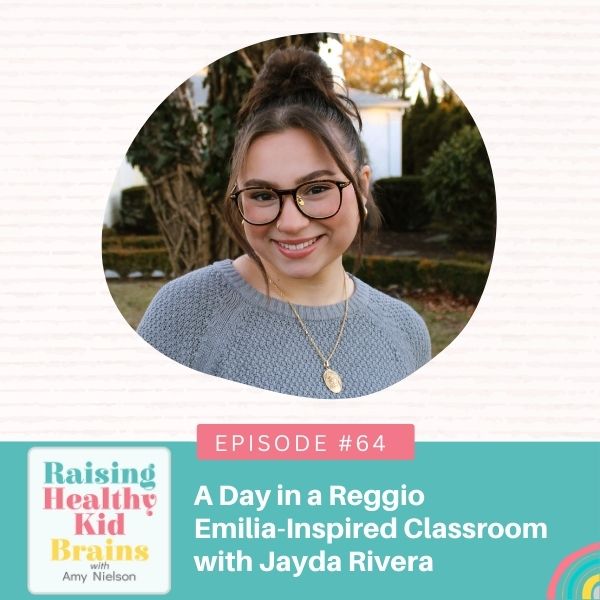
Jayda Rivera is a teacher at Bloom Learning Center in New York, where the approach is inspired by the Reggio Emilia philosophy. This philosophy views children as active participants in their learning journey. In this week’s episode, Jayda takes us through what a day of preschool looks like in a Reggio Emilia and nature-based classroom.
Tune in to discover what happens in Jayda’s classroom based on that approach, how she structures her day, and how learning activities are conducted. Learn how the individualized notes she takes influence what she teaches the next day, and how she manages to spend one-on-one time with the children.
To thank you for being a listener here, we made you a special freebie. It’s an amazing alphabet activity you can begin using with your kiddos that is so fun, so get started by clicking here to grab it!
The notes that she takes, the individualized notes she takes on children and how that influences what she teaches the next day. Very interesting. What I wanted to do was be able to give you a chance to look inside of this kind of classroom and so that when you’re considering what kind of preschool you want to take your child to, or if you’re wanting to adjust some of the things that you do with the preschool you teach. You can get some ideas from other teachers and from what’s happening in classrooms around the country and around the world. I hope you enjoy this conversation. It’s coming up right after this.
Welcome to the Raising Healthy Kid Brains podcast where moms and teachers come to learn all about kids’ brains, how they work, how they learn, how they grow and simple tips and tricks for raising the most resilient, kind, smart, compassionate kids we can. All while having lots of grace and compassion for ourselves because you know what? We all really need and deserve that too. I am your host, Amy Nielson. Let’s get ready to start the show.
Amy: Jayda, I’m so excited to have you on the show today. Welcome.
Jayda: I’m so excited to be here.
Amy: This is so fun.
Jayda: [inaudible] excited.
Amy: That’s okay, nervous it can be fun. It’s so close to excited, which is basically the same, it’s the same feeling almost. I am so excited to talk to you today because we’re going to be talking about the Reggio Emilia approach to preschool and just kind of what that looks like and talk about that. And I remember when I was kind of looking at preschool options, seeing these different methodologies or whatever and I’m thinking I don’t know what any of these are.
And so I love that we get to kind of have a chat today and kind of talk about what that even is and maybe just give people a little bit of a look into what that looks like. So tell me before we get into that, tell me how you got into teaching preschool and what led you to this in the first place?
Jayda: So a funny story. I’m actually 21, so I haven’t even finished school. I’m currently, I literally just graduated with my associates degree. I have my infant toddler CDA and my preschool CDA. And so I’m currently in school for my master’s degree in elementary education. So when I had started working about two years ago at this preschool, I had no idea what Reggio Emilia, or Montessori, or any sort of those ideologies were. I had no idea what they were.
I thought preschool was preschool. I thought kids were kids. And I’m thinking, I’m going to get to hang out with kids for eight hours. That’s awesome. So when I had gotten there, I had noticed the vibe was just different. And immediately I just fell in love. I started studying everything, Reggio Emilia. I started studying everything Montessori. I started just really, just falling in love with all of the programs’ ideology. And it just brings me so much joy. It’s just a sense of community and a sense of it’s just a self-guided curriculum in a sense and it’s just it’s beautiful and it’s magic and it’s just wonderful.
So I started working very local in New York at a place called Bloom Learning Center. And I love everything about it and it just makes me so happy. And they’re Reggio Emilia based. They’re also nature based. We’re an outdoor preschool too as well, so they kind of go hand in hand and it’s just wonderful.
Amy: I’m so excited. So I’m clapping my hands over here, can you tell? I’m basically a kid in a grown up body, it’s fine. There’s so many things I want to ask because I see pictures of these nature based preschools and I’m obsessed with this idea. I have to, just as a background, I didn’t go to preschool but I did spend a lot of time outside. And so when I was doing home school off and on as a child, we spent so much time outside because we would live on a farm or have all these acres of gardens we would take care of.
So I feel like I got a lot of nature based learning, but it wasn’t a structured kind of thing with a school. So I’m so curious to get into this and find out about a nature based preschool. So let’s talk a little bit about Reggio Emilia and then kind of go into nature preschool. Just tell me all the things. So let’s start with Reggio Emilia, tell us a little bit about that.
Jayda: So like I said before, Reggie Emilia is just an approach. It’s not something that you can do or copy or replicate. It is just something that you can be inspired by because it’s from Reggio Emilia, Italy. So it’s just a self-guided curriculum. And it’s just the most wonderful thing because it really gets the children involved and it gets you out of that place of leadership and that place of authority, and puts the kids kind of, I don’t want to say in charge, but kind of gives them that opportunity to learn and grow themselves.
Instead of it being a teacher directed curriculum, it’s really just about the children and it’s about that sense of community and working together to figure out what works best for you guys. Because Reggio Emilia can look different to anybody. So it’s really awesome because it’s very self-directed and it’s very personalized to cater the needs to your specific classroom and your specific program.
Amy: So this is so cool and I love it. And now I want to know because if you have a classroom of all these small children and they’re all self-directing, that could get interesting. So tell me, can you take me into a day in your classroom and what just kind of that looks like as you’re going from activity to activity and learning together, what does that look like?
Jayda: So when we come in, in the morning, I like to set the tone for the day. I have meditation music going. I only have natural light in my classroom. I keep the lights off. All of the blinds are open, the windows are open when it’s summertime, and I’ve got alternative lighting. So I’ve got the twinkle lights and just very mellow, very, exactly what you would want to be in is exactly what the children would want to be in. And of course it’s a reflection of, you need to understand your children and know your children so you have to keep that in mind.
But it’s just very mellow and calm. So when we come in the classroom in the morning, there is lots of free play. Free play is my favorite kind of play because it just gives them the opportunity to flow between each center. So we do have centers. We’ve got dramatic play, a block center. We keep table toys [inaudible], tabletop toys out of course, just things that they’re able to go about and play with. But they’re also able to just go and play in the kitchen if they want to play in the kitchen or play in the block center if they want to play in the block center.
And then today was beautiful outside and so we all sat down after breakfast, and they all wanted to go outside. So we went outside. We had our circle time outside. We have these little log stumps and we sat at the log stumps and we did everything that we would do inside. We just brought it outside. And so we spent, I want to say, probably about two hours outside this morning just doing everything that we would do inside, but we brought it outside.
And it was just the most wonderful, beautiful thing because they have that opportunity to free flow and play in the mud kitchen and come read with me in our little play castle. And it’s just great because it’s just very child led and child centered, but also we’re keeping that structure of we are going to have morning meeting. So if you want to join me, that’s wonderful, you can join me. But if you want to go play in that mud kitchen, you can go play in the mud kitchen. It’s day by day.
Amy: Yeah. So you come in, you’re kind of in this space together. And then you have centers set up, but there’s no specific flow to it. They’re allowed to go where they want. You don’t have specific rotation times or anything. They’re just kind of allowed to free rein around in those centers you’ve set up. And then so this decision to go outside, which I love by the way, because going outside is amazing. And we just kind of switch up our brain too when we go outside and it just kind of activates more I think in a different way.
So do they just say, “Hey, we want to go outside today.” And then you do like a vote to see who wants to go outside or how do you make that decision together?
Jayda: So like I said, I’m in New York, so it has not been the nicest out. So today was absolutely beautiful and they all noticed it and they were all very aware of the fact that the sun was finally shining. So I had brought it up to their attention, “It’s so sunny out today.” And they were all talking about it and I was like, “Should we have circle time outside?” And some of them said no, but the majority of them said yes. So I was like, “Right, we’re going to do it. We’re going to try it.”
Of course, there’s times where they have to go to the bathroom or they need something. So we’ll kind of go back inside and then we’ll go back outside, and then we’ll go back inside, and then we’ll go back outside. Yeah, so it just, it works for us. So I think that the most important thing is just do what works for you and your classroom.
Amy: Do you have a lesson plan kind of going into your day when you’re getting ready to do this, and then you just kind of do that with flexibility based on what the children are needing and where they need to go, or what does that look like?
Jayda: So my lesson plans are based on my anecdotal notes always. So the majority of my day is spent with the children, but also with my notebook next to me. So I will be taking anecdotal notes, little Johnny was holding that friend this morning with a fist. And now tomorrow when little Johnny comes in, I’m going to be taking that time to do a quick one-on-one with him to be able to work on his pincer grasp or I will incorporate doing Play-Doh work because he needs to work on his pincer grasp. So my lessons are very based off of my anecdotal notes and what the children need.
Amy: That’s so cool. So you’re kind of taking notes just throughout the day, noticing very specific needs and things the children are having and then working on them with them individually. And what is happening with the rest of the class while you’re kind of giving focused attention to one student?
Jayda: So like I said, I work with three-year olds, so that’s not always the case. We’re a very community based classroom. So when I’m having one-on-one time it’s usually three kids or four kids. But I also have a partner who I very heavily rely on. So like I said, I will have tabletop toys and I’ll say, “My kitchen’s open. Are we going to go play in the kitchen? Or my block center’s open. We’re going to go play in the block center.” And so I’ll have three kids at the table and then I’ll get to work with Johnny and I’ll sit next to Johnny and I’ll play and interact with the other children. But I’m working with Johnny, so that’s kind of how that works.
Amy: I love that. So tell me a little bit, you kind of have this element of the nature based preschool going on too. Tell me a little bit about what that looks like. I think we kind of started to get into it a little bit but tell me about a nature based preschool because I think that’s such a fun, neat idea.
Jayda: So 90% of the brain develops by the age of five, between zero and five. So I think that it is the most important that they are getting that open-ended play and that nature play and that aspect of freedom and exploration. And they’re not going to get that confined in four walls. So being able to go out and explore. And I mean we bring inside tools outside. Everything that they do inside can be done outside so why not just do it outside? That’s kind of the fun of it.
Amy: It’s so fun. It’s so fun to go outside. So you take toys outside to play outside, do you bring outside stuff inside to kind of look at it more or do you kind of explore mostly outside?
Jayda: Most of our exploring is done outside, but I mean we bring leaves in. If we find a cool feather, we’re bringing them in. I had a student the other day bring in a giant stick. He was like, “I need to bring this home.” And I was like, “That sounds like a great idea.” So I put it in a safe space and I was like, “When we’re in the classroom, this big stick might not be the safest option to play with. So we’re going to put it up high, we’re going to put it in a safe space. When you go home, you can bring it home.” So things like that happen all the time with rocks and pebbles and things of that nature.
Sometimes we bring leaves in from outside, and that’s what they’ll use to cut and just do some fine motor activities, especially when the leaves are falling in the beginning of September for us. We will literally grab a basket and we’ll just collect the leaves and we’ll just use them to cut. Outside tools do wind up coming in with us, yeah.
Amy: I love it so much. So talk to me, do you do science when you’re out there? Do you do observation or is it just kind of more, especially when you’re working with three-year olds, just allowing them to just kind of be in nature and kind of explore and notice nature organically?
Jayda: So I think that they kind of go hand in hand because sometimes I’ll notice like I said, I’ll be taking anecdotal notes and I’ll notice that little Johnny needs to work on his pincer grasp. And so sometimes I will bring something fun out for them, and we’ll bring pipettes and we’ll be in the mud kitchen. And we’re using pipettes and we’re moving water from one pot to another pot. And we’re cutting leaves and we’re doing things that are part of that, the math and science and things of that nature.
Amy: I love it. I’m having all the fun thoughts too of what I would want to do. And pincer grasp and you could do it with sticks and drop pitchers in the dirt. And I don’t know, all the fun things you could do outside. I love it so much.
Jayda: So many fun things.
Amy: Talk to me about, so weather, we have different weather in different parts of the world. So what does that look like on hot days or cold days?
Jayda: This is my favorite topic because we are going out in all weather. It does not matter the weather at all, we are going out. We are always prepared. And so what that looks like is in the summertime, we are super extra prepared. We are wearing bathing suits in the summertime. So the kids will alternate between bathing suits, or if they want to wear obviously shorter clothes like tank tops, shorts, things of that nature. And we’re always doing water play in the summer. So we’re always finding ways to stay cool.
We do lots of water breaks, lots of water play. So there’s absolutely staying cool while having so much fun outside. And then in the winter like now, we wear big snowsuits and it’s the cutest thing ever. And right now I have them actually in my dramatic play center. So where I would usually have costumes and whatnot, I actually have their snowsuits hanging up, and it’s just the sweetest thing because sometimes they will try to wear their friends’ snowsuits or they’ll practice putting on their snowsuit by themselves.
And it’s really cool to watch their growth just between when we first started putting on snowsuits versus now when they’re just putting them on by themselves. It’s amazing. So yeah, we’re always prepared, wear hats, gloves, snowsuits, snow boots. And then in the summer, wear water shoes and bathing suits. So we are always prepared and we are always going out no matter what and they love it.
Amy: You’re going to go outside. I love that so much. And I love another thing about it, I think that I really like kind of, in the weird education experience that I had, it was very unique. I’ll call it unique. Unique’s a nicer word than weird. So I had a very unique schooling education experience. But one of the things that I thought was so wonderful about it is that I learned that you didn’t have to be in a classroom to learn because most of my education didn’t happen in a classroom. And so that was something that was just built in.
And then as I’ve had children that have gone to more public, typical school. And sometimes I’m homeschooling, but sometimes they’re there. Sometimes I think they forget that learning isn’t just something that happens in a classroom with a textbook or whatever. And learning is happening all over. And I love that with this outdoor nature based preschool they’re seeing that first hand. That is their experience with education as they’re learning anywhere. Anywhere we’re learning. It just is such a freeing thing to realize that learning is happening all the time, anywhere you are you can be learning.
And I think opening up kids’ brains to that idea is so beautiful because then whatever they’re doing is learning. And then learning isn’t this thing we have to do because we have to go to school now and sit at our desk. And so I love that aspect of it. And of course, I think just being in nature is so valuable. I heard a quote, I think it was Jay Shetty that says, “Sometimes we forget, we spend so much time with technology that sometimes we forget we’re actually part of nature.”
And I love that just this idea that we’re not supposed to be the same all the time and you open it up and it always looks the same and it does the same things and it’s clockwork and it’s a computer. Instead the leaves are falling, they’re coming back, they’re doing this and that. And we change, and everything, and just kind of remembering that we’re part of nature. So I love that piece.
So if you were going to be giving advice to a parent that’s trying to decide where to send their child for preschool. What would you say about this kind of a Reggio Emilia or even a nature based because that’s kind of two things? What would you encourage people to think about or do you have resources you’d send them to when they’re trying to make that decision?
Jayda: So two people that I absolutely love on play based learning and Reggio Emilia. For Reggio Emilia I’d say Suzanne Cotton from Mulberry House and is just my absolute favorite human being. I love her so much. And she has taught me so much, and she’s just amazing.. And for play based learning, which is really how children learn, I would say Kristen RB Peterson. She is just absolutely amazing. She just did a virtual summit. I would absolutely recommend both of them. I think they’re amazing. And I think that they’re just awesome. I would recommend both of them. And I think that they’re great. I think that they’re a great way for people to learn and explore those topics.
Amy: Their resources for sure and play based learning is something we’re so passionate about. That comes from our name. So I love that. And where can people find you if they want to come and learn more about your journey and what you’re doing and kind of see what you do, where would they find you at?
Jayda: So I am on Instagram and I am working on a website but I am reggio_roots on Instagram and then my website which is coming very, very soon is reggioroots.com.
Amy: Love it. That’s so amazing. Thank you so much for coming on and chatting with me today. It was so fun to get to kind of talk about nature, preschool and the Reggio Emilia approach and I just, I love it. This was so helpful. So thank you for coming and spending this time with me and sharing.
Jayda: Thank you for having me. This is an amazing opportunity, [inaudible] talk to you and have this opportunity, it’s amazing.
Don’t you just love all the fun things we’re learning on the show together? Well, we wanted to give you a chance to practice a little bit of it at home. And so we made you a special freebie just for being a listener here and you can grab it at planningplaytime.com\special-freebie. That is planningplaytime.com\special-freebie. So what this freebie is, I’ll tell you, is an amazing alphabet activity that you can start using with your kiddos and it is based in play and is so fun.
You can use dot markers with it, you can use Q-tip painting, you could use circle cereal.
There’s all kinds of options, but you can print it out today and get started. Just head over to planningplaytime.com\special-freebie and we’ll send that to you right away.
Thank you for hanging out with me today for this fun chat on Raising Healthy Kid Brains. If you want to see more of what we’re doing to support kiddos and their amazing brains, come visit us on our website planningplaytime.com. See you next week.