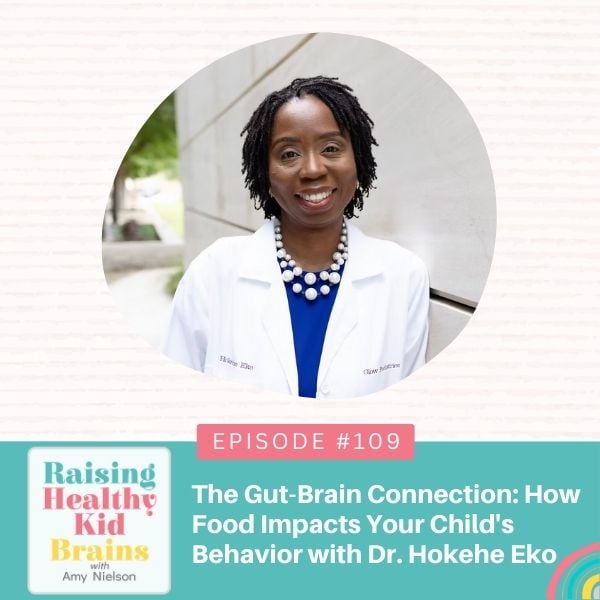
Ep #109: The Gut-Brain Connection: How Food Impacts Your Child’s Behavior with Dr. Hokehe Eko
When Dr. Hokehe Eko’s 9-year-old daughter’s lips turned black and her behavior shifted dramatically, conventional medicine had no answers. Allergy tests were negative, dermatologists were stumped, and frustration grew as her condition worsened. The cause? Severe food sensitivities.
This personal experience transformed Dr. Eko’s approach to pediatric care. Today, as a board-certified integrative pediatrician, she helps families uncover how food sensitivities can show up as behavioral challenges, sleep issues, and even aggression in children—especially those with autism or ADHD.
In this episode, Dr. Eko shares stories of children going from aggressive to calm, from constipated to regular, and from non-verbal to speaking their first words. She breaks down practical, evidence-based dietary changes that can improve therapy outcomes, family dynamics, and overall quality of life—without overwhelm or guilt. Learn how to start small, focus on one change at a time, and support your child’s brain and gut health in a meaningful way.
To thank you for being a listener here, we made you a special freebie. It’s an amazing alphabet activity you can begin using with your kiddos that is so fun, so get started by clicking here to grab it!
What You’ll Learn:
How constipation can drive aggressive behavior in children who can’t communicate their pain.
The connection between dairy consumption and opiate-like effects in some children with autism.
Why simple cereal swaps could reduce inflammation.
How Wi-Fi and devices in bedrooms can worsen sleep issues.
The signs that indicate your child isn’t sleeping well (beyond just trouble falling asleep).
Simple strategies to transition your family’s diet without overwhelming yourself or your children.
Does your child ever have behaviors that you don’t understand, or they’re struggling maybe with sleep or constipation? I had the most fascinating conversation today with Dr. Eko, and she talks about the brain and gut health connection and how sometimes behaviors, particularly when we have kids that are struggling with autism or ADHD, and how behaviors can be impacted simply by changing diet. And it was so fascinating to hear the reasons why those connections are happening.
And the stories she told and examples of these kids that were coming in with aggressive behaviors or struggle with sleeping or struggle with attention and focus and some of the different things that they could do just by decreasing dairy or gluten or some different things that they were able to do. So she talks about why those things are connected. She talks about how to shift and how to do so without overwhelm or guilt.
And of course, while these things don’t necessarily cure ADHD or autism, they can have such a huge impact in combination with therapy and in improving outcomes and lifestyles for not only these children, but for their families as well.
My guest, Dr. Eko, is a mom. She’s a board-certified integrative pediatrician. She’s a TEDx speaker, author, and CEO of Glow Pediatrics. She partners with parents of children with ADHD and autism to address the root causes of behaviors so that they can glow with health from the inside out using integrative pediatric medicine. Our conversation is coming up right after this.
Welcome to the Raising Healthy Kid Brains podcast, where moms and teachers come to learn all about kids’ brains, how they work, how they learn, how they grow, and simple tips and tricks for raising the most resilient, kind, smart, compassionate kids we can. All while having lots of grace and compassion for ourselves, because, you know what? We all really need and deserve that, too. I am your host, Amy Nielson, let’s get ready to start the show.
Dr. Eko, welcome to the show today.
Dr. Hokehe Eko: Thank you so much, Amy, for having me. Such a pleasure. Thank you.
Amy: I’m excited to talk to you. So we are going to be talking about behaviors and about autism, ADHD, but we’re going to be talking about it from I think a little bit different perspective. And that is that we’re talking about it more the gut-brain connection, which I’m super excited about. So before we get into that, tell me a little bit about how this became something that you were interested in. How did you get into this and find your passion for this topic?
Dr. Hokehe Eko: Yes, great question. I was going to ask myself how did I get here too. I’ll tell you. So my daughter was nine, and she was doing well, and all of a sudden her lips started turning black. Her lips used to be pink. And then I was like, hm, okay. So then not just her lips, her whole face started breaking out. And her behavior changed, and she started not doing well in school. So I said, okay, well, this is a little much.
So of course, I took her to see the dermatologist and they said they have no idea what’s going on. So then I went to see the allergist who did the whole full panel of testing, the skin prick, all of those things they do, and everything was negative. So that’s when I got upset because I was like, listen, you can’t tell me there’s nothing. Look at this kid. She looks like she’s on fire, right? What in the world do you mean there’s nothing? Not even dust? He’s like, nothing. I’m like, okay.
So I was really frustrated and desperate at this point because she was just getting worse by the day. And so I started looking on Facebook and I came across something called integrative medicine. And I was like, what in the world is that? I’ve never heard of that. So it turns out integrative medicine is simply the combination of evidence-based complementary medicine and conventional medicine, right? Like regular medical school. So I said, okay. So I reached out to a few of them. I asked questions. I was like, can you help me? My kid is changing in front of my very eyes.
And so they suggested I do a food sensitivity test that was home-based. So I did it. And my goodness, my kid was highly sensitive to gluten, eggs, wheat, dairy, cashew, pineapple, so all the things I was giving her thinking I was the whole wheat mama, the mama with the dairy with the cream on top, like the really cool milk. Yeah, that. So when I saw that result, I was like, okay. So everybody in this house has suddenly become gluten-free, dairy-free, egg-free. I cleaned out my fridge. I was like, that’s it, we’re done.
So, but the amazing thing is that in six weeks, her lips turned back to pink. And that’s when I was like, oh, so in medical school, they don’t teach us about nutrition, honestly, barely. Like, yeah, we can tell you eat better, but not really anything.
Amy: But it’s not really deep, yeah. Wow.
Dr. Hokehe Eko: So I said, oh my goodness. So that’s what led me on the path to completely becoming retrained. So I did a fellowship in integrative medicine, and I couldn’t unsee what I saw, right? But how did I get into autism and ADHD? Yes, that’s the question I asked myself too. I’m not sure how that happened, but I’ll tell you a series of events that led to that.
What happened was based on what happened with my daughter, right? I was a general pediatrician and I had this patient that had never let me touch her. She had both ADHD and autism. She was 9 years old. And her parents were desperate because she was about to be kicked out of the only school that she could go to because she was so aggressive, right?
So they came in and, of course, she was aggressive. She was constipated. She did not sleep at night. Parents could not take her out of the house barely because they were afraid of what she would do in public.
So I said to them, hey, this stuff just happened with my kid. Maybe we can try your kid off because she was also drinking a lot of milk. I was like, how about we try her off gluten and dairy and see if it makes a difference? Because that’s all I knew, right? They were on board and they decided to try because at this point they were desperate too. So they tried.
And in 4 months, this kid was no longer aggressive. She was sleeping better at night, constipation was gone. She still hadn’t let me touch her, but we were making progress. But by month 6, this kid was no longer in danger of being kicked out of school. She was happy. She could go to school. They could take her out. She let me touch her for the first time. And I forgot to add she was nonverbal, so she also said her first word, Mama. I said, oh.
Amy: Oh my goodness. Wow.
Dr. Hokehe Eko: What? So I cannot unsee it at this point because it was clear that there was a big connection between what we eat and what we see as behavior, right? So I started saying that to more and more of my patients, right? This was before I became retrained, and I was starting to see results. And I said, oh my goodness.
And then I had this epiphany. It’s not that I didn’t know, but I had an epiphany about – it’s a 2-year wait list in Oklahoma where I live to get a medical diagnosis for autism for a kid. And if you know anything about pediatrics, which I’m sure you do, first 5 years of life is critical, right? That’s when brain growth is most rapid, and if we’re going to make changes, we need to make changes then. And so if a child is waiting 2 plus years to get a diagnosis, they’re already almost out of the zone where we should be making changes for them.
So I decided I was going to go learn how to do the medical diagnosis, right? So – and my job, they were harassing me. So I was like, okay, forget this job, I’m going to go learn how to do the medical diagnosis. And then I started my practice doing the medical diagnosis. And at first, I would just do the diagnosis and say bye, and that was it. And then it’s like, but I know how to help these kids feel better. What am I doing?
So then that’s how my practice evolved into what it is now, which is we do the medical diagnosis, but then we treat kids using holistic medicine, the kids with ADHD and autism. So we’re addressing their constipation, their picky eating, their lack of sleep, their aggressive behavior, all of those things that are concerning.
And I don’t claim to cure autism because that’s not what I’m doing. I am simply improving their lives on the inside, right, from a medical standpoint, so that when they go to therapy, it actually works, right? It’s one thing for a child to go to therapy and get help, but if the child is on fire, which is how I like to describe inflammation, they’re on fire on the inside, then it’s not really going to work as well as it could, right? So.
Amy: Right. Wow, that is fascinating, and that is just a lot to take in. And that has to be, I mean, was this just kind of like a huge surprise to you as a pediatrician who’d been doing this and then seeing that with your own daughter? You said you couldn’t unsee it. That would just be amazing.
So talk me through why this matters. How is this impacting, you know, I could see maybe changing diet impacting your constipation, possibly sleep, things like that. But like aggressive behavior, like that one kind of blew my mind, right? So talk me through why does the food that we’re eating kind of impact all of these things so much?
Dr. Hokehe Eko: Right. Okay, great question. So serotonin, which is the happy mood neurotransmitter that’s made in our brains, right? Did you know that 90% of it is created in the gut? So –
Amy: That’s huge. That’s so huge.
Dr. Hokehe Eko: Yes. So if you’re looking for a happy kid who has a brain-based issue going on and they are inflamed on the inside and their gut, do you see how this is not going to work? We’re going to give them medication, but if we don’t address the reason why their body isn’t making what it should make to help them, then it’s not going to get better.
Amy: So if we go and we’re just trying to fix the..
Dr. Hokehe Eko: Symptom.
Amy: The result, but yeah, the symptom, but we’re not really correcting the issue. So we’re trying to like feed them serotonin or whatever with these medications, but really the long-term solution is just to help resolve the issue in their gut so they can create their own naturally.
Dr. Hokehe Eko: Right, because lots of research shows that what’s driving a lot of what we see is inflammation, right? So inflammation in the gut is directly connected to inflammation in the brain because the brain and the gut are directly connected through the vagus nerve, right?
So anything that’s going on in the gut will impact the brain, and anything going on in the brain will impact the gut. So they talk to each other. So that’s why it’s important to address both things and not just hand them medication. Okay, so for example, children that are aggressive, typically, the medication they’re handed is Risperidone. That’s an antipsychotic, right?
But in my practice, doing research, I have seen that lots of kids with autism who are highly constipated are also aggressive. Because they are in pain, they can’t explain it to you, and instead what comes out is aggression.
And I’m not saying that’s the final totality of it, but a lot of it is driven by that, right? And constipation means your body isn’t releasing toxins. Because that’s essentially what poop is, right? It’s toxins that our body is trying to get out. And constipation means your body is holding on to it.
And anything you hold on to in the gut starts to make holes in the lining of the gut, gets into the bloodstream, and goes straight here. So I see kids with aggressive behavior. My first question is, are you constipated, or what’s going on in your GI tract? Because when we address that, then it improves. I’ll give you an example.
I saw a kid 2 weeks ago. I was evaluating him for autism. He’s 2 years old. When mom came on the call, she was crying. And I asked her why. She said her 2-year-old had just slapped her so hard, her glasses fell off and broke. Then she said these words, “I am scared of my child.” If a parent can be scared of a 2-year-old, now you know we have some serious problems going on. So that’s how aggressive he was.
And so I told her, because I wasn’t doing the holistic treatment, I was just doing the evaluation. I said, well, I can’t ignore that. So I said, try him off dairy. Oh, she also mentioned he’s highly constipated and he drank like 24 ounces of milk a day, which is a lot for a 2-year-old. At that age, they don’t really need that much milk, right?
So I said, try him off dairy because dairy in kids with autism, it doesn’t break down completely, right? And so what’s leftover of the breakdown is something that acts in our brains, in their brains like an opiate.
So what do people who are on opiates, what are they like? There’s always an underlying aggression going on, right? So they’re either really aggressive or they are like nonresponsive or they’re somewhere in the middle, right? So and that’s how it acts in their brain. So I said to her, try him off dairy. So she told me later that she thought I was crazy, but tried it – since she has no other, she doesn’t know what else to do, she’ll try it.
So she lowered his dairy intake, like significantly, and almost stopped it. So the next time I saw her, she said he is acting like a regular 2-year-old. So what changed? The dairy, right? All of that inflammation from the dairy was decreased. All that backlog of – and now he was pooping better. So he now became a happy toddler. That doesn’t mean he doesn’t have autism, but my goodness, the aggression was gone.
Amy: Wow. That is so huge if there’s like these small things that we can adjust. So how as a parent, and a lot of, you know, our listeners here are parents or sometimes teachers that could be making recommendations to parents if they’re seeing some of these behaviors in classrooms, things like that.
How do we know – like do we just try this? If we’re seeing behaviors that we’re concerned about, is this something we should just try at home? Do we go like and get like a food sensitivities test? Like what’s the best way to kind of start if we think maybe that food or, you know, gut issues could be leading to some of these behavior things? What the best first step really for us to do?
Dr. Hokehe Eko: Yeah, so that’s an interesting question because it depends, right? Depends on what’s the major thing is going on with your child. So for example, if your child is very aggressive and they also are constipated and they also drink a lot of milk, and or they never eats any vegetables or fruits or the things that will help relieve constipation. So that’s where you want to start. So yes, if your child is drinking a lot of milk.
The other thing that drives aggressive behavior is like food dyes, right? I know that they just recently banned or said they’re taking away red 40, but it’s really all the dyes, all the greens, the yellows, all of them, because they are neurotoxic, meaning they are toxic to the brain. So you want to – that’s where you can start. Instead of buying Fruit Loops, which is all colors, get Cheerios, if your child must eat cereal. I mean, yeah, just –
Amy: Start making transitions, transitioning over to less color. Okay.
Dr. Hokehe Eko: Okay. Yes, yes, take as much as possible, like all those fruit punches, all those things are all colored with dyes. Decrease that, increase water, right? For example, the brain needs the most water in the, of all the organs in the body, right?
If we start thinking, how can we make our brains happy, then we’re going to do things that will make our brain happy. Your brain needs water. Give it water instead of fruit juice or fruit punch or Hi-C and all those things, right?
All those things that are artificially flavored, you want to just get rid of them because they drive inflammation in your child’s gut and brain and that’s basically where to start is learning that. I mean, I often tell parents, just follow us on our IG at Glow Pediatrics because we have literally our posts are, these are the things that inflame your kid, take them out. These are the places where you find the things that don’t inflame your kid, add them in.
Amy: Yeah, get them. Yeah. Let me ask you this because I feel like sometimes that feels overwhelming, right? And this idea of not doing any gluten, you know, whatever. I mean, it’s in everything, it’s everywhere, right?
But then I’ve heard, right, that if you don’t completely remove it and you’re getting traces of it, right, it can still cause problems at least, you know, for people that have significant, you know, gluten issues. If you just start decreasing these things like the dairy and the food dye and gluten, is it possible to see results just from reducing even if you’re not like doing a complete elimination diet?
Dr. Hokehe Eko: Absolutely. Yes. Yes, it’s possible to see a decrease in the behaviors. Yes. And I mean, that’s why it’s a progression, right? So no overwhelm allowed.
Amy: Oh good. Okay. Pass.
Dr. Hokehe Eko: Pick one thing. Just pick one thing and slowly decrease it. So for example, if you’re going to try off dairy, you don’t have to be like me and completely make everybody dairy-free in one day. You can get some almond milk, add in some of it into the dairy, and slowly decrease dairy and increase almond milk, for example. That’s an example. So just pick one thing and try one thing. And yes, on the way to getting rid of it, you should start to see improvements. Yes.
Amy: Okay. How long does it normally take to start seeing some of that improvement? Is it – like you’ve talked about like a couple weeks? Like how long does it normally take to see like some kind of improvement or result?
Dr. Hokehe Eko: Every kid is different, right? Every child with autism or ADHD is that one child. So.
Amy: You don’t know. Okay.
Dr. Hokehe Eko: No. I’ve seen people make change and like see a difference in 3 days. I have seen people, it takes 2 weeks. Some people, it takes 3 months. By the 3-month mark, you should see an improvement.
And again, we’re not talking about we cured autism or ADHD. What we are saying, look for the improvements. It could be as slight as, oh, he’s making more eye contact. Oh, he’s not as aggressive as he was. Oh, he sleeps a little longer than he used to sleep. So those are the things we’re saying look for, right? Because then you will be empowered to continue the small consistent changes. And sometimes it’s dramatic, like this kid that went from hitting to no hitting in 2 weeks.
Amy: That’s huge. Yeah. Okay, let me talk to you about – because we talked specifically about aggressive behaviors and constipation and things. Which, oh my goodness, even if we could just get rid of aggressive behaviors, that’d be great. But when we’re talking about, you know, maybe kids that are struggling with symptoms of ADHD, things like that, what are some behaviors there that we could be looking at and some things you’ve seen in your practice that are improved by some of these diet changes?
Dr. Hokehe Eko: Okay, so sleep is a big one. ADHD could also be called a sleep disorder because think about it. It’s brain-based, its frontal lobe is the most affected area, right? And if a child doesn’t sleep. So you – how do you function when you don’t sleep?
Amy: Not very well.
Dr. Hokehe Eko: So we expect these kids who have not slept all night to come and sit down in your classroom and pay attention and sit quiet. So that’s not going to work. Okay? Because it’s brain-based and they haven’t slept. But I’ll tell you something. Did you know that most of the melatonin that you’ve heard is produced in the brain, did you know it also is produced in the gut?
So again, we’re back to the gut. So we can give you clonidine, we can give you melatonin, but if the gut isn’t happy and so it’s not producing melatonin, then we’re replacing melatonin. Do you see how we’re not going anywhere fast? Because the underlying problem is still there. And how long can you supplement for? Not forever. At some point, the body needs to kick in and do its work.
Amy: So sleep is hugely impacted by our gut. And so if we’re trying to resolve sleep issues. How do you know if your kid is having sleep issues? I mean, maybe if they’re really, really young, like toddlers, they’re coming and climbing in bed with you or something, right? But like, is it just that they’re having a hard time falling asleep? Can you always tell when a child’s like having sleep issues?
Dr. Hokehe Eko: Yes. So they may have trouble falling asleep. They may have trouble staying asleep. They may complain that they are tired when they wake up. If you put them to bed on one side of the bed, the next morning, they are in an opposite direction, which means they are restless. That’s also an indication they’re not sleeping well. If they snore, that’s an indication they don’t sleep well.
If they grind their teeth, which is essentially CPR for the brain, it’s telling you something is wrong. Grinding of teeth, that’s what that means. Fix this. They’re not sleeping well, right? So all of those things are indicators. There are some kids who’d lay awake for hours and cannot sleep.
Amy: Mmm. Wow. Okay.
Dr. Hokehe Eko: Yes. We have to ask the questions as like teenagers may not tell you they don’t sleep well. They’ll just be grouchy. So if you don’t ask the exact questions, like how long did it take you to fall asleep?
I’ll give you a tip. So the devices, like all our devices, our phones and all of that. Maybe you’ve heard, but Wi-Fi emits rays that decrease melatonin production in the brain. So you are sitting in a room and there’s a Wi-Fi-enabled TV on and you say your kid needs TV to sleep. Well, the TV is also not helping your kid sleep because it’s also sending out things that are decreasing melatonin in your child’s brain.
Plus, your child’s melatonin production in the gut is already decreased, right? Because of all the other things going on. So can you see how we’re not going anywhere really fast? And so I always tell parents either we’re turning things off to airplane mode or you’re completely turning off the Wi-Fi in the house.
Amy: Removing devices from. Okay.
Dr. Hokehe Eko: Yes, devices from the room because you also want to teach the kids that the room is a place to sleep, not a place to watch TV. So I tell all the parents, take TVs out of the rooms. Let them watch TV in the living room and then come to bed. It’s a lifestyle thing. You want them to learn that this is how they should sleep. So instead of us handing you melatonin, we should be trying to get rid of the inflammation going on in the gut, which will, of course, lead to melatonin production again, which will help the brain sleep better.
Amy: Oh my goodness. This is so fascinating. It’s super interesting. And it’s interesting too because I’ve also seen children, right, that are having, we talked about this brain gut connection, that are having stress and are feeling a lot of anxiety and then that seems to give them stomach aches. And then there’s the stomach issues that seem to be impacting the brain and causing behaviors. And so it’s just so interesting how interconnected those two parts of our body are.
Dr. Hokehe Eko: Yeah, they are. It’s completely connected. So that’s why you can’t look at symptoms in isolation. You have to look at the whole child.
Amy: Yeah. Oh, that is so good. Okay, so if you were speaking to a mom, the moms that are listening, the parents that are listening, or even a teacher who’s trying to help a mom figure out, you know, some of these things going on that they’re seeing in school, what’s like the one thing you would say to them if you just say one thing to them really quickly, what would you suggest or what would you say to help them in this journey that they’re on?
Dr. Hokehe Eko: I would say that recognize that there’s that connection between what your child is eating and your child’s sleep and the way your child is behaving. And so if you can just make one change and start somewhere that you’ll start to see a difference. And when you make one change, then it leads to the other changes being easier.
For example, children that are picky eaters, if you relieve the constipation they’re experiencing, then their palate opens up. Then they’re no longer as picky. Now you can start to feed them healthier food, right? Because they’ll be more accepting of it.
And just remember you’re valuable and you’re the best parent for your child. I like to say that to all parents because it is overwhelming. It is a long journey. It can feel like I’m on this island by myself, but you’re not alone, right? And there absolutely is hope.
And while we haven’t found a cure, we can absolutely help quality of life be better, which is really the goal, right? It’s how can we help improve not just the child’s quality of life, but the entire family? Because whatever is going on with your child, I have three kids. If my kids are not sleeping, I know I’m not sleeping. So can you imagine all the parents who are not sleeping and still have to show up and go to work and be productive? It’s hard.
Amy: Yeah. Oh, that’s so good. Yes. I love that so much. Okay, we need to know, Dr. Eko, where to come and find more about this because you talked about on your Instagram, you’re posting stuff like this and that’s so helpful. You tell us where we find you online so we can get more information.
Dr. Hokehe Eko: So our website glowpediatrics, which is where if you need a medical evaluation, we’re in 14 states and counting, and we do the telemedicine virtually. So we can do the medical evaluations if you need that. If you’re looking for holistic care, you can also sign up on our website and we’ll reach out to you. I have a podcast called Brain Power with Dr. Eko everywhere podcasts are heard. I also have a YouTube channel at Dr. Eko, and I mentioned our IG at Glow Pediatrics.
Amy: Amazing. Thank you so much. And of course, we’ll drop those links in the show notes everyone so you can catch those. Thank you for coming and sharing this with us today. I know I’ve taken away some insights.
I’m thinking, okay, there’s some stuff there I can try and just see if it helps some different things. You know, like you mentioned even breakouts. I have a kid that’s struggling with breakouts right now. That’s a thing we could talk about, right? Or one that has had a harder time sleeping.
So I’m thinking, okay, there’s some things to test. So that’ll be really good. Thank you so much for coming and sharing, and it was lovely to talk with you. And I’m going to go look up your Instagram because I think there’s some stuff there for me too.
Dr. Hokehe Eko: Yes, wonderful. Yes, my pleasure. Thank you for having me.
—
Don’t you just love all the fun things we’re learning on this show together? Well, we wanted to give you a chance to practice a little bit of it at home. And so we made you a special freebie just for being a listener here. You can grab it at PlanningPlaytime.com/special-freebie.
So what this freebie is, I’ll tell you, is an amazing alphabet activity that you can start using with your kiddos. And it is based in play and is so fun. You can use dot markers with it. You can use Q-tip painting. You could use circled cereal. There’s all kinds of options. You can print it out today and get started. Just head over to PlanningPlaytime.com/special-freebie, and we’ll send that to you right away.
Thank you for hanging out with me today for this fun chat on Raising Healthy Kid Brains. If you want to see more of what we’re doing to support kiddos and their amazing brains, come visit us on our website PlanningPlaytime.com. See you next week.
Enjoy the Show?
Don’t miss an episode! Follow the podcast on Apple Podcasts, Spotify or anywhere else you get your podcasts.
We use cookies on our website to give you the most relevant experience by remembering your preferences and repeat visits. By clicking “Accept All”, you consent to the use of ALL the cookies. However, you may visit "Cookie Settings" to provide a controlled consent.View Terms and Conditions
This website uses cookies to improve your experience while you navigate through the website. Out of these, the cookies that are categorized as necessary are stored on your browser as they are essential for the working of basic functionalities of the website. We also use third-party cookies that help us analyze and understand how you use this website. These cookies will be stored in your browser only with your consent. You also have the option to opt-out of these cookies. But opting out of some of these cookies may affect your browsing experience.
Necessary cookies are absolutely essential for the website to function properly. These cookies ensure basic functionalities and security features of the website, anonymously.
Cookie
Duration
Description
cookielawinfo-checkbox-analytics
11 months
This cookie is set by GDPR Cookie Consent plugin. The cookie is used to store the user consent for the cookies in the category "Analytics".
cookielawinfo-checkbox-functional
11 months
The cookie is set by GDPR cookie consent to record the user consent for the cookies in the category "Functional".
cookielawinfo-checkbox-necessary
11 months
This cookie is set by GDPR Cookie Consent plugin. The cookies is used to store the user consent for the cookies in the category "Necessary".
cookielawinfo-checkbox-others
11 months
This cookie is set by GDPR Cookie Consent plugin. The cookie is used to store the user consent for the cookies in the category "Other.
cookielawinfo-checkbox-performance
11 months
This cookie is set by GDPR Cookie Consent plugin. The cookie is used to store the user consent for the cookies in the category "Performance".
viewed_cookie_policy
11 months
The cookie is set by the GDPR Cookie Consent plugin and is used to store whether or not user has consented to the use of cookies. It does not store any personal data.
Functional cookies help to perform certain functionalities like sharing the content of the website on social media platforms, collect feedbacks, and other third-party features.
Performance cookies are used to understand and analyze the key performance indexes of the website which helps in delivering a better user experience for the visitors.
Analytical cookies are used to understand how visitors interact with the website. These cookies help provide information on metrics the number of visitors, bounce rate, traffic source, etc.
Advertisement cookies are used to provide visitors with relevant ads and marketing campaigns. These cookies track visitors across websites and collect information to provide customized ads.