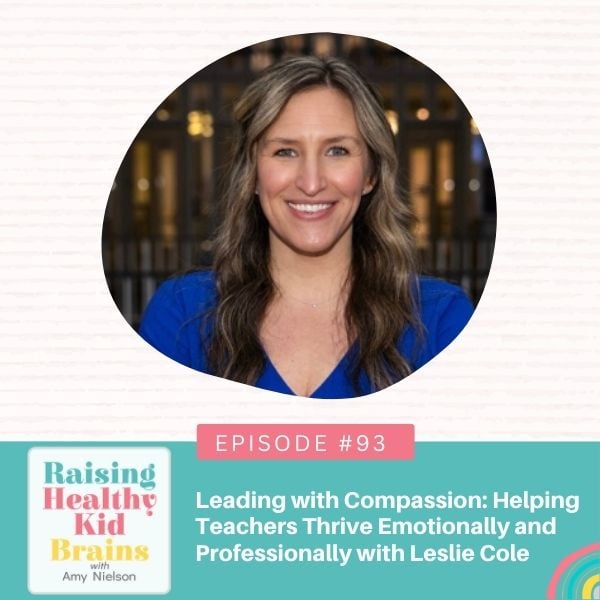
Ep #93: Leading with Compassion: Helping Teachers Thrive Emotionally and Professionally with Leslie Cole
Are you feeling the weight of burnout as an educator? You’re not alone. In a world where teachers are leaving the classroom at record rates, it’s critical that we rally together as a community to support our educators. But what can leadership and parents do to make a real difference?
In this powerful episode, I sit down with Leslie Cole, Director of School Solutions at eLuma, to explore practical strategies for fostering educator well-being. Leslie brings a wealth of experience as a school psychologist, district administrator, and MTSS coordinator, and she’s on a mission to promote student success by supporting the adults who serve them.
Get ready to discover actionable tips for open communication, healthy boundaries, and a culture of respect in our schools. Whether you’re an administrator looking to prevent teacher burnout or a parent wanting to partner with your child’s teacher, this episode will equip you with the tools you need to make a positive impact. Let’s dive in!
To thank you for being a listener here, we made you a special freebie. It’s an amazing alphabet activity you can begin using with your kiddos that is so fun, so get started by clicking here to grab it!
What You’ll Learn:
Why supporting educator well-being is critical for student success.
How leadership can model healthy communication and boundaries with email.
The importance of fostering positive relationships among school staff.
Ways parents can show respect and support for their child’s teacher.
Strategies for providing professional development that builds educator social-emotional skills.
How small acts of appreciation can make a big difference in preventing burnout.
The power of grace and forgiveness in creating a positive school culture.
In a world where a record number of teachers are leaving the classroom and we are seeing burnout at a level we’ve never seen before, how do we do a better job as a community and as leadership in supporting our teachers? I love this conversation because we speak a lot about what leadership can do, but also we talk about parents and our role in supporting teachers so that they can support our kids. It is critical as a community to make sure that these teachers are supported and have the structure and help that they need in making sure that our children are not only being educated, but are having their emotional needs met throughout the day.
My guest today is Leslie Cole. She’s the director of school solutions at eLuma. She holds a certificate of advanced study in school psychology and certifications in school building and district leadership. Her experience spans from school psychology, district administration, MTSS coordination, she focuses on promoting student well-being by fostering positive systems of support including educator wellness. We talked in this episode about e-mails, how to e-mail teachers. Is there a way to do a better job of emailing them so that we’re making sure we’re getting the correct amount of communication but doing it respectfully of their time.
We talked about ways as a community to support teachers. We talked about leadership ideas for making sure that teachers are getting emotional support, social engagement, the training they need, all kinds of different things to help support their mental and emotional well-being as they are on the front line all day educating large groups of children and trying to meet not only their educational needs, but their emotional and mental health needs all day long.
This conversation is for everyone and it’s really good. And I hope it just opened your eyes a little bit to maybe think, is there some small thing, some little adjustment you can do where you are to be more supportive of the teachers that are serving your children and the teachers in our community? I hope you enjoy the conversation. It’s coming up right after this.
Welcome to the Raising Healthy Kid Brains podcast, where moms and teachers come to learn all about kids’ brains, how they work, how they learn, how they grow, and simple tips and tricks for raising the most resilient, kind, smart, compassionate kids we can. All while having lots of grace and compassion for ourselves, because, you know what? We all really need and deserve that, too. I am your host, Amy Nielson, let’s get ready to start the show.
Amy: Hi, Leslie, welcome to the show.
Leslie: Hi, Amy. I am so happy to be here.
Amy: Oh, me too. I’m so glad you’re here because I think this conversation is so needed and we are going to be talking. Tell us a little bit about what we’re going to be talking about today.
Leslie: Sure. So we’re going to be talking about how leadership can really impact our educators and how the educators impact the students. So really that nice circle of how what we can do as leaders and administrators to support our staff really has that necessary impact on our students’ well-being.
Amy: Okay, so educators’ well-being and their mental health impacts our children. And I almost want to see if we can go in this conversation, too, to how parents can be more aware of that and the impact that parents can maybe have on that, too, because I think a thing. I was telling you kind of off-camera, there was a post today in my city group and Facebook about a school that’s had the police called to it like five times within the last school year. And several teachers have actually left the school based on like allegations back and forth of bullying between teachers bullying students and students bullying teachers and all this stuff.
And it just, you read it and you just hurt for everyone involved. And we hear this a lot. So many teachers are feeling so disrespected, so not supported. And then children are dealing with all their stuff and it’s so tricky and it’s just tricky everywhere. And so I just, I feel like this is so important. So I’m so glad you’re here that we get to talk about this today.
Leslie: I am too. And I, unfortunately, it’s not just your city. I mean, it is across the nation where this is just really impacting schools overall. Everyone in the school, from the leadership team to the students, to the custodial staff. I mean, everybody is impacted by this.
Amy: Well, let’s just start by talking about, I feel like some of this is kind of given, but like, why is it so important as leadership and as parents really to want to make sure that our teachers are in a good, like support them in their mental and emotional health? Like why, why should we care as parents and leaders? Yeah.
Leslie: Well, let’s think about that. Right. Our educators are in front of our students, they are student facing all day long. So you and I, we might show up for work and we’re behind a screen. Or if you’re working in a grocery store or you’re in an office, you might interact intermittently with people. Teachers are on all day long. Our educators are in front of our most vulnerable population, our youth. And so if they’re not feeling well, think of just how much more challenging that can be to ensure that students are feeling well.
Amy: Yeah, and I’m thinking about it, right? And teachers probably, I mean, to some degree, spend more time with our kids, maybe even that we do during the school week, it’s a lot. And they not only have just our kids, I think sometimes we, you know, there can be days, right? Or we’re like, oh, it’s been a lot. I might need some time for myself for a second to just regroup. And the teachers don’t really get that. And they have so many more than just our kid or our kids, right? They have this whole group. So that’s a lot.
Leslie: Exactly, yeah, exactly. And when I think about class sizes and the expansion of some of our schools across the nation, it’s a lot.
Amy: And it’s not just keeping them entertained and giving them a screen to go play on or whatever, right? Like they’re responsible for their education and teaching them and helping them grow, pushing them a little bit, which of course this can be challenging if you’ve been a parent and tried to get kids to do chores or do things, right? You’re responsible for that at all these different levels. And then also I think, you know, we see a lot of kids needing a lot more support and help with their mental health or emotional health. We’re supposed to be modeling that for them and helping them through all of those things, which just feels like additional weight, I think, on a teacher as well.
Leslie: It absolutely does. If we think about student skills coming into school, maybe 10 years ago, those skills looked very different than the skills that students are entering kindergarten or preschool with at this point. So what is on a teacher’s plate is not just reading, writing, math, it’s much, much further. It’s teaching students how to be good humans. And you’re right, Amy, teachers spend a lot of time with kiddos. So we really want to make sure that they are at full capacity so that way they can support them in that holistic manner.
Amy: That feels kind of overwhelming, honestly, just thinking about it. And I’ve taught, you know, but I usually worked with smaller groups rather than like these full, really large classrooms. It feels like a lot. And every day, for months and months and months on end, how do we help support teachers? What can we do to help them be at their best for this incredible job that they have.
Leslie: Yeah, that’s an excellent question, and I can certainly share my opinions. I just want to, again reiterate, you know, my belief is that when a student enters the school, that is the student’s experience, right? That individual’s experience. And so yes, our educators might have 20, 25 students in their class, but each student, that’s their one experience in kindergarten and first grade. And that it’s just, it feels so heavy, right? We’re shaping as educators and what can we do? It’s a great question. In my opinion, it starts with listening, right? It starts with that open communication to be able to feel safe for our educators to say, hey, you know what? I need a break or even, hey, I just need a moment to pause, right? Think about it. All day that they are at work, using the bathroom is even a challenge sometimes. We have certain privileges not being in a classroom that we take for granted. And I think first understanding that and keeping those lines of communication open is the foundation for really supporting educators.
Amy: So good. I remember, I don’t know if this was, I’m trying to remember if this was a Brene Brown book. But anyway, the author was talking about working in a restaurant and that they have a thing, you know, when they’re, when they’re feeling, you know, like they need help, like it’s, it’s getting overwhelming cause that’s really high pressure waitressing sometimes. And so they have like something they can say to say, Hey, I’m feeling overwhelmed. Can someone take over like this table or whatever, they have a code for that, a word they can use for that. And then she said there gets to a point where you just kind of, if it gets beyond that where you just shut down and you can say the phrase that is applicable to that situation and everything like they just send you outside, everyone takes over everything for you and you’re just out for a couple of minutes till you can regroup and like get your brain back or something like that.
So this is what came to mind when you were talking to me about how do we provide the kind of support, you know, hopefully open communication helps with that, but is there a place where someone’s like having a human experience? And has a day where they just need that moment of, I just need some help for right now. I just need to go take a breather or I need to use the bathroom or whatever. Anyways, all those kinds of things, do we provide that same kind of support for teachers?
Leslie: Amy, your example reminded me of sometimes at family events, I can get very overwhelmed and my husband and I have a nice keyword that I’m not gonna share openly, but you know, just to say, okay, yeah, maybe we need to step out and go for a walk together and communicate that. So educators, that is challenging because oftentimes we’re short-staffed, but having a group to lean on, so really those relationships within maybe your grade level or your relationship with maybe some of the support staff, being able to build that in and having those, whether it’s a safe word or maybe it’s just a scheduled time throughout the day that happens, or maybe they’re able to pick up the phone and call and say, hey, I need to take five minutes just to be a human, instituting some of those things in schools can make a miraculous difference. Obviously having the capabilities to do that can be challenging, as I mentioned, with shortages in staffing, but it’s a wonderful thing to support some of that burnout.
Amy: Yeah, and that is one of the number one words because I get to work with a lot of teachers from all over the world. And when I say the word burnout, it’s just instant, like they identify with that. It is something that is so, I think, widespread. And so, I don’t know, all-consuming. It’s just, it’s everywhere. It’s so hard. So, okay, so talk to me through the step in communication. What are some other recommendations that you have for leadership in schools for supporting their educators.
Leslie: Sure, I do wanna also say that, you know, we’re talking a lot about student-facing, right? The time that an educator is in front of students. But unfortunately, their day doesn’t stop when students leave. So that’s just another area that I do wanna call to light that is continuing that burnout for educators, the accessibility through whether it’s a phone call or an e-mail and the continuation throughout the evening when we get to leave work and educators, they can’t always leave work behind. You get phone calls from parents, you get phone calls from leadership and it’s important. It’s important for the students, but it also just contributes to that burnout.
So that’s one thing as a leader, e-mails, right? There has to be a point or there has to be a model that’s set to not be emailing at all hours of the night. As a leader, when you’re doing that, it kind of sets the tone and the expectation that I’m emailing at night, so I need my educators to respond to me. And I think that’s one thing that is very simple to institute as a leader is maybe set a schedule for the timeframe that e-mails go out. Because I know when I was in education that if I were to get an e-mail at seven o’clock, I felt a sense of urgency to respond to that. There are ways, there’s tons of tools within our mailbox or e-mail box where we can do scheduled sends and send that later when it’s actually time that educators are working, not when they should be spending time with their family. So respecting that boundary.
Amy: I love that so much. And I relate to that too, right? So in the business that I have, and I work from home and have a pretty large company, and e-mails come in all the time. In fact, I’m known in my family for not responding to messages very good. I’m like, if you only knew how many messages I get. But one of the things that we’ve done as a team, right, is find ways to batch it. Is there a way to batch, right? Like you can, you know, make sure all your newsletters or something are done at the beginning of the month and schedule them all. So is there a way to do that so you’re not having to worry about it? You can worry about it once during the whole month and then let it go, right? Or we have an autoresponder with our company.
We actually got the sweetest message about it where someone says this is like the best autoresponse message I’ve ever seen. It was really cute, but it’s on weekends. We just let people know we are so happy to help you, but we have family as a huge priority here at our company. And so we will get back to you on Monday. Weekends are for family here. And so we just let people know that so that they’re aware, but it’s an auto-response. We’ll get back with you on Monday. So they feel like they get something back immediately, but we’re just telling them why. We respect our family so much that we’re going to get back to you on Monday.
So are there things like that? And I’m thinking some of this could be training, right? Training teachers how to set these kinds of systems up so that they’re available to them, right? And then also I feel like that sets the expectation that they’re not required to be available 24-7 on the weekends at all times to respond to every single message, and it’s okay to prioritize your family on the weekend and respond on Monday morning or something like that, right? So I love that idea. I think that just really, it removes weight, I think, just from a mental perspective and gives them the functional training of how to do it or the systems that they need to be able to do that.
Leslie: I agree 100%. I think that the majority of teachers that I’ve met are very type A, not to provide a label, but they wanna do their best and they are so on top of it. And if you get an e-mail on the weekend, there is some pressure to respond. So as a leader, giving staff, giving educators permission to do that, modeling that, I think that is so important for leadership, for administration to be able to say, hey, my staff also needs their time. And I think communicating that with the community, the school community, with parents, it’s such the stage for those expectations. Always wanna have that nice back and forth communication. It’s the best way to ensure that our students are supported, again, in that holistic manner.
But there has to be some boundaries. I do think that COVID blurred some of that, but I think it was there before. Even if you’re not giving your personal cell phone, you know, there are Google Voice and you can utilize, you know, a different cell phone number to communicate. And I respect that completely. I’ve done that with parents that prefer to text. And it’s a great way to have communication. We want that communication, but there has to be those boundaries as well.
Amy: What came to my mind when you were talking is it almost sets a tone of respect, the administration setting the culture of respect for teachers, right? So I feel like sometimes teachers really get just pulled in the middle. I just feel like they’re the ones getting torn back and forth in the middle. And so just setting that tone of respect, we, our teachers are amazing. They want to talk to you. Communication is amazing, right? But we’re going to respect our teachers and let them have the weekends off and them setting that. I’d love that. That’s, yeah. I don’t know if I thought about that before, but I love, I love that idea.
Leslie: I really do think that’s something that’s rather simple. Communicate at the beginning of the school year and throughout the school year as things get busy, but it’s something very simple that can be done. I think the other thing, or another thing, that our administration and our leadership teams can do is to monitor the e-mails that we’re sending. I know I’ve been guilty of this myself, and my practice has been, instead of sending multiple e-mails about multiple things, we’ll try and keep those e-mails nice and concise with the information that’s necessary and it’s just one e-mail. So again, condensing what can be condensed so it’s not e-mail after e-mail because teachers don’t have time to look at them either. They’re in front of students all day. When are they checking their e-mail? So ensuring that things are condensed and not overflowing in boxes as well.
Amy: Do you feel like that comes from parents more or is that coming from administration or is that coming from all sides? Because I think on the parent side, I feel like we get so many e-mails too. And granted I have kids in six different schools, right? So there’s a lot going on. But yeah, so we get just so many e-mails, especially once you get up into having kids in junior high and high school and you’re getting e-mails from all of their teachers, right? But even in elementary school, sometimes you’ll get like multiple, multiple e-mails a week.
And it feels like a lot of work for the school or the teachers to be sending and so much work for parents to try to keep up with. So is there a culture change around that or something? And it’s probably overwhelming teachers too. They’re probably getting a lot of e-mails too. If we’re getting that many e-mails, how many are they getting back? Oh my goodness, right? What do we do with that?
Leslie: Right. And also think about the leadership team. They’re the ones usually behind sending those mass e-mails that go out. So if there’s an incident at the school, they want to provide transparency and provide certainty for the community and the parents. But if a bus is five minutes late, that’s a communication. And then there’s a lot of back and forth going on. And it goes both ways, Amy, to answer your question. I don’t think it’s just leadership or parents that’s overwhelming. It’s everybody’s overwhelmed by one another. I really do think that.
And I think if we talk about it, we’ve got to be open and say, wow, this communication, it’s great, but it’s too much. And maybe we have teams, right? So we’ve got PTAs out there. Maybe there’s a way to work together and figure out what’s the best for our community and our community as a whole, those in the school, working in the school, and those that are on the receiving end of what the school’s providing. What does that look like? And what works for a specific community? I think having those conversations is a wonderful idea.
Amy: I know our school switched to an app this year, which is different than they’ve done in the past. How do you feel about apps versus e-mail?
Leslie: I think apps can be beneficial. Everything can be stored in one spot. I’m familiar with app-based platforms as well just from being in a school and being an administrator, it can be great. And then parents can also control the notifications on that. So you can oftentimes turn off notifications after a certain time, or maybe they don’t get pushed through unless you’re checking it. So that allows a little bit more control on the receiving end, and also you can schedule sends as well on the sending end, so from the school. So apps do have benefits when technology works, right? But I would.
Amy: Yes, yes, that’s so true. And I, one of the things that the app, our district or our schools have implemented, it sends you, it’s called the daily digest or something, where it just, it’ll send you one e-mail a day with kind of like the top bullets of whatever’s going on. So it just feels like it really has kind of decreased the number of e-mails coming into my inbox, which I feel like is helpful because yes, then if you see something, you’re like, I do need to know about that. You can go in and check it, but it’s not just being inundated. And we talked about, right? Like my inbox gets really full really fast. And so sometimes like, oh my word, that’s a lot of e-mails. So, you know, being able to go in and check, what do I need to know for this kid or whatever, and being able to have like kind of a condensed thing. And I’m assuming that’s probably helpful on the teacher side as well, on the educator side as well.
Leslie: Yeah, I 100% agree. I haven’t seen it on the educator end, but that’s what I’m talking about when I say administrators and leaders thinking about the e-mails that they send to the educator, you know, letting them know maybe a faculty meeting is canceled or after school activities are postponed, whatever that might be, or maybe there’s a shift in the schedule for the day or an incident that they need to share with educators, but really making sure that what’s urgent goes out and things that can wait can be condensed as you’re talking about. Again, it’s about that respect of time and also the respect of those boundaries. I know I keep saying that, but I think that that’s what’s gotten blurred in recent years.
Amy: I think so. Oh, I so agree. Yeah. And just the respect of that. And I was thinking, too, yesterday I was working and I was trying to focus on something and then someone was calling and there was this appointment and then another person was talking to me about this thing needs to happen. And it was all of these things were good things and they were things that needed my attention. But trying to kind of have them all going where I was trying to just focus on something and get some progress done at work or whatever, right? And it just tears apart your focus and ruptures it into pieces and makes it so hard to kind of focus.
So maybe even like you talked about, are there times of day when you get these updates or something so that it’s not an e-mail pops into our inbox, and I’ve gotten better at this. I can ignore them really well. But my husband, if there’s a red dot on his mail thing, he has to check it and make the red dot go away. And he’s not alone. There’s other people. There’s the red dot. And so maybe just how do we help teachers and make it okay, give them permission to not check or not send it while they’re trying to focus on that FaceTime with the children and then bring it in later when it’s an appropriate a great time for them to get all the notifications and look at it once and get through all their stuff and move on.
Leslie: Amy, we’re talking about adults here and I know that, but it’s the same for our kids, right? There is so much thrown at all of us nowadays. There’s so much information that just comes so quickly and so easily. Again, I’m gonna go back to modeling, right? So if a teacher is distracted by the number of e-mails that are coming in and they’re not able to give the attention to the students, and students are seeing that. So again, starting with that modeling, it will support our students. That’s that trickle down effect, right? So I think that’s important to know. We all have so much coming at us and how do we navigate that? How do we teach our younger generations that this is gonna continue? Technology can be great, but how do we really balance what’s in front of us versus what might feel really important and pressing.
Amy: Yes, I love that. And it’s making me think again, sitting here through this whole conversation thinking, how do I do a better job as a parent? Because then I’ve got my life going on too, right? And I am quite busy. I have eight children and I have a business and I have a lot going on. And so if something comes up and I’m like, I need to e-mail a teacher about something, right? It can just be responding to a thing that they asked or just signing up for whatever form that they sent out to help with the class thing or whatever, right? And the challenge is, I’m like, if I don’t, with the number of e-mails I get every day. If I don’t respond to this right now, it will be gone. I will not remember to do it later.
So I’m just going to send it right now because this is when I’m thinking about it. And I don’t want to forget because it’s important. But then I wasn’t really thinking about, is this a good time for the teacher to get it? And I don’t mean for them to read it right now. I just send it right now. So I’m almost wondering too, how do we bring that into the conversation of, is this an e-mail that I need a teacher to look at right now? Or is this something they can look at later? And how do we differentiate between something I need a teacher, you know, like, I have a message my kid needs to have before they get out of school, right? This is important. Or this is just, you know, whenever you have time, like, don’t stress about this, but I need you to know this at some point, you know, this week.
Leslie: Yeah. I think subject lines are a really easy way to do that right so sometimes if something is not as urgent I’ll put not urgent right in right in the subject line or if it is urgent I’ll put urgent or need a response so having that communication right there so it doesn’t even have to be an e-mail that’s opened you can see from the subject line. I think the other thing is there are ways to set up schools so that way things like early pickup or early release, those can go through the office, right? So making sure that we’re communicating with the appropriate school staff so that we were not bombarding teachers and also not having that expectation that they’re sitting and watching those e-mails come in and feeling that pressure because they get a lot of them, we’re sending a lot of them, schools are sending a lot out.
I think we need to always give one another grace, right? So there might be times when we miss an e-mail or miss a notification. And I think that’s the human aspect, right? So I think having grace and some forgiveness for ourselves, this is okay, then I’m not going to respond to this immediately. And even, you know, if you feel the need, if you give it a couple days, and it’s not an urgent e-mail, and you’re replying, thank you for your patience. I think that’s a nice way of modeling like, yes, it’s going to take a minute for me to respond to you, but I will respond. So I think having, again, that appropriate communication going back and forth is key for educators in the community to keep the communication going, but also keep those boundaries.
Amy: So good. I think too, in partnership, sometimes I feel like there’s this kind of, I almost get like an us versus them or something. And I’m wondering, I feel like it used to kind of be more community based, like just so much support for teachers. And I wonder if we still have that same thing, and I’m wondering how do we do a better job of just being really supportive of teachers as parents, right? We’ve talked about a lot of ways to do that for leadership, but as parents, is there thoughts you have around how we just kind of rally around teachers better and support them, even if they are getting all these e-mails and things, if they feel supported, if they feel like they’re having the support of parents and getting backed up and things like that I feel like that helps kind of deal with everything else.
Leslie: Yeah. So this is my opinion again, but I do think leadership can assist in some of this. So if we don’t know our educators as well, they’re a name on a piece of paper we get in the summer, and this is going to be my student’s teacher and their responsibility is, and parents have those expectations, but let’s say we do a welcome back to school and we have some events where, you know, we’re able to interact and view our educators as humans, just like us, and building that relationship, not saying we all have to be, you know, friends and, you know, hang out or anything like that outside of work. But if there are those events to view our educators as humans, just like us, I think it kind of establishes those relationships at a different kind of level, and hopefully fosters that respect. Obviously, outside of the school day can be, you know, an extra burden on teachers, but establishing that early on and really laying that foundation for those relationships and that level of understanding of a parent as well. And, you know, communicating that with the community and those parents of the students in your classroom can really form those relationships to lead to that mutual respect.
Amy: I love that. I love that. Another thing I’ve seen, and I’m curious what you think about this, I don’t know if I’d seen that until this area that I live in, but in several of the schools, the faculty or the leadership creates these experiences for the faculty to interact with each other. I can’t remember exactly what the game’s called, but basically they pass out names and exchange names, and you have to squirt the person you got their name with a water gun, and then they have to give you their name or whatever. Anyway, so there’s these whole things, week- or two-week-long big games going on with all the faculty at the junior high.
And then the kids are getting all involved, because it’s only between the teachers. But they’re talking to the kids, and they’re like, okay, you’ve got to help me. When is this person going to be in the hallway, or I don’t know, whatever, right? It becomes this huge thing, but it allows the staff to interact with each other. I’m wondering what you think about that, because one of the other concerns that I’ve heard from educators is sometimes the politics of things or just, I don’t know, you’re kind of interacting with these other teachers, but you’re really not. with them very much because you’re in your own classroom. Is this a way of helping them get something where they’re not just face-to-face with kids all day, but they actually are getting something adult from the other adults in their school and getting to have that emotional connection from work.
Leslie: I think that is a super important aspect. Again, that leadership and administration can really institute in a building. I have seen anything from school-wide themes and really building activities around that for staff. So maybe it’s a luncheon that is given and during teacher’s lunch, there’s a big celebration or a big decorated room where they can go and have a nice quiet lunch, but also have a little fun with it. I’ve seen sunshine committees or committees on campus where you get a name of another teacher and you learn about them and you get some fun facts. And then, there’s a little gift that’s given every month. It makes it feel more connected within a school. And if I need to take that break, maybe my sunshine buddy is somebody that now I have a relationship with that I didn’t previously. And I feel comfortable saying, hey, I just need five minutes and do you mind helping me out with this? So making sure that those relationships are created within the building, I think is also something that’s extremely important for administrators to foster and cultivate within their school.
Amy: So good, and again, we talk about modeling. Those are things we want for kids to have with each other. So all of these things we’re talking about, healthy boundaries, good communication, connection and social interaction, all of these things that we’re talking about being really important for our educators are all things we want for our kids too. And so if we’re helping educators get what they need, they’re maybe even better able to model that for our children.
Leslie: Absolutely, and I think about things like professional development too. I’m really excited that I’m actually creating adult social emotional learning and supporting adults. Let’s think about that for a second, right? We all have skills, right? There’s different skills in different areas. Our engagement with other people is extremely important as an educator and our ability to regulate ourselves and have time management skills and emotional control. Those are all things that we all have varying degrees of skills in, but they’re really important, especially when we wanna be modeling those positive skills, those pro-social skills for our students. So providing educators with learning about themselves in those skill areas, that’s an opportunity that I’m so excited to be working on in supporting that professional development for a specific district and their staff. They asked for it, and that’s even more exciting because they want to learn how to support their skills, to build their skills, so they can then build the skills for the students as well.
Amy: That’s amazing, that makes me so happy. And that is like the secret behind the scenes goal of this podcast. We talk about raising healthy kid brains, but the number one way to do that is having healthy adult brains. And so as we’re learning about kids and how to help and support them, I feel like this whole journey is all about learning more about ourselves too. And so as we’re developing these skills, we’re able to help our kids develop the skills. So I love that you’re doing that. That’s amazing.
And also I talk to educators and I say, oh my goodness, if you’re feeling burnout, one of the things that I feel like is so healthy is to go learn something yourself. It is still using your brain, but it’s doing it in a different way and in a way that just reminds you about why you cared about education in the first place, why learning is good and why it’s fun and healthy. And so I feel like getting to learn something for ourselves sometimes is just a break from always trying to teach others and helps us feel more taken care of and more powerful and all kinds of really amazing things.
So I love that on so many levels. That’s fantastic. We are out of time, but I want you to just tell us where can we find you if people are wanting to recommend you to their schools or how do we find you so we can get more information on helping leadership know how to better support our teachers and our educators in our schools.
Leslie: Absolutely, Amy. This time has gone by so fast. I am sad to leave and end this conversation. But to answer your question, you can go to www.eluma.com, E-L-U-M-A, and sign up for a free consultation. I’d be happy to chat with you about some of the strategies that I spoke about today and really plan how to best support educators so that way they can best support students.
Amy: That is such a good goal. I love it so much. Okay. We will have the link to in the notes for the podcast so we can hopefully get you more people because I think this is going to speak to a lot of people. So thank you so much for your time and for coming and sharing your ideas and for the work that you’re doing in the world.
Leslie: Thank you for the opportunity.
Don’t you just love all the fun things we’re learning on this show together? Well, we wanted to give you a chance to practice a little bit of it at home. And so we made you a special freebie just for being a listener here. You can grab it at PlanningPlaytime.com/special-freebie.
So what this freebie is, I’ll tell you, is an amazing alphabet activity that you can start using with your kiddos. And it is based in play and is so fun. You can use dot markers with it. You can use Q-tip painting. You could use circled cereal. There’s all kinds of options. You can print it out today and get started. Just head over to PlanningPlaytime.com/special-freebie, and we’ll send that to you right away.
Thank you for hanging out with me today for this fun chat on Raising Healthy Kid Brains. If you want to see more of what we’re doing to support kiddos and their amazing brains, come visit us on our website PlanningPlaytime.com. See you next week.
Enjoy the Show?
Don’t miss an episode! Follow the podcast on Apple Podcasts, Spotify or anywhere else you get your podcasts.
We use cookies on our website to give you the most relevant experience by remembering your preferences and repeat visits. By clicking “Accept All”, you consent to the use of ALL the cookies. However, you may visit "Cookie Settings" to provide a controlled consent.View Terms and Conditions
This website uses cookies to improve your experience while you navigate through the website. Out of these, the cookies that are categorized as necessary are stored on your browser as they are essential for the working of basic functionalities of the website. We also use third-party cookies that help us analyze and understand how you use this website. These cookies will be stored in your browser only with your consent. You also have the option to opt-out of these cookies. But opting out of some of these cookies may affect your browsing experience.
Necessary cookies are absolutely essential for the website to function properly. These cookies ensure basic functionalities and security features of the website, anonymously.
Cookie
Duration
Description
cookielawinfo-checkbox-analytics
11 months
This cookie is set by GDPR Cookie Consent plugin. The cookie is used to store the user consent for the cookies in the category "Analytics".
cookielawinfo-checkbox-functional
11 months
The cookie is set by GDPR cookie consent to record the user consent for the cookies in the category "Functional".
cookielawinfo-checkbox-necessary
11 months
This cookie is set by GDPR Cookie Consent plugin. The cookies is used to store the user consent for the cookies in the category "Necessary".
cookielawinfo-checkbox-others
11 months
This cookie is set by GDPR Cookie Consent plugin. The cookie is used to store the user consent for the cookies in the category "Other.
cookielawinfo-checkbox-performance
11 months
This cookie is set by GDPR Cookie Consent plugin. The cookie is used to store the user consent for the cookies in the category "Performance".
viewed_cookie_policy
11 months
The cookie is set by the GDPR Cookie Consent plugin and is used to store whether or not user has consented to the use of cookies. It does not store any personal data.
Functional cookies help to perform certain functionalities like sharing the content of the website on social media platforms, collect feedbacks, and other third-party features.
Performance cookies are used to understand and analyze the key performance indexes of the website which helps in delivering a better user experience for the visitors.
Analytical cookies are used to understand how visitors interact with the website. These cookies help provide information on metrics the number of visitors, bounce rate, traffic source, etc.
Advertisement cookies are used to provide visitors with relevant ads and marketing campaigns. These cookies track visitors across websites and collect information to provide customized ads.