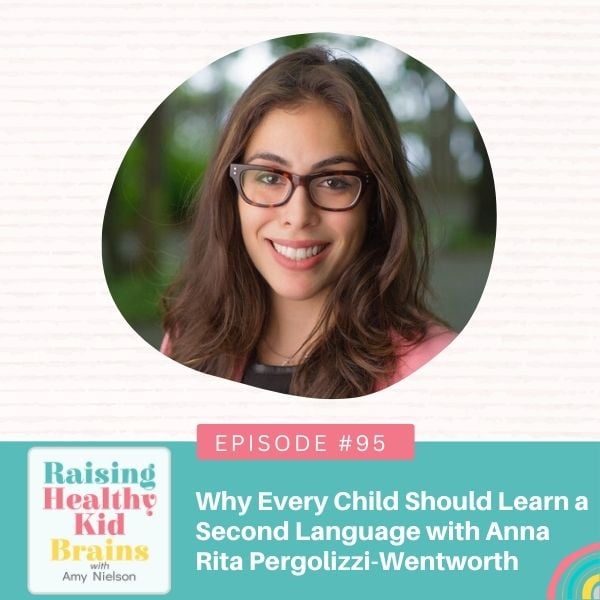
Ep #95: Why Every Child Should Learn a Second Language with Anna Rita Pergolizzi-Wentworth
Have you ever wondered if learning a second language is just a “bonus” activity for overachieving kids and parents? I know I used to think that way. But it turns out, learning multiple languages has tremendous benefits for children’s brain development, especially when started at an early age.
Anna Rita is the Regional Managing Director of Green Ivy International School and Interim Head of School at Pine Street School. As an expert in multilingual education, we explore the incredible power of learning languages in childhood. Anna Rita shares why the ages of 0-6 are a critical window for language acquisition, how bilingualism enhances executive function and cultural understanding, and the long-term cognitive benefits of speaking multiple languages.
Whether you’re considering language immersion school, learning a heritage language at home, or simply want to give your child’s brain a boost, this episode will open your eyes to the world of possibilities in multilingual learning. Get ready to be inspired to help your child become a global citizen!
To thank you for being a listener here, we made you a special freebie. It’s an amazing alphabet activity you can begin using with your kiddos that is so fun, so get started by clicking here to grab it!
What You’ll Learn:
Why ages 0-6 are the optimal time for children to learn new languages.
How early language exposure takes advantage of a child’s brain plasticity and prevents “pruning” of language abilities.
The concept of “toggling” between languages and how it enhances executive function skills.
Why bilingual kids have an easier time picking up additional languages later in life.
How learning languages builds confidence, cultural understanding, and global mindedness.
Simple ways to expose kids to new languages, from changing the TV language to exploring cultural centers in your community.
The spectrum of language programs available and how to determine your goals as a parent or educator.
Teaching your preschooler or earlier, another language sounds amazing and ideal. And yet, is it practical, right? Unless they’re going to be really speaking that language as an adult, is it helpful? My guest today is Anna Rita, and she had the most amazing information for us on how learning another language helps children build skills that go across so many different things in their lives.
She talked about the concept of toggling and switching between languages is actually something that applies to so many different ways of communication, of different parts of education and different ways of using our brain. She also talked about the impact this has on children being more culturally aware and able to work well in a global environment as we’re becoming increasingly global as a world.
And then another piece we talked about that I found so interesting and valuable is the grit, right? And the confidence that children get from accomplishing a skill like that is applicable, of course, in every other part of their lives. It was an amazing conversation. Anna Rita is regional managing director of Green Ivy International School.
She’s the interim head of school at Pine Street School, which offers international baccalaureate programs. And dual language immersion in both Mandarin and Spanish. She is very knowledgeable, speaks multiple languages herself, has her children in these programs, and it was fascinating to talk to. I hope you enjoy the conversation.
It’s coming up right after this.
Welcome to the Raising Healthy Kid Brains podcast, where moms and teachers come to learn all about kids’ brains, how they work, how they learn, how they grow, and simple tips and tricks for raising the most resilient, kind, smart, compassionate kids we can. All while having lots of grace and compassion for ourselves, because, you know what? We all really need and deserve that, too. I am your host, Amy Nielson, let’s get ready to start the show.
Amy: Anna Rita welcome to the show. I’m so happy to have you here today.
Anna: Thank you. Thanks for having me. It’s a pleasure being here. Thanks for thinking of us.
Amy: Oh, of course. I’m excited about this conversation because we’re going to be talking about second languages and children. And I think I kind of have always thought like this is kind of like one of those like bonus things for like people who just you know like are really trying to be extra and do something extra or whatever. But I feel like I want to know more because oddly enough I grew up in Homer my mom was always trying to learn Spanish. She’d spent a couple months in Mexico and so she was always trying to talk to everyone. And so I kind of was raised trying to learn a second language from that perspective.
But I want to know, why does this matter for everyone? Why is this important? And when do we start? And all those things.
Anna: Yeah. Sure. Where do I start? There’s so much to share just with that alone. But honestly, any time is good to start. But I would say the ultimate or the best time is really when a child is between the age of zero to six years old.
That’s largely because their brains are just absorbing everything around them and particularly language and how language is formed. That’s when it’s all really happening to magic, if you will, relative to the rest of someone’s life. It’s not to say you can’t learn a language later on, but it’s going to depend largely on someone’s intrinsic motivation to want to learn that language, similar to your mom’s, right? Like she, there’s probably some reason that she really wanted to do that. And so that propelled her to do so.
Whereas when you’re doing this from zero to six, it’s sort of is what is right, they don’t necessarily know any differently. And they just assume that that’s what everybody does, because that’s what they hear around them. So that’s just one thought behind why it’s a good time to start between those ages.
Amy: So interesting. Okay, I’ve heard something, and I’m just gonna like fact check it with you because I thought this was interesting. But someone told me too that it’s sometimes harder to hear sounds because we have different sounds in different languages and that it is harder to actually hear those sounds. Sometimes if there’s like very different vowels or very different things in a different language, it’s harder to hear those if you’re waiting until later than if you start when you’re young. Is that true?
Am I just making things up?
Anna: That’s absolutely true. There are a number of studies on this, you know back in the day we fit it necessarily, Poker Prod children’s brains in the way that we can do so now and in a non-invasive way and essentially because of the dawn of certain technologies we can actually see how the brain sort of lights up when there are certain sounds that the child hears, particularly again, between the ages of zero to six, they’re going to hear it differently. And we could see that from the way the brain sort of lights up relative to how they’ll hear it later on in their lives.
And so there have been many studies that basically show that children are somewhat wired to come into the world to hear all the sounds of the world. And if they use those sounds, then pathways are essentially being created for them to continue using those sounds.
And if they don’t hear those sounds, if they’re in an environment where they don’t necessarily hear that, it gets pruned away. And so that’s very telling, right? Obviously there are too many neurons in a brain when a child is born, there has to be natural pruning that occurs. Otherwise, there are no pathways or room for pathways to be created. But you know, there are some that we want to keep.
And that large part can be those sounds. And it’s a really that’s why you know, if you start usually before in this timeframe, there’s less likelihood of an accent later on in life. And that’s because you basically have been captured in that window. So it’s, yeah, so you’re correct.
Amy: That’s so fascinating. And it makes so much sense because that is, that’s the age of pruning we start, you know, we build all these connections, so many connections. Then we’re like, oh, a lot. We can start… Let’s Marie Kondo our brains a little bit, right?
Yes. We’re going to tone it down a little bit so we can focus here, right?
Anna: What brings me joy, right?
Amy: What brings me joy. I really, really need it. Kids are like, I hate math. Let’s get rid of that one. So I love that.
I think that’s so interesting because I kind of like languages, right? So just a little tidbit about me, right? I did Spanish with my mom a little bit growing up and then my niece has got me into Korean, so I started learning some Korean. And that’s fascinating because it’s an alphabet-based language, but it looks totally different. It sounds – they have different vowels.
And I’m like, oh, they sound the same, but they’re not the same. I’m trying to hear – and it’s just tricky. So I think, my gosh, why didn’t I hear this when I was five? Anyway.
Anna: Yeah. Yeah. And that’s, you know, since I have two children, I know we talked a little bit about kids before this started, but I have two boys and I was very lucky. I grew up in a household. My mom is from Honduras. My father is from Italy. And I didn’t learn English until I was in kindergarten. And obviously my schooling then continued in English, and obviously went to college in English, etc. But it definitely planted the seed for loving language.
And I definitely, like looking back, you know, I ended up majoring in Russian when I was in college and I think a lot of that has to do with what I was introduced to as a young child or this like belief that I can learn another language but also the accent is very similar Spanish to Russian, believe it or not, there are some similarities in that. And so it made it very helpful. But I do know that it was also very challenging, because it’s not an alphabet similar to what you will find in English, Spanish or in Italian. And I’m like, wow, I wish I learned this a little bit sooner and what impression would have that left behind for me had I learned the Cyrillic language earlier rather than later.
And so flash forward when I’m obviously a mom now, I’ve got these two boys. And I remember when I was choosing, you know, my children go to the school where I work, which is Pine Street School. And I remember when I was choosing, you know, my children go to the school where I work, which is Pine Street School. And I remember when I was choosing for my older son, who’s now 12, where he would go to school, the principal at the time was like, well, I’m assuming you probably want to do Spanish because we offer Spanish, we offer Mandarin. And I actually said, no, I want to do Mandarin. And the reason is because talk about imprinting before he turned six, right? Like being able to learn characters from such a young age. I’ve even seen with my own child, and to a certain extent, he’s a guinea pig, right, for a lot of the work that I do in terms of languages as well.
But I have seen how comfortable he has grown with character-based language, simply because he learned it or he had access to it right before that sort of “make-believe cutoff” let’s say, right? Or at least what research has shown is the cutoff. Yeah, that’s one of those things that, you know, when I’m lying in my pillow, when I’m however old I am, I’m going to be like, thank goodness I did that for him then versus later because who knows if he would even want to learn the Mandarin language at that point he had no choice.
Amy: Exactly, right? That is, I have some junior high kids. I know that story. Right? Okay.
So the thing that happens in my brain, and I’m guessing I’m not the only one then, is like as moms, we’re like, you know, or parents, wherever we are. And we’re like, oh my goodness, I have to expose my children to all the languages. Ah, panic, right? Which I don’t think is healthy. So let me just go from here. Another thing growing up, and my family moved constantly, so we moved all over the place.
But in one place I lived, we had this amazing neighbor who lived all over the world and spoke eight languages. And he was just this fascinating man. And he would tell me that when you learned a language, then it just became easier to learn more languages. So do you agree with that? And then is there a benefit then to saying, okay, parents, we don’t have to just turn on tapes of all the languages every night and make sure your child has exposure to every possible language so they don’t miss out on anything later in the future, but is giving them exposure to one extra language going to have a benefit through the rest of their life in being able to potentially learn other languages or more languages or things like that?
Anna: Yeah, I believe so. I think there’s, again, lots of research on sort of the executive function processing that’s happening when you’re learning another language. You know, you’re constantly having to switch, right? Recognizing, okay, with this person, I’m speaking in this one language, with this other person, I’m speaking in another language. There’s obviously cultural nuances involved in all of that.
And so that constant sort of mental game that a child or whoever’s learning another language is playing, it’s sort of, I call it, and I’m sure maybe this isn’t really in line with how the brain works, but I view it as though you’re forming columns. And the ability to toggle the columns back and forth, just that ability of the toggling helps you establish the other column a little easier.
And so that’s why it’s not uncommon for people that do know two languages to later on be able to pick up a third because a few things have already been established, the toggling mechanism to begin with, but also this really deep understanding that you can say phone in multiple ways. This deep understanding that culturally there might be a reason why in one place there’s like 20 words for snow or something like that, whereas in another place there’s maybe just one. And just going into language learning with that helps pick up the others throughout the course of one lifetime, of course, if there’s interest to do so, because I think that’s also important.
And this is if one is interested in learning the language or a new language. So yeah, I fully agree with that. It’s so fascinating.
Amy: I was doing preschool and I had a kid, this adorable little girl, three years old, and her parents were both hard of hearing, legally deaf, right, and had hearing aids. They would sign with her all the time. But then I noticed this adorable little three-year-old, right, just kind of at the beginning of her language journey, right? And she would be in my home and I would watch her switch based on who she was talking to to go from signing to speaking. And I just would watch her and she had already learned to navigate so much of that.
I met her grandparents one time and how she communicated. It was just like amazing that this little three-year-old had the ability to just understand how to speak to whoever she was talking to. And it was fascinating.
Anna: It is. You know, a lot of the parents that come in sometimes, they’ll say to us, so we obviously we have Mandarin, we have Spanish, obviously English, but a lot of families are like, oh, my child speaks none of those languages, or they speak two, like one family came to us, child spoke Arabic and French, and they were like, is my child going to be okay? Are they going to be able to learn also other languages on top of that? And what we have found over the years is that the children that come to us already wired as bilingual or multilingual speakers, even if they are not speaking Spanish or Mandarin, which are target languages, even if they are not speaking those, they’re actually the ones that pick it up the quickest. And it’s because the goal for a monolingual speaker, let’s say they’re coming to us with just English, the goal for them is to develop that pathway of toggling.
Whereas those children already came to us with that. So their next step is just like I mentioned before, again, I don’t know how rooted in science this is. I will probably write a dissertation around this at one point, but it’s like, they’re establishing their other column, you know, and it’s a very different pathway that’s being created, but the hardest part has already been done. And it’s been done essentially from birth. It’s hard perhaps for everybody else, but for that child, again, it goes back to what it is.
They don’t know any differently. And it was tapping into, it just happens to be like tapping right into when all those sounds were easily absorbed for that child’s life. So it’s fascinating. That’s why I’m jealous of the people that had access to those eight languages, but for those families that are, like you said, I don’t want any family to feel like, oh, I’ve missed a boat or this, that, and the other. That’s not what it’s about.
If you give your child the gift of one and however you give that gift, whether it’s through songs, whether it’s through school, whether it’s exposure, you know, it just overall, I think it leads to global competency in some way.
Amy: It’s so fascinating. And I wanted to ask you this question too, like, what are some of the benefits, right, of having this other language? But I think it is so interesting. I felt like I learned English better or understood English better, which is my first language, right? By learning some Spanish because the grammar rules are different and you have to understand the differences in grammar to take on a different…
Or you mess up more, right? And then I bring in Korean. Korean has completely different grammar rules, right? And now I’m looking at all these pieces and you’re learning the different pieces of language. And it almost, I think, really enriches your own language as you’re trying to like kind of see the different words and how they work.
And it just gives you nuance and flavor and things to your own language and you understand it better. So I find that fascinating, but I want to know what other benefits, like why? Why should we do this? Why should this, you know, in all the things that we’re thinking about and doing, why is this a priority? If we’re not 100% sure our kid was really going to want to speak Chinese when they’re 20 or something like that, does it benefit them in other ways?
And what would that be?
Anna: Well, I think, like I mentioned before, just global mindedness, especially now. I mean, it’s always been important, but now more than ever, I think it’s very important to really understand where other people are coming from. I think when you learn another language, it forces you to your point to really understand how a language was even developed and what’s important for those cultures that influence the language within itself. And so that’s one piece. It’s sort of like a window, right? The other parts of the world.
And then from a neurological standpoint, I mean, it’s building reserves for either continuing with the language or for something else. So there’s lots, again, research around cognitive decline and how knowing more than language, obviously, if you have a genetic predisposition for Alzheimer’s or dementia, it’s not that it’s gonna go away, but it can definitely delay the onset of that, which is pretty fascinating, right? Like you’re building reserves for something else by just utilizing the brain and taking advantage of these sounds in your lifetime. So that’s one aspect of it.
I think the other is, you know, really supporting the understanding of other content. I think there is a confidence that’s built when you are forced to learn another, or not, I don’t want to say forced, but when you are learning another language, like one of the things I’m telling my 12 year old now, whenever he says something’s difficult, I’m like, dude, you’re learning Mandarin. None of us in the household speak it. You are figuring that out. Building number one is independence. And it’s building that confidence to basically say, hey, you figured that out. You know, mom and dad couldn’t help you because we don’t have that language in our skillset, you know, but you are figuring that all on your own.
So now when there is a challenge in algebra or wherever, whatever challenges are gonna come up in a schooling, and frankly, even in life, it’s like you were able to navigate that. And so therefore, try to use that pattern, that problem-solving pattern, and use it in something else. So I think global mindedness is one. Obviously, building reserves for other things that hopefully it’s not a neurological decline, but if it is, then it’s going to help with that as well. But also that confidence and that independence I think is something that is notable in why one should pursue languages. Yeah.
Amy: I love that so much. Okay. I just like want to go back and hit on a couple of things you said because they’re like making me happy inside. So what is this idea of the toggling? And I’m thinking, can that skill like apply in other things, right? Like that, like learning that system of switching between when we’re trying to teach kids how to manage all of the stuff that’s going on these days and like being able to switch between work and family and all these things, you know. And there’s so many instances where I feel like we have to toggle. Maybe it’s even just going from math to, oh my goodness, they told me I now have to go into writing. And you’re like, oh, okay, I have to toggle, right? That skill, if that’s something that’s transferable, is invaluable. That’s something massive.
And also maybe even in communication, right? When we’re talking to someone, we’re moms, right? We’re talking to one kid and then you might have to change how you’re talking a little bit if you’re talking to the next kid, because they’re at a different stage of development, whatever, like we’re toggling all the time. And so that skill is amazing.
And then the other piece that you talked about, I’ve just been having the same conversation with my almost 10 year old, and she wants to go do rim to rim, like the Grand Canyon, it’s like 25 miles, it’s a mile in elevation change. So you go like down a mile and you walk and then you come back up. It’s brutal. And I did it a year ago. My almost 10-year-old wants to do it with me. And so we hike a lot. We were practicing hiking and it was getting hard. And we started talking about why do people do hard things? Life is already hard. Like, why do you do hard things? Like, that’s crazy. And then I said, but here’s the thing. Confidence comes after competence a lot of the time. And every like hard thing you challenge yourself to do and then you do it, even the ones that we pick ourselves, give us a little bit more confidence in our ability to do hard things.
And then when the hard things come that we did not plan on or choose for ourselves, we’re like, okay, I’ve done this before. I’ve done so many hard things. I can do this one too. And that is like, I think one of the greatest gifts we can give a child is that confidence in themselves to be able to do whatever comes their way.
Anna: Absolutely, yeah, absolutely. I couldn’t agree more. And I think to your point, whether we’re imposing it on them or not, or they’re choosing it, recognizing that things are hard. You know, you need that practice in getting through things that are hard so that when you are faced with other adversities in your own lifetime, you have some problem solving skills or strategies in your tool belt. And so with language learning, that’s definitely one way to do it, right? Is to give them that practice for sure.
Amy: I love it. Okay, let’s talk some practical things now because the idea of it sounds really good, then real life happens, right? So how do we actually do it? Like maybe we can break it down and talk tips for parents and then maybe tips for teachers. Like what is a way that we can do this at wherever we’re at to have an influence with children to give them a little bit of exposure to this?
Anna: Yeah, that’s a great question. You know, obviously there are schools dedicated to this and then there are families that are like, well, I don’t necessarily know if I want to invest in that or I want to try something else. I get it. Like there’s a broad spectrum of possibilities out there and more children you have, the more important permutations you can have.
Amy: Right, we talked about that a little bit.
Anna: I get it. There’s lots involved with that. But I think one of the really important things or one of the gifts that we can give to children. In line with languages, children are born sort of really comfortable with obviously their family, right, and they grow more and more in comfort with them as the years go on, so much so that they end up liking or being attracted to people that look like their parents and people that sound like their parents. So look like their parents, sound like their parents.
And I think if families are a bit more aware of that, really thinking through like, okay, what do I expose my childhood and who do I expose my childhood and the relationship around who it is that they’re exposing them to. I think from a language perspective, from a diversity perspective, from so many things, the goal for a family is for their child to be more globally minded. I think it’s not just about language. I also think it’s exposure to all kinds of people. And that starts before six years old.
So that’s one. And so with that being said, or with that in mind, and that is something that’s really important to a family. I think it’s finding linguistic opportunities. You know, not everybody perhaps travel, but there are places even within their community where there are these language hubs. And if those don’t exist in the community, you know, finding music, you know, something as simple as putting the TV on and changing the language of the cartoon.
You know, and I’m not a person that believes necessarily in television, but let’s be honest, you know, before six years old as a parent, sometimes a babysitter is the screen. And if you are going to do that, think about the quality of that screen time and what you can do to perhaps trigger the mind to think in a different way. And so things as simplistic as changing the language, singing songs or finding those songs, you know, exposing them to different parts of their community. If there is access to those languages, I think that’s huge. Just that little bit can help perhaps not in being fluent in the language, but at least this understanding of like, wow, there’s like different ways to see the world.
You know, there’s different ways to say things and that within itself is very powerful.
Amy: Yes, I think too. And this kind of goes back to my research around curiosity, right? But in order for a child to be curious, which I believe is what leads to that really good learning. Right? We have to get them started somewhere, right? But the curiosity that really leads to them self-directing it, going deep and wide and getting really into something, they have to be aware of their gap. They have to have a knowledge gap. They have to be aware of that gap.
So if they just only ever hear English or whatever your native language is, and they’re never exposed to anything else, they don’t realize there’s anything else to be curious about. And so to your point, the more that we give them exposure. And sometimes I think you can do that with storybooks in the library. I like to go get fairy tales, even from other cultures or different things that maybe isn’t even another language yet, but helping them see like, oh my goodness, this is kind of fascinating. That looks similar, right? Like it’s so close, but also different than ours. That gets interesting.
Then we do foods. It’s kind of fun to do foods from different cultures. That’s such an easy one. I think, especially if the kids get to help cook it or music. I love the idea of music. Yeah, sometimes you need to shower and you know, if you can turn on PBS kids in another language or something, you know what I mean? But yeah, so I love that idea.
But I think just giving them that curiosity and I will always be grateful to my mom because her excitement about Spanish, I mean, it was just, you could just see it, right? She would just try to speak to anyone who she thought looked like they might speak Spanish, whether they did or not, or wanted to speak it or not. But they loved her because she was really nice, so it worked.
But I was like, I just grew up loving that and wanting to be able to talk to everyone. And now I’m like, if anyone’s speaking a different language, I want to know that one because I want to be able to talk to you in the way that you speak. And anyway, so I feel like that was a gift. She gave me her excitement around it, and then building that curiosity like we talked about. Okay. So what could that look like in a classroom setting? Is there a way we could do that there?
Anna: I think, you know, I’ve worked with a number of schools that are either considering, you know, adding a language or they already have the languages in place and they either want to do more or less with them. I think the big conversation there starts with what is the vision for the school, right? Meaning, what are the goals for the languages? And it’s perfectly fine if a school is like, you know, we just want light exposure and we want two times a week, 45 minutes. Like, fine, that’s their goal, right? They might have other goals in place, other priorities, and so that’s important to them, but perhaps not as important as some other things and that’s perfectly acceptable.
And then there are the schools that are like, no, we want our children to be conversationally bilingual, or we want them to be conversational bilingual or academically bilingual and literate in their target language. And so it’s really starting from there and then working backwards to be like, okay, what do we need to put in place so that the children get to that point?
And so therefore it is in large part going to look very different in the classrooms, you know, depending on what those goals are. And it can, again, start at the level of like music and building that excitement towards the language and hopefully building or piquing the child’s interest in wanting to continue it some more outside of perhaps two 45-minute sessions a week, or it’s the approach of like, you’re going head first, everything in here is going to be in the target language, you know, or you’re finding sort of like this in-between, Right?
And so I think one of the things we do use just on a, again, more at a professional personal level based off of where I am, you know, at Pine Street School and formerly at Battery Park Montessori, which, you know, their sister schools under Green Ivy, we use the one parent, one language theory. And so essentially what that means is that each teacher remains in their native tongue throughout the course of the day or throughout the time that they are teaching the children. Of course, you know, perhaps going into English where they really see that a child is struggling in terms of understanding the content.
But what that helps the child with is understanding, again, sort of like column creation or toggling creation. You know, with this person I speak to that person in English and with that person I speak to that person, you know, in Mandarin or in Spanish, whatever target language that they have that they’re in. And so that helps with establishing that toggling control.
And then, you know, another thing that we do is, I mean, we talk a lot about what the goals are and we’re constantly reevaluating, like, what is it that we want out of this? And so, yeah, there are a number of ways to do this in the classroom, starting superficially with music, but that again can be very powerful because it peaks the interest, all the way to full immersion or something similar to what we do, which is we start dual immersion in the younger grades, and then from kindergarten and up, we move to 90 minutes a day. And we do not only the learning of the language for the sake of learning the language, but we’re learning it through our units of inquiry, which is essential to an international baccalaureate curriculum, which is the type of school that we are. So there’s, again, a number of approaches to this.
Amy: Amazing. Okay. We are almost out of time and I want you to have a chance to talk a little bit more about your school and what you do because I think it’s so beautiful and fascinating. So can you give us like a little bit of information about that and then let us know where parents could get more information if they wanted to choose that option for their children?
Anna: So I am currently the interim head of school at Pine Street School, and it is, as I mentioned, one of the Green Ivy schools. Our sister school is Battery Park, Montessori. And I have been with these two schools directly or indirectly now for eight years. I actually started off as Battery Park Montessori’s head of school where I was tasked along with a team of educators at that time to make it the first trilingual Montessori school in New York City. And so we probably have that honor now.
And that meant that our children came to us and they had one Spanish speaking, one English speaking, one Mandarin speaking teacher, and they heard it nonstop or they hear it nonstop every day until they’re about five years old. And then, yeah, so that was a joy, again, an honor to work with Battery Park Montessori. And then I moved recently to Pine Street School and has a very similar model in the younger grades in our preschool. So in the ones and the twos, we’re fully trilingual. We’re taking advantage of where they are neurologically speaking, right?
They can handle all three at once. And then when they get to the threes and the fours, they do dual immersion. So they have one Spanish speaking, one English speaking teacher, or they have one Mandarin speaking, one English speaking teacher. And then from kindergarten all the way through the middle school, we have 90 minute block. And so children basically from kindergarten all the way throughout, they will have that 90 minute in their target language.
And again, it’s not only learning the language for the sake of learning the language, but also learning through the units of inquiry. So they’re applying that knowledge in real life through context. So yeah.
Amy: I love that so much. That sounds amazing. And I’m thinking, I don’t have that in my neighborhood, but that’s so cool.
Anna: Yeah. New York City, you know, we obviously there’s lots of different opportunities.
Amy: But there are opportunities everywhere. So if you’re in New York City, then that is an option to look into for sure. And if not, then look and see what else is available because I love how many options we have now available for kids. It’s kind of amazing. And there are some dual immersion options in my area.
You have to drive to another school often, but you can learn Chinese or you can learn Spanish or there are different options available, which is amazing. And then there are also things, like we said, that you can just start at home and just start from there. And like those little tiny things can make a big difference over time and it might give you room to kind of move as you decide you want to do more, which is exciting.
Anna: Yeah, it is. And there’s like to your point, I mean, there’s tutoring programs too. There are a lot. There’s even, you know, online versions of lots of virtual tutoring too. There are definitely opportunities around.
It’s just a matter of doing some research, asking around, going to those parent groups that probably exist, going to your channel. There are lots of ways to do this if that’s what a family really wants to do.
Amy: I love it so much. Amazing. All right. Well, we are out of time. Is there anything else I should have asked you that I missed or any last message you want to leave with our listeners today?
Anna: I think no. I think this is great.
Amy: That’s so good. I love it. That’s like winning when we got it. I’m like, that’s awesome. It has been so much fun to talk with you and thank you for coming and sharing your wisdom with us and inspiring us a little bit.
It’s fun to get to be inspired and think, ah, like, you know, aspirational. This sounds like a really cool thing to do. So thank you for bringing it to our attention and giving us ideas.
Anna: Perfect. Thank you so much for having me and thanks to all the listeners out there. And of course, if they ever have any questions, I know I’m putting this out there probably to lots of people, but feel free to reach out. Always love helping families wherever they are.
Amy: I love that. That’s so kind. All right, and we will have links for that in the show notes so you can find that easily. So thank you so much. And we will catch you guys on our next episode here at Raising Healthy Kid Brains.
Don’t you just love all the fun things we’re learning on this show together? Well, we wanted to give you a chance to practice a little bit of it at home. And so we made you a special freebie just for being a listener here. You can grab it at PlanningPlaytime.com/special-freebie.
So what this freebie is, I’ll tell you, is an amazing alphabet activity that you can start using with your kiddos. And it is based in play and is so fun. You can use dot markers with it. You can use Q-tip painting. You could use circled cereal.There’s all kinds of options. You can print it out today and get started. Just head over to PlanningPlaytime.com/special-freebie, and we’ll send that to you right away.
Thank you for hanging out with me today for this fun chat on Raising Healthy Kid Brains. If you want to see more of what we’re doing to support kiddos and their amazing brains, come visit us on our website PlanningPlaytime.com. See you next week.
Enjoy the Show?
Don’t miss an episode! Follow the podcast on Apple Podcasts, Spotify or anywhere else you get your podcasts.
We use cookies on our website to give you the most relevant experience by remembering your preferences and repeat visits. By clicking “Accept All”, you consent to the use of ALL the cookies. However, you may visit "Cookie Settings" to provide a controlled consent.View Terms and Conditions
This website uses cookies to improve your experience while you navigate through the website. Out of these, the cookies that are categorized as necessary are stored on your browser as they are essential for the working of basic functionalities of the website. We also use third-party cookies that help us analyze and understand how you use this website. These cookies will be stored in your browser only with your consent. You also have the option to opt-out of these cookies. But opting out of some of these cookies may affect your browsing experience.
Necessary cookies are absolutely essential for the website to function properly. These cookies ensure basic functionalities and security features of the website, anonymously.
Cookie
Duration
Description
cookielawinfo-checkbox-analytics
11 months
This cookie is set by GDPR Cookie Consent plugin. The cookie is used to store the user consent for the cookies in the category "Analytics".
cookielawinfo-checkbox-functional
11 months
The cookie is set by GDPR cookie consent to record the user consent for the cookies in the category "Functional".
cookielawinfo-checkbox-necessary
11 months
This cookie is set by GDPR Cookie Consent plugin. The cookies is used to store the user consent for the cookies in the category "Necessary".
cookielawinfo-checkbox-others
11 months
This cookie is set by GDPR Cookie Consent plugin. The cookie is used to store the user consent for the cookies in the category "Other.
cookielawinfo-checkbox-performance
11 months
This cookie is set by GDPR Cookie Consent plugin. The cookie is used to store the user consent for the cookies in the category "Performance".
viewed_cookie_policy
11 months
The cookie is set by the GDPR Cookie Consent plugin and is used to store whether or not user has consented to the use of cookies. It does not store any personal data.
Functional cookies help to perform certain functionalities like sharing the content of the website on social media platforms, collect feedbacks, and other third-party features.
Performance cookies are used to understand and analyze the key performance indexes of the website which helps in delivering a better user experience for the visitors.
Analytical cookies are used to understand how visitors interact with the website. These cookies help provide information on metrics the number of visitors, bounce rate, traffic source, etc.
Advertisement cookies are used to provide visitors with relevant ads and marketing campaigns. These cookies track visitors across websites and collect information to provide customized ads.