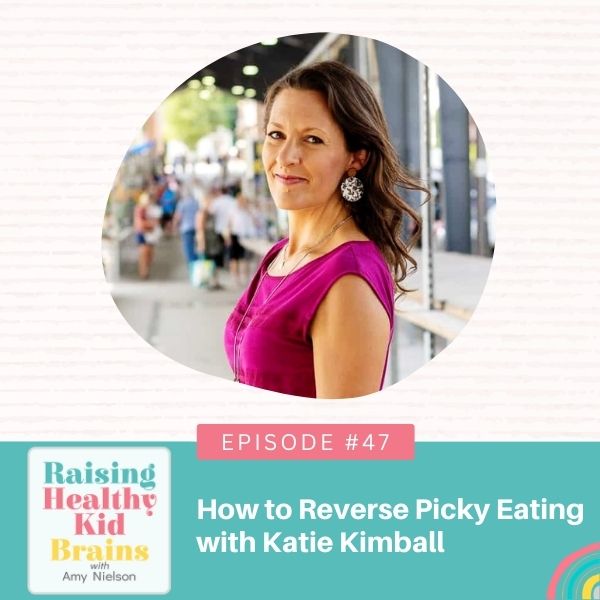
Is your child a picky eater? As the parents of picky eaters, what can we do to make sure our kids grow up enjoying a healthy relationship with food? To help answer these questions, I’m bringing you a conversation with Katie Kimball, the creator of Kids Cook Real Food and a trusted authority and advocate for children’s health.
Katie Kimball is a former teacher, a two-time TEDx speaker, a writer, and a mother of four kids. Her Kids Cook Real Food course is recommended by the Wall Street Journal as the best online cooking class for kids, and she’s full of amazing tips and insightful advice for parenting picky eaters.
Tune in this week to discover how to tell if your kids are picky eaters. We’re discussing why it seems like picky eaters are increasingly common, how to stop your toddlers from becoming picky eaters, some basic steps parents can take to start reversing picky eating habits, and some general tips on how to assist your children in building a healthy relationship with food.
To thank you for being a listener here, we made you a special freebie. It’s an amazing alphabet activity you can begin using with your kiddos that is so fun, so get started by clicking here to grab it!
She speaks at conferences and summits and is on podcasts and is a trusted authority and advocate for children’s health. And today we’re so fortunate to have her here. We cover topics like why do we have so many picky eaters today and what are some ways you can tell if your kids are picky eaters? What are some basic steps that parents can take to maybe start reversing picky eating habits? What are some maybe steps that we can do to prevent kids from becoming picky eaters in the first place? And those start when they’re toddlers and preschoolers.
We talked about Katie’s feelings about the clean plate club as she calls it, which I think a lot of us grew up in. And it was just a fun conversation about how to help your children develop a healthy relationship with food. I think you’ll enjoy it. It’s coming up right after this.
Welcome to the Raising Healthy Kid Brains podcast where moms and teachers come to learn all about kids’ brains, how they work, how they learn, how they grow and simple tips and tricks for raising the most resilient, kind, smart, compassionate kids we can. All while having lots of grace and compassion for ourselves because you know what? We all really need and deserve that too. I am your host, Amy Nielson. Let’s get ready to start the show.
Amy: Katie Kimball, welcome to the show. We are so happy to have you on today.
Katie: Thank you, Amy. I am so glad to talk to preschool parents. This is just a critical time for our subject today.
Amy: I know I’m so excited. And I think probably almost every parent, every teacher, everyone that has worked with kids has had this come up and had to think about this before. So today we are talking about picky eating and you have some ideas for us. And we’re going to chat all about it. I am so excited. So why, can we just start with why, why are there so many picky eaters? Let’s talk about this. What is going on?
Katie: I love that you work with preschoolers. And you’re like, why? Why? Why? Because that’s just you embody the preschoolers so, well, Amy, bravo. Amy: Thank you.
Katie: Let us be curious like a three-year old. So I do, I have some personal theories on why picky eating feels and probably is for real so much more rampant now than decades ago when we were kids. And part of it is our culture. Our culture of easy convenience food aimed at kids makes it really, really easy to short order cook. And although the short order cooking is not the cause of picky eating, it can definitely proliferate it, and kind of keep it going. So I think our culture is sending the wrong message to parents. They give kids’ food they like, make it fun, make it easy.
Don’t have high expectations about anything. And here is some food in the freezer section you can purchase from us to make that happen. Parents are just shackled by that. And so, no guilt, no shame. This is not your fault. You have to work really hard to fight against that. But I think the culture is running a disservice to parents in that way. I think there are also some physiological and environmental factors. We know that our kids are bombarded from the moment they’re conceived with toxins.
Studies show that, I mean, I can’t even think of the number, it’s over 200 chemicals are in umbilical cord blood. And so we have a lot more, our children have a lot more coming at them physically in their environment in the food we eat, the air we breathe, the water we drink. And what that can do is sort of overload the system. So I think we have a lot more kids who are highly sensitive children who have auditory sensitivities or texture or taste or visual sensitivities. And that all plays into how we interact with our food. And so I think that’s definitely a piece.
Very related to that is another physiological root cause. We know just by observation that there are more food allergies and sensitivities in our kids. And so for some kids, they might be experiencing a constant low level of pain if those allergies or sensitivities are undiagnosed as of yet. And especially with preschoolers, you just might not have discovered it yet. So imagine you’re eating gluten or dairy or something that bothers your system every day. The child just thinks that this is how they feel. But there’s something in them that sort of revolts against food is what happens.
They present like a picky eater, but they’re really just in pain. So that’s number three. And then the fourth one is, I think we do have a little bit more of that helicopter parenting going on. And again, this is kind of just the culture. We’re told that our kids are unsafe and we need to protect them and in that valid sense of protection, sometimes we misguide that and end up choosing to, again, feed our kids those easy foods to really hover, to worry so much about their eating.
And that worry can inflame the stress at the table and it just kind of snowballs into picky eating. So those are my four theories on why picky eating is more rampant, but none of them are insurmountable. That’s the important part.
Amy: So I get really curious. I love those answers. I think so many of them are so relevant. The idea that came into my brain when you were talking about our short order cooking was my kids call them dino nuggies, the dinosaur chicken nuggets which I essentially never buy, but my kids think they’re so fun. It’s the biggest treat ever if they get those. But they do and they’re so easy and they’re so simple. And they’re made so kid friendly and they’re just so attractive and all of those things. and it looks different than when you actually go and cook together and make something that is more like real food.
But also I think the food sensitivities was such an interesting one you brought up because I have had food sensitivity issues and yeah, it hurt my stomach. And it took me the longest time to actually figure out what was hurting my stomach, but that could be a real issue and then I get into the space of well, how do you know if it’s just that they need more experience and exposure to foods, or if it’s actually hurting them? And then it gets a little bit tricky there.
Katie: Yeah, it’s always kind of a both and proposition with our kids. We really need to set up a good environment, a positive environment for them to interact with food. And we’ll talk about that in the rest of this podcast. But I always tell parents, “Keep that detective hat on, once now that you have this little information in your folder in your brain you can go, “When my kids are reacting and responding to food. What if it’s not the food? What if it’s their body?” Just that little nugget of knowledge, dino nugget of knowledge is so important for parents to just be watching and be observing.
I know in our family I had two of my kids take a month off of dairy because I just had some theories. And for one of them it didn’t make any difference. For the other she’s been dairy free for five years because when she’d had yogurt that first time, she realized that oh my goodness, not everyone actually breathes this hard after gym class. It’s just me with dairy. And she had no idea it was just she thought that was her life and that was normal for people, this shortness of breath. So sometimes it’s just trying experiments like the whole family is going to try a week without dairy, a week without gluten and just see what happens.
Amy: And I love the way you did that because that sounded fun. And you could turn it into some kind of fun adventure challenge you’re doing instead of it being well, this person can’t have blah, blah, blah. Where it’s kind of more of a punishment as opposed to maybe an experiment or adventure. I love that. That’s so fun. So what are some basic steps that we could take towards beginning to reverse if we’re struggling with some of this, maybe a picky eater and we’re not sure exactly what that might look like, what are some steps we could start with?
Katie: Well, especially because we’re talking to parents of preschoolers I’ve got to give you a mindset tip that I don’t always, I don’t always start with this. But it’s so important because when kids turn about two, between the ages of two and three, you know this, Amy. Developmentally, their job in life is to test their boundaries and figure out where the boundaries actually sit.
Amy: Yes.
Katie: Yeah. So at the dinner table that looks like they have gone crazy. Parents tell me all the time, “My child was such a good eater, Katie, they ate everything. I made my own baby food. And then they turned two and they became picky. They stopped liking things they used to like.” It is the most common story I hear. And the trouble is, is the definition’s wrong. They’re not becoming picky. They’re just testing. They’re just testing, what if I say, “I don’t like this”, today? Oh, my goodness, I got dino nuggets, dang, but I learned something.
So what we need to do is run under the assumption that your two, three and four year old is not actually a picky eater. They’re just a very smart child doing their job. And your job as the parent is to continue serving variety. That’s really, really, really critical. In our Kids Eat Real Food system we start with snacks. So that is the first actionable tip. First tip is mindset. Second tip is to start with snacks because this is not a problem for everyone but sometimes it’s a game changer. Here in America, we tend to over-snack. Again, this is our culture, it’s everywhere.
And sometimes those snacks can really sabotage dinner. So what I tell parents is, “Create at least a 90 minute buffer, if not two hours between every eating opportunity.” So between breakfast and your first snack, hopefully that works with the preschooler daycare center. You want 90 minutes between snack and lunch, at least 90 minutes, preferably two hours, and so on and so forth. And we want to watch the content of the snacks. I am not going to judge what you give your kids. We’re talking about how full they’re getting. So I like to teach our little kids to use the word satisfied instead of full.
And I say, “Your snack’s job is just to help you stop being hungry. This snack is to satisfy you, not to fill you up.” So in our household our rule is no seconds on snacks because the snack’s job isn’t full, it’s just satisfaction. So we want to make sure that we’re serving a snack that cuts the hunger but doesn’t fill them up so much that lunch or dinner feels optional.
Amy: I love that so much. That’s so good. Let me ask you a follow-up question because this is something I’ve been experimenting with. And at my house, it feels like there’s a big difference too in just the visibility and ease of getting it. So if the fruit snacks are on the highest shelf of the pantry and you have to get a ladder to get to them, you’re much more likely to grab that first as opposed to the vegetables. If there’s some celery and carrots and whatever cut up on a tray on the counter. My kids eat through an entire large tray of vegetables every day if I have it sitting out and the vegetables cut up.
Now, what used to happen is I would buy vegetables and they would sit in the drawer in the fridge, in the crisper or whatever. And they would just go bad in there and nobody would eat them. But when I started cutting them up, putting them on a tray, I didn’t have to say a thing. I didn’t tell them. I didn’t push anything. They just sat there and then they just started disappearing. So is there something around that? Did I stumble on something helpful as far as ease of access and visibility?
Katie: 1,000% your gut led you to a perfect place. And it makes sense. I mean I remember writing a decade ago, a Facebook post before we took pictures and put them on Facebook. “Hey, if you put out a bowl of M&Ms at a family gathering at the lake, they all disappear. If you put out a bowl of washed blueberries at a family gathering at the lake, they all disappear.” So, absolutely, it’s access. And in fact that is the second step of our system. You just perfectly described lead with your ace, which means once you’ve prepared the space, which is what we call the snack time rolls.
You’ve prepared the space, meaning the child has an appetite hopefully coming into the meal. You lead with your ace because what they eat first tastes best, it does. And so that’s exactly what we tell parents is, “Put out a plate of vegetables, put out some dip with that, some frozen peas, whatever it is that you most want your kids to eat.” For the majority of people, that’s veggies. And don’t say anything. It’s not a snack. We say if the kids are saying, “I thought we didn’t have snacks right before the meal”, they call you out. This is an appetizer. This is the beginning of our meal.
Because sometimes the kids really will get hungry. And that’s where mom’s cave and dad’s cave because you’re preparing dinner. You’re so close but the children are melting down. They’re becoming hangry. And they’re begging for that snack. And those are absolutely the snacks that sabotage the meal. So try your best to have something prepared the day before, in the morning, whenever so that you can just shook hup, put it out, put those veggies out on the counter. Watch what happens. That can be amazing as you’ve found.
Amy: It’s so interesting. Are there phrases or words that you use? I agree with you. I love that you bring up that you don’t have to say anything. And I think that’s been kind of my method as well. And I try to always offer it, if I’m cooking asparagus or something and I know I have a kid that’s just very anti-asparagus and I don’t push it. But I always put just a little bit on their plate and then they’re not obligated to eat it.
I know I grew up, you have to eat everything on your plate and that I haven’t really gone with that one so much because I don’t want to force it and make it a punishment, I guess, I don’t know. For me it’s worked better to just always offer it and then just my eating it seems, I don’t know. I feel like occasionally throwing in a phrase of like, “Well, you can just try it. Sometimes your taste change or something.” I don’t know, but are there phrases there that you would use to kind of encourage them without it being really pushy or kind of pushing them away?
Katie: Yes. So very many. My superpower is toolbox phrases. I really like to give parents things to say so that you don’t have to think in the moment. Especially by dinner time, we’re basically running out of good decision making power. So we decide now what we’ll say. And I would say this applies to the classroom as well. I would love to hear more teachers use some of these phrases at snack time. And I have a story about school, I’ll tell you in a second.
But yes, so starting with saying nothing. That’s a great way to serve and just allow the children to form their own judgments. But phrases like, “Don’t worry, you don’t have to eat this or you choose how much you eat.” Allowing the child, it’s really important for the children to know that they’re not going to feel that pressure, I think, what I call the clean plate club that a lot of us grew up with and you said you did. It has some dangerous habits that get formed. If we go into adulthood, feeling that we always have to clear our plate. Gosh, what happens when we go to a restaurant? Look at those portions.
So we’re literally habituating overeating when you talk about those undiagnosed food sensitivities, we could be telling a kid, “Hey, don’t listen to your body. Yeah, you hurt, but you need to eat this or you’re getting full but you need to eat this.” So listen to your body is another great phrase. And it does internally bother me when my kids waste food. And so it’s very hard, I have to suck it back. Don’t say it, don’t react. And I just force myself to say, “Honey, I’m so glad you listened to your body, you can be done.” Because I really, really do want to form that habit that our kids understand that food affects how they feel.
So you don’t have to eat that, listen to your body. I like that you put that bite on the plate. We call that a taster bite or an experience bite. And it always comes with the phrase, “You don’t have to eat that.” Even for little kids, three and four, I might say, “Why don’t you serve your own taster bite?” Yeah, and allow them to choose as small as they want. That just gives them, again it gives them that agency because when the pressure is off, they are more free to make decisions.
When the pressure is on, sometimes that stubbornness and that boundary pushing causes them to say no when maybe that’s not even what they would mean. They’re pushing against you.
Amy: Yes. Oh, my gosh, this just blew my mind. So I feel like I’m already doing some of these things. But that, I love that, letting them serve their own taster bite because it just gives them so much power in it. I think at least with my kids, they would all serve themselves some. But they could do it in their amount, and then it gives them more ownership of it. And I love that, so good.
Katie: Yeah, another good taster phrase is just, “Would you like a taster or a serving?” And that allows them to think about amounts. I think we have so many toolbox phrases that I love teaching parents. But I think those are, I mean, those are a lot of the most important ones for the meal. Although you touched on a growth mindset too. There’s a whole bucket of phrases with growth mindset like, “It’s okay if you don’t like that yet or your taste buds just aren’t grown up yet.” We put yet at the end of a lot of things and really try to project and allow the kids to tell that story to themselves that they will like different foods later.
And I would say tell your stories, too. Talk about foods that you disliked when you were a kid because everyone’s got those stories. I used to hate beans or I used to hate tomatoes and now I appreciate them or whatever it may be. It’s great for kids to hear those stories. It gives them the opportunity to expect success from them.
Amy: So this was a thing that actually I ran into this last weekend and it’s maybe slightly off topic, but I’m curious if you have a thought on it. So someone serves your child the food, they made this lovely dinner and your child, there’s tomatoes in there. And they just don’t really like eating tomatoes and they kind of just only ate a little bit of it. And at my house the rule is, you don’t have to eat things, I encourage you to taste it, whatever, but you don’t have to clean everything off your plate.
But then it almost becomes, they might make a comment about it that this was really not good. Do you have toolbox phrases that you would use to share with your kids on how to express that this wasn’t working for them but do it in a way that is polite and respectful of the person that cooked for them?
Katie: Speaking of polite, that you were very gentle and polite about how kids react to food they don’t like. Because I think it’s more often that kids will see the food coming out and not even taste it at all and say horrible things like, “Gross. That’s disgusting. I’ll never eat that.” Talk about button pushing phrases for parents. Those are not good. Yeah. So what we do in our household and what I teach others is to give the kids toolbox terms that they can use. And so my favorite toolbox term is to teach the kids to say, “It’s not my favorite.” And that is just so, it’s so calming and diffusing of potential negative situations.
Other adults will hear them say, “It’s not my favorite.” And they go, “Your kids are so polite.” And so that’s training that happens, obviously not when you’re out. That’s training that happens at home. And the way I do it is, again, very gentle when the child says something more offensive. We just say, “You mean it’s not your favorite.” I’ll do that to guests in our home, poor kids, they come to visit the Kimballs and then they’ll say, “I don’t like blah, blah, blah.” I go, “Oh, really, it’s not your favorite. That’s okay.”
So that’s the initial wave for a couple of weeks after you explain, here’s what you may say. This is the term. You just kind of redirect, “Oh, it’s not my favorite.” And then eventually, if they’re still pushing it, you might need to say, “Honey, we don’t use that word. I need you to say it’s not my favorite. Can you say that for me, please?” And just have them repeat that back again. You’re getting a little more stern, but it’s not dictatorial by any means. And there are some options for that too.
Kids can say, “I don’t think I like this yet, or I don’t prefer this or I’m still learning to eat. I’m still learning to like these foods.” Those are all great alternative options. The thing that needs to be taught is that you can’t say, “It’s not my favorite until you’ve tasted it.” So I [inaudible], “Yeah, we don’t taste with our eyes.” So if you want to say, “It’s not my favorite, you’d need to have a taste. If you don’t want to have a taste, you don’t get to say anything.”
Amy: I love that. This is so good. So I really like the one too, that I’m still learning to be an eater or something like that. That’s such a good one too because again, I like the growth mindset of it that explains it, I’m still learning to love tomatoes or whatever, something like that.
Katie: That one’s very empowering for kids. I remember hearing a story about a little four year old who was given that toolbox term to use. And then the next time grandma came over, grandma very much subscribed to the clean plate club and was doing her grandma pressure thing. And this girl looked and said, “Grandma, it’s okay, I’m still learning to eat.” I can just imagine the mom going, “Yes, good girl.”
Amy: Oh, my gosh, that’s amazing, so powerful. I love it so much. And we’re going to have links in the show notes. Can we just send people to your site so they can get these toolbox terms from you because they’re so good?
Katie: Oh, my goodness, absolutely. We’re at kidscookrealtfood.com. And I’ll make sure you have a link, a couple times a year we run a picky eating challenge, which is free. And we walk through five daily action steps and really do a lot of support through that time. And people can always get on the waitlist and get some free tips while they’re waiting.
Amy: This is so good. I’m going to ask you a couple more questions and then we’ll have to let you go back to your amazing life. But you said that picky eating is best solved away from the table. Can you tell me a little bit more about that?
Katie: We find that a lot of the most impactful changes that happen more quickly and more powerfully actually start in the kitchen. And this has to do with kids having the chance to work with food without that expectation to eat. Because when you can see that when they’re pressured at the table, they’re going to push back, and sometimes even once you remove the pressure. Once you make positive changes as the parent, the child still remembers. And so when they see food on their plate, they have that perception. I’m going to have to eat this.
Someone is going to make me eat this and then their stress goes up, appetite goes down. That’s not good. So if we can get our kids into the kitchen and most preschoolers are so motivated to work with food. I mean, I always love hearing about daycare centers and preschool classrooms where they do food exploration activities and cooking. If they can touch and smell and hear and accidentally taste because they lick their fingers. That’s a good thing. All those foods without the pressure to eat, it’s such a better venue for building that relationship.
So I really always encourage parents to pull your kids into the kitchen. And there’s a little fun piece of brain science around this too, that all kids have sort of a certain exposure bucket, I like to call it, that they will need to enjoy a food. And for some kids, they’re going to like that apple sauce on their first try. Some of your toddlers might have taken 10 tries to like apple sauce or broccoli. But some of our more highly sensitive kids, especially kids on the spectrum. They might need 150 or 200 attempts at broccoli or apple sauce. That’s a lot of little taster bites.
But the good news is it’s every exposure counts. So you go to the farmers market, you put that apple in the basket, the child picks it up. One, they wash that apple. Two, they help you cut it. Three, they serve it to the family. Four, every single exposure helps fill that bucket. And so that’s why I say it’s faster to bring them in the kitchen because it’s not just one bite per meal. It might be five or six or seven exposures per meal plus the pressure is lifted and all of that has a beautiful synergy to really help kids make friends with their food.
Amy: Oh, my gosh, that’s so powerful. I love that. And I don’t know if you’ve noticed this at all, too. I tend to have a vegetable garden. And I feel like giving my kids a chance to go and pick out plants from the store or seeds and actually be involved in growing some of those foods seems to have made a difference as well. My son, who bought a pizza plant and he was very excited to grow pizza. And then it turned out that there was no pizza on it and it was just basil, but he’s still a little bitter about that. But he was more interested in trying the basil and making some homemade sauce or whatever.
But yeah, it’s been a neat thing too to start even maybe earlier than that. But I love that you brought in farmers market, if you don’t have the opportunity to grow some of your own food. But I think, yeah, that earlier bring them in as quickly as you can into touching and helping and participating with food is amazing.
Katie: Absolutely. And the garden, that’s actually where my son, John. He’s our number three in line. He’s 12 now, but when he was four, he was a no green foods kid. Absolutely wouldn’t touch anything green. And we visited a friend and we were just walking around her garden. She was giving me the tour and the kids are just playing with her kids. And I look over and there’s John picking green beans raw off of the trellis and munching them one after another. I was like, “Oh my goodness.” So it was just that exposure in a different way, turned out he’ll eat frozen green beans out of the bag, but he wouldn’t eat them cooked.
So that’s a twofold tip is, yes, expose kids to food as it grows, but also try different ways that you might not expect that kids will accept a food. Because a cooked green bean to a child, to a preschool child’s brain is very different than a raw green bean. It’s very different than green bean all mixed up in a casserole, those are actually completely different foods and completely different experiences. So it’s really important to try for an extreme variety.
Amy: Interesting. And I found too that myself personally and my children, some of them prefer vegetables cooked or some prefer it raw or whatever. And I try to give them opportunity to say, “How would you like to eat your vegetables, what’s your favorite way”, or something like that to kind of give them the chance to pick their style? Do they want to eat it frozen? My mom’s favorite treat was frozen peas. That’s what she would just get for dessert. And that’s not my favorite dessert, but that’s okay.
And I like just eating the snap peas or whatever. But anyway, so interesting, I love that. Let me just ask a little bit about cooking. So I feel like we kind of touched on this but is it valuable then to have children cooking and obviously it gives them those exposures, but is there any other benefits to kind of having them cook as far as healthy eating or picky eating is concerned?
Katie: Yeah, for sure. I mean anytime kids can have a positive experience with food it helps. Obviously it helps them think this food could be for me, this food could be my friend. We see a lot of kids really gain confidence too, just confidence in trying new things at all in all areas of life, when they work in the kitchen. And so again, those of you with preschoolers, you are so fortunate because most preschoolers want to be near their parents. They love working shoulder to shoulder with you.
And so you don’t even have to deal with the stuff that our elementary aged parents have to deal with, of, I don’t want to help, this is boring, most of the time. The kids are still intrinsically motivated. So if you can get them into the kitchen while that intrinsic motivation is still a reality and they feel competent. Hey, I know how to measure a teaspoon of salt. It doesn’t have to be a big thing. I know how to stir my homemade granola bars, whatever it is. They have that experience, it’s positive, they feel competent. It raises their confidence and that makes them feel like, hey, I belong in the kitchen.
So they are actually less likely to be stubborn and push you away when they’re eight and nine and ten and can actually be helpful in the kitchen and you ask for their help. So it’s a really critical window with our preschoolers to just help them feel at home in the kitchen. That their brains say this is a place for me. This is where I belong. This is where I can do fun things with mom and dad and feel good about myself. So there’s massive benefits to just saying yes when they ask for help. And by the way, if that stresses you out, say yes not before dinner.
Because making dinner is that horrible time where you’re like, “If I’m late on dinner, my kids are late to bed or we miss an evening event.” Or it’s just stressful. So if that totally overwhelms your brain and your child says, “Mom, can I help, dad, can I help?” And it’s before dinner say, “Yes, tomorrow, as soon as you get home from preschool, we’re going to do such and such. Do something that’s prep for dinner or prep for snack.”
Because then it can be a positive experience instead of a stressful one because the catch 22 is we don’t want to say, “Yeah, sure, Katie said I have to let you help me cook and I hate this, and I’m going to act stressed.” That’s not the experience we want to give them. So just move yes and, move the time to where it’s not a stressful space.
Amy: That’s such a good tip. I love that. Let me ask you this really quick. I have kids that I’ve always tried to bring them into the kitchen, they want to get experimental. So they want to make macaroni and cheese or pancakes and they want to make it black and put in a lot of food coloring. Or my son wants to make me a birthday cake and he knows I love carrot cake, so he wants to make me a carrot or a spice cake and put mint frosting on it.
So my question is, is it healthy to let them experiment or is there a point at which we say, “Maybe not”, where is the balance there? Do you have an opinion about them getting experimental in the kitchen and maybe putting combinations together that might end up being wasteful to some extent if it’s not edible?
Katie: I hear you. Painful. I hate seeing dollars go down the drain and also probably you didn’t want to really taste the mint carrot cake. So this is another, yeah, it’s another yes, and it’s yes, very good for them to experiment and within boundaries. So the boundaries you’re going to give your kids are very small amounts, “So, honey, I know you want to make mommy a birthday cake but you know when professionals make cakes, they start out with one cupcake. And they test their idea and see what other people think and what they think, and then they make changes based on that.”
So you’re doing a couple things. You’re confining the waste to a very small amount. And you start talking about how do we think about what others think. This is a big developmental leap for preschoolers. They’re not, they’re very egocentric. They can’t actually do that, but we need to start laying that groundwork for do you want to make something that only you like? Or do you want to make something that everyone in the family might like? And so that’s kind of where it starts.
And then in our Kids Cook Real Food classes where we have video lessons that teach kids to cook. We have an experience activity where they smell all the herbs and spices and think about what might go together. And they kind of put little groupings on the table of what spices kind of match well. Mint and carrot, they don’t actually. They’re not in the same group officially. And they think about whether they’re pleasant or unpleasant.
Those are the words we teach kids to use. So to me, this one is pleasant, this one is unpleasant. So they get to have their opinions and they get to sort of begin to learn some structure for that experimentation, which helps everybody be a winner.
Amy: I love this so much. Just to wrap up, oh, my goodness there’s so much. And I’m so excited for everyone to get to hear this. And we talked a little bit about your challenge. One of things that I thought was interesting in this is that you said that it’s about empowering kids to take control of their food choices and create an environment that allows kids to approach food with curiosity instead of fear and I love that.
I think I heard a quote that the opposite of fear is not confidence, but curiosity, and that we build confidence as we experiment. Confidence only comes as a result of confidence and confidence comes from, I think, being able to be curious and keep working on that. So is that kind of what you do in your challenge, is just helping overcome fear or something by allowing kids to have curiosity and experiences with food?
Katie: Yeah. When we teach parents those toolbox terms, including the silence, that starts to take away some of that fear and pressure that kids feel that I’m going to have to eat this. Because it’s true, curiosity can neither thrive nor even exist when you’re so fearful and you’re so stressed. And so I think a lot of parents would agree. Yeah, the table feels stressful. Guys, if it feels stressful to you, it feels stressful to the children. And so if we can dissipate that stress now kids have the opportunity. They have a little brain space to even begin to be curious.
So it is so empowering for families to be able to implement tiny little things, snack time boundaries, leading with your ace, starting with some vegetables, keeping your poker face is what I call it, using some of these toolbox terms. And I mean, we just dipped our toe in the water, Amy, of some of the steps that we take. But that is definitely the goal is that kids have the space to be curious about food, because if you’re curious, maybe you can make friends with that food and actually enjoy it.
Amy: I love that. Go make friends with that food. This was so amazing, Katie, thank you so much for coming on. This has been such a fun conversation for me. And I just feel like every parent on the planet can relate to this. And so I’m so glad that we had this conversation. We will include your link in the show notes so that people can come and find you. And when are you running your next eating challenge? Do you do those a couple times a year or when could people get involved in that?
Katie: We generally do them live in September and February. So just definitely go to the page, hop on the wait list. We’re talking about running them more often, so just be eyes wide open.
Amy: Amazing. Okay, thank you so much and we will send people over to go and join that and get some more of your phrases because the ones you shared, I can tell you have so many more and they’re just so brilliant. I can’t wait to go and look at some more on your site. So thank you so much, I appreciate it.
Katie: My pleasure.
Don’t you just love all the fun things we’re learning on the show together? Well, we wanted to give you a chance to practice a little bit of it at home. And so we made you a special freebie just for being a listener here and you can grab it at planningplaytime.com\special-freebie that is planningplaytime.com\special-freebie.
So what this freebie is, I’ll tell you, is an amazing alphabet activity that you can start using with your kiddos and it is based in play and is so fun. You can use dot markers with it, you can use Q-tip painting, you could use circle cereal. There’s all kinds of options, but you can print it out today and get started. Just head over to planningplaytime.com\special-freebie and we’ll send that to you right away.
Thank you for hanging out with me today for this fun chat on Raising Healthy Kid Brains. If you want to see more of what we’re doing to support kiddos and their amazing brains, come visit us on our website planningplaytime.com. See you next week.