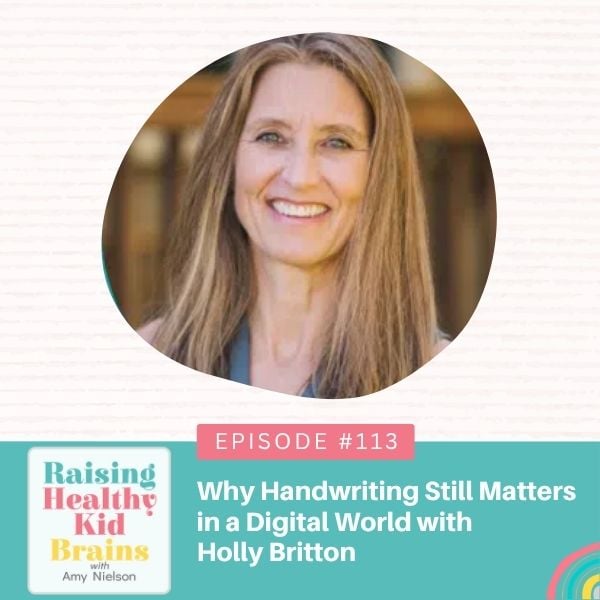
Ep #113: Why Handwriting Still Matters in a Digital World with Holly Britton
In a world where every kindergartner has access to an iPad, does handwriting still matter? The answer, according to handwriting expert Holly Britton, is yes – and it’s not just a penmanship issue; it’s a thinking issue.
In this episode, Holly explains why the way we teach handwriting is critical for young learners. She shares her eye-opening experiences as a teacher, where she saw firsthand how skipping systematic handwriting instruction leaves kids struggling – whether it’s third graders who can’t complete assignments or kindergartners unable to form letters properly.
We dive into why handwriting is such a powerful tool for cognitive development and why, without it, kids are missing out on vital brain connections. As more classrooms move toward digital devices, Holly makes the case that handwriting is still the key to unlocking deeper learning and success in all areas.
To thank you for being a listener here, we made you a special freebie. It’s an amazing alphabet activity you can begin using with your kiddos that is so fun, so get started by clicking here to grab it!
What You’ll Learn:
Why handwriting is a thinking issue, not just a penmanship issue, and how it impacts word processing and communication skills.
The critical difference between “trace” (handwriting) and “imprint” (typing) modes of writing and their distinct effects on brain development.
How removing handwriting instruction limits kids’ cognitive options later in life.
Why the “path of least resistance” with technology can prevent children from developing fundamental baseline skills.
The connection between hand flow and thought flow and how inefficient letter formation disrupts cognitive processing.
What happens when we give young children technology before they understand basic language concepts like letters representing sounds.
Practical strategies for encouraging writing at home.
What role does handwriting have in a world of AI and every child in school having their own iPad? Does it still matter? Does it matter how they form their letters? Where does handwriting fit?
I had the most amazing conversation today with Holly Britton. She’s a curriculum designer, handwriting specialist, and instructional advisor. And what we talked about was the role of handwriting in acquiring language and being able to use language, how it impacts both your ability to visualize words. She talks about the difference between tracing and imprinting, and she talks about the idea that taking away this sequential handwriting instruction that children need, that we’re literally removing a thinking tool away from children.
We had a fascinating conversation about technology. We talked about the change that’s happening in education right now, the realization of how important systematic, sequential phonics instruction is, and moving away from this idea that if you put enough books in front of a child, they’ll learn to read.
But we haven’t quite gotten there with reading, and it still seems like in our world today that we’ve kind of removed sequential handwriting instruction, and we assume that children will just kind of learn how to write if we have letters in front of them. And so more children are learning to form letters wrong. They’re becoming frustrated.
They’re not able to form letters as quickly, and so they’re losing flow, which impacts their brain flow, their thinking flow, and all of these different things that impact children and their ability to think in the way that we were able to as children that grew up without a computer.
It was a fascinating conversation. It will change the way you think about handwriting. I hope you enjoy it. It’s coming up right after this.
Welcome to the Raising Healthy Kid Brains podcast, where moms and teachers come to learn all about kids’ brains, how they work, how they learn, how they grow, and simple tips and tricks for raising the most resilient, kind, smart, compassionate kids we can. All while having lots of grace and compassion for ourselves, because, you know what? We all really need and deserve that, too. I am your host, Amy Nielson, let’s get ready to start the show.
Holly, welcome to the show.
Holly Britton: Thank you for having me. Excited to be here.
Amy: Yeah, I’m so excited to talk about this. And today we’re going to talk about handwriting, which I think is such an interesting topic right now in our world. I know I have kids in two different school districts and every kid has a Chromebook, right? Even starting in like the lowest grades, every kid has a Chromebook and then transitioning into iPads as they get older.
So there’s a lot of conversation around handwriting and how much it matters and all of that. So we’re going to get into all of that stuff and talk about how it impacts everything. And I’m very excited to get to that. But before we do, I just am wondering how you became passionate about handwriting? Like tell me how this became a thing for you and then we’ll get into it.
Holly Britton: Sure. Well, I didn’t start my career path in education. I actually started at UC Davis with a mind towards equine veterinarian medicine. So I—teaching was not a thing growing up. I mean, it wasn’t a part of my career goals. So I started rather organically with my own children, and in order to teach them well, I had to learn how to teach. This was way back before the internet, so there’s no cheating.
Amy: I love the internet. It’s so great. But yeah, I get it.
Holly Britton: I bring that up as no small thing that for 18 years I worked with four children, including a dyslexic and a lefty, on everything connected to handwriting. You need handwriting for everything you do. So I couldn’t have that be an issue if I was going to be using handwriting as a tool for other learning. I never put it into words like that when I was raising my children, but that’s what it became.
And so later, when I did get my master’s and my teaching credential and I went into private and public education, I was acutely aware of the shortcomings of the way children were being taught how to write by hand. And it didn’t become a huge issue for me personally in terms of teaching children until I was teaching in third, fourth, and fifth grade and the kids did not have the foundational writing skills I needed them to have in order to teach higher-level writing skill.
They were lacking the fundamentals and it was very frustrating for me and frankly, very frustrating for the kids because they were being required to do something they were not set up to do. And it became very evident to me that handwriting is seen in society as a penmanship issue, but it is a thinking issue. It is a word processing issue. It is a communication issue. It is ultimately a transcription issue. I need those kids to be able to see and hear words in their heads and put them on paper. And if they can’t do that, I can’t forward them to more advanced learning.
So when COVID happened, I’d been coaching in kindergarten for new teachers coming into the profession and had never—not only had never taught kindergarten, but coming out of the teaching schools had never been taught how to teach handwriting. And I have been through some cert programs. I have some training in various ELA programs.
All of them touch on handwriting, but with the exception of the cursive certification program that I went through, of which there are very few and far between, none of them really address handwriting as a transcription issue that needs to be taught over a long period of time and practiced frequently in order to reach mastery.
And so when COVID happened, I was sort of at a crossroads. Should I step out of the classroom and do something to address this problem on a larger level? Or do I go do a PhD program and start researching this area? Or do I go in the classroom and help the kids one by one, school by school, year by year?
So I chose to step out. I designed Squiggle Squad based on all the features that are needed neurologically, developmentally, to take a kid through the incremental progression of learning to acquire handwriting skills. And the program—I really wanted it to also ulteriorly teach teachers how to teach handwriting. So I wanted them to see the incremental steps that was needed for a child in order to acquire this skill.
Amy: Okay, so I love this and you created this program based on your own experience and understanding. But I want to backtrack a little bit to kind of talk about why it matters in today’s age, because when I am talking to people out in the world, right? And they’re asking, why does handwriting matter? You know, I’ve had my 13-year-old son ask the same question, right? Like, does it matter so much?
Because kids aren’t writing very much anymore. You know, they’re typing. I actually still love to write, but then it never seems to quite make it into my digital stuff where my team can see it and whatever. So why is it important still if we’re all having, you know, a Chromebook or an iPad if every kid has those in school, does handwriting still really matter? We’re not sending letters anymore.
Holly Britton: Have you ever seen a kid keyboarding in a kindergarten class?
Amy: No.
Holly Britton: Yeah. So one thing to keep in mind, there’s so much to talk about when it comes to this, but this is not so much about the mode of writing as it is the brain training that handwriting does. And when you get a little on a screen, there’s so much research being done right now about what’s actually happening in their brain, and the way they’re actually processing language.
Remember that they don’t have a full vocabulary of language yet. When they’re 4 and 5 years old, they’re still acquiring language. They still don’t understand what a letter is. They don’t understand the symbolism behind letters, that letters actually represent a sound, and that sound is part of a word. And we do not break language apart well enough in our schools to help kids build up those skills in a developmentally appropriate way so that they can build on those skills.
So when we jump ahead and assume they understand more than they do and we bombard them with information we want them to know and think they can just get if we just tell them, then we completely 100% frustrate them and of course they want to find the easiest way. And neurologically, the easiest way is just to swipe and punch buttons even if they don’t understand what they’re doing or why they’re learning it.
And we don’t need them being motivated by dopamine. We need them motivated by the intrinsic reward of learning something, and they don’t get that if we don’t take them through the struggle of discovering, connecting, coming to their own understanding and reaching those aha moments where you see the little sparkle in their eye and understanding happens. That just doesn’t happen very much. I don’t know if I’ve ever seen that happen on an iPad in a kindergarten class.
Amy: One of the things that I’ve found really interesting is we have done a lot of research on this and of course, we train teachers how to teach kids to read and start reading coaching businesses wherever they are, which is amazing.
But one of the things we teach them and talk about is how critical it is. We talk about this idea of teaching phonological awareness and that whole process of language, right? And being able to hear and break down language, you know, words, sentences, all these things down to individual sounds, right? As a concept without even looking at symbols on paper and then bringing that to paper and both being able to decode that, being able to read it and then be able to encode that to be able to write it.
And what’s so interesting is how important and valuable it is to teach reading and writing at the same time. It’s—they’re doing both. They’re going both directions and it just reinforces every concept that we’re teaching with reading, which is such a critical skill, right? And that’s just fortified by the writing piece, and it’s using their brain in a different way. They’re building additional connections, those pathways we’re trying to create in the brain and then make into super highways where they’re fast enough that it feels like instant instead of just, you know.
And so all of that’s happening. And so writing is so fundamental to that process of learning. And I think that yes, that starts in, you know, hopefully we’re talking about phonological awareness being really important starting from preschool, you know, every day on, right? And then adding in these other pieces as it’s developmentally appropriate. But of course, in kindergarten, we’re still doing that. But then does it matter? Is it still relevant later? So is handwriting still relevant later on? Or is this just something that’s important in like kindergarten, first grade, second grade kind of grade levels?
Holly Britton: There’s two ways you can get words on paper. One is through what we call trace, and that would be a handwriting or painting or tracing through the letter in order to create a letter on paper. The other is what we call imprint, where you push a button and it happens. We know by research, and we also know just by being teachers and parents, that this requires different processes in the brain in order to use that mode of writing.
Many, many, many of the most famous writers we know still go to handwriting when they need to process something more deeply. It slows down our thinking process so that we can mine through what we know and the best way to say things. And I also use handwriting and keyboarding interchangeably. I also use voice-to-text or voice-to-writing. All of that is a different way of processing language. All of that are different ways of communicating what’s in our brain.
But if we never teach a child to write by hand, they will not have the skill to use that as a tool. We are effectively taking a thinking tool away from a child. And we’re in a really weird time in history where the people teaching children, unless they’re under like the age of 30, were themselves taught how to write by hand. So we take for granted that we were explicitly taught how to do it.
And as a generation without computers, we actually grew up the first part of our years never using a computer. So we were practicing whether we knew it or not, we were practicing, and we had been shown how to practice correctly. So there were classic protocols in place for handwriting instruction, and it was done through the grades.
Now, we expect a preschool teacher to teach a child all 52 letters of the alphabet, by the way. So there’s 26 lower case, 26 capitals, and those are all different shapes for a child. And they need to figure out what they are, what they mean. And again, they are working hard to sort it all out to really make meaning of the stuff that’s being put in front of them. And now they’re being pressured to know it. So there’s this, you know, extra stress.
And then not only do you have to know them and be able to name them, you have to be able to write them. Then when you don’t know it in kindergarten, the kindergarten teacher is upset that you’ve come up the pipeline without knowing how to do it. And then even worse when you get to first grade and by the end of kindergarten, you’re still struggling.
So what ends up happening is the kids can’t do it. It’s very difficult for them. They haven’t been given the instruction, the time, and the coaching that they need to reach any kind of mastery, which all skill need, all skills.
Amy: Right. Absolutely.
Holly Britton: For, right?
Amy: And then they become frustrated and then it’s almost like a I don’t need this or you know, I, you know, I can’t do that. I don’t really need it. I can just type and…
Holly Britton: And because that happens, the teachers stops requiring it.
Amy: Yes.
Holly Britton: And if the teachers in the classes stop requiring, there’s no more practice. It would be like—I’ve used this example before, but one of my daughters plays violin. If I had just put a violin in her hand when she was four and said, “That sounds good. That’s great. You’re really trying. That sounds really good.” And then in junior high, they say, okay, tonight’s the concert. We would like for you to get on stage and play the violin. Of course, she’s going to hate violin.
Amy: That’s going to be terrible. That will not be a good experience.
I find it so interesting. I love this phrase you said that we’re taking away a learning tool if we’re not teaching children how to write, like handwriting, which I think is so interesting because in my world and conversations around AI and I know it kind of feels like the internet from like 25 years ago and people are like, what’s happening? I don’t know. Whatever. Right, and trying to figure out how to use that.
So there’s this conversation then and we’re going in and we’re starting to try to learn to use AI, and it can do some amazing things. And then what happens is is that people are already starting to notice a loss of skill of some of the thinking that they were doing on their own by having AI take over and do it.
And so I was talking to my business coach, and she was saying, there’s still these tasks that I make sure I always do on my own, so I don’t lose the skill of being able to do it because I need to be able to use this to be really good at what I do, and then I can use AI as the tool to kind of help me do everything around this, right? And I thought that was so interesting.
And when you were talking about taking away a learning tool from children, I thought, that’s what this made me think of. If we’re—it is such a way of engaging our brain and our thinking in a different way when we’re writing by hand versus typing. It just impacts our brain differently, as you talked about, it’s a different process.
And so if we take that away and that slower thinking you were talking about and being able to just go through, we’re not on spell check. We’re like, we’re having to slow down, scratch out, keep rewrite, whatever, all those things, draw the arrows. But it uses our brain in a different way. And if we’re taking that away, are we robbing our children of this additional way of using their brain and thinking? And that, yeah, that’s kind of—that’s kind of frightening.
Holly Britton: Well, one aspect of this conversation that I rarely hear even when I listen to podcasts or I go to reading panels or, you know, literacy experts, we rarely talk about the age of the child. So we talk about AI in classrooms, but we don’t talk about the appropriateness of AI in a preschool class or a first grade class versus a high school class.
And the hard part about that is that we are neglecting brain development. So people who designed AI, who made AI, had fully functioning adult brains. And by the way, they never grew up on AI. So obviously, you don’t need AI to become a genius. You don’t need computers to become a genius.
As a matter of fact, you won’t become a genius if you depend on the computer and AI to do everything for you, you will not grow to your potential, to your human potential. And that’s one thing I love about handwriting. It’s uniquely human until we teach AI how to do it and then you know, they’re going to do handwriting and everything.
Amy: Well, here’s that question though, is then how do you pair those things? Because it’s interesting. I was talking to my business manager on my team, and she’s saying that they’ve removed phones from their schools in Texas. There’s a lot of things about that that I like having done some of the research I’ve done around phones and the impact it’s had on children the last 20 years.
But I think I’m curious around the idea too. We do want children to learn how to use things like the internet and AI and be able to use these as tools for their lives without it,like you said, atrophying their ability to think on their own, right? Or allowing them to still develop these skills of thinking, of writing, of seeing words in their brain and being able to construct that mentally before putting it on paper.
So what is the right combination? Do you have like an age that you feel like or like a divide between handwriting versus using a Chromebook or other kind of piece of technology? Obviously, for really, really young kids, probably we’re not needing to use those. But what age or what divide would you suggest? Do you have thoughts around that?
Holly Britton: I have a lot of thoughts around this.
Amy: Oh perfect. Well, give us just a couple. We don’t have like all the time, but I’d love to hear like your top most interesting, like, what would be valuable for our listeners? Like what could they take with them that would be really helpful?
Holly Britton: Sort of a misconception and maybe even a myth that we have to teach children how to use a cell phone because the people who invented it made it so intuitive that a 3 year old can use it.
Amy: It’s so cool and also a little scary.
Holly Britton: And very scary. So we have—I had a dad come up to me one time and say, it’s amazing. It’s amazing when I give my 3 year old this iPad, she can do everything. And the inference was, she’s a genius. And really what I wanted to say was, no, the genius was the person who made the iPad because they made it so intuitive that a 3 year old can use it.
So we are kidding ourselves if we don’t think that those kids can’t teach themselves better than a teacher in a classroom how to use these incredible tools. It’s like, okay, maybe to a lesser degree, but it’s like a calculator. We can use a calculator to do high-level math, but we don’t give it to a 5 year old in kindergarten to learn how to do math, although we might be now. I don’t know. That might be changing with all this stuff.
Amy: Hopefully not. I don’t, I haven’t seen that yet. I’m not seeing that till like, yeah, high school usually.
Holly Britton: Yeah, but once they learn how to use an iPad and the internet, they won’t have to do it anymore. So if we keep saying to them, oh, you need to do it. It’s really hard work. You need to do it, but here’s a tool that makes it easy. What’s the choice they’re going to take?
Amy: Right. Path of least resistance, here we come.
Holly Britton: That’s right. And I do think these tools are amazing and they do wonderful things. I think sometimes we need to take a step back and ask ourselves, why are we using what we’re using, when we’re using it? Let’s use these tools appropriately as adults. And then we’ll train children to use them when it’s appropriate and when they have developed the fundamental baseline skills that they need to develop in order to use these AI tools wisely.
Kind of like what you said at the beginning of this conversation about AI was these are amazing tools. Oh, it was your coach that said, I have to practice this if I want to keep my brain about me while I use this tool. Well, she is a an educated, fully functioning adult. Kids will not have that discernment. They don’t have executive function. And so they are not going to know the right thing to choose in the moment. They’re going to choose what feels good and what they can access.
So it’s going to be up to teachers and adults and society and culture and parents to say, you know, as you get older, this is something you will use right now, you’ve got that computer in your brain and we’re going to train it to work.
Amy: I love that. Okay, so one of the things I feel like that I’m getting from you that you’re speaking about, which is something I think is a concern I’m kind of seeing in the education space from teachers is that we’ve kind of walked away from writing. I mean, it was—it was like cursive and then almost handwriting too, where there’s, it’s kind of just expected to come naturally, you know, like kind of we used to do with reading. We were like, well, reading will happen naturally. If you just give children enough books, they’ll learn to read naturally.
We now know from the neuroscience and the brain imaging and things that are amazing advancements in technology, right, that’s not how that works and that we actually have to train the brain to do these things. [crosstalk] Do you feel like that’s happening with writing as well?
Holly Britton: 100%. I’m waiting for the other shoe to fall because—
Amy: Right?
Holly Britton: We’ve got the decoding part.
Amy: Yeah.
Holly Britton: Now we need the encoding part, which is way more complicated, by the way, but it’s what takes you to mastery of language.
Amy: Mmm.
Holly Britton: And I would say that a huge evidence of the whole language learning instruction not working is our literacy rates. Our literacy rates.
Amy: Oh. They’re so bad.
Holly Britton: It’s so bad. This did not happen overnight.
Amy: Yeah.
Holly Britton: This crawled in. And it’s a confluence of many, many things that are happening, but not the least of which is our instruction of how we acquire language. And I do think that education was complicated by the influx of digital technologies, you know, mostly computers and I don’t know what happened at the teaching level side of things, but you know, things just started getting really complicated when you had to learn software in the teaching colleges instead of handwriting.
Amy: There are so many pieces happening and I look at it and it just kind of feels like the perfect storm. We’ve just developed so much as a world, as a species in the last, you know, 30 years. And I don’t know if we’re quite keeping up with ourselves. And even just the last decade, the things that we’ve advanced in. And it just takes a while, I think, for kind of us to notice some of the negative impact.
But if you look at phonics over the last 100 years and reading, right? And the evolutions through that, it takes, it feels like sometimes a couple of decades for people to recognize, oh, this new thing that we were trying didn’t work. And I love to come at it from the perspective of I think people are doing the best that they can and the best they know how with what they are given. And then when we see the results, then we have to kind of go back and correct.
And so, like we talked about, we’re seeing that with phonics finally. And I wonder with you and that’s going to come back to, okay, writing is a core piece of this. We need to bring back that systematic writing, handwriting instruction to teach this skill because it is such an important part of literacy.
I want to ask you too, just – do you have tips because one of the things that I find, yes, we want to get this like structured teaching handwriting back into children’s instruction. But then going a little bit beyond that, do you have suggestions for parents or teachers of just encouraging children to write because they want to or because it’s more available than a screen or something?
Like what are some ways—I know my children are, several of them are writers. They love to write. My oldest had written four like full-length novels by the time she was 16. She’s obsessed with writing, wants to be a fiction writer for her career and is hoping to publish her next book, which is super exciting.
But one of the things I did was I would go, at back-to-school time, which we’re recording this at back to school time. I would go get the spiral notebooks. They always go on sale, and I would just have a stack of them in my house all the time, and my kids just had free access to those. And so they would go and they’d get a spiral notebook, which was super fun. And they would be able to draw before they could write. And they would love to write me books and stories and they would just scribble and they were so cheap, it wasn’t like a big deal, right?
And they would draw pictures and then bring me, mom, look at my book I wrote, you know, and show me their little stories and then it kind of developed more and more into writing. So that’s something I’ve done that I felt like has worked really well for my children. Do you have suggestions for just something simple for parents, teachers to do to kind of encourage a love of writing so that kids practice it and are not just on an iPad?
Holly Britton: Well, it’s hard to answer that question exactly because when you say a love of writing, are we talking a love of using your hands to write versus composing stories and essays and reflections of your trip to the museum or you know, there’s different aspects of loving writing and I—
Amy: Do you feel like there’s a connection between the two though? Like is there—if you are able to write it, does that impact your desire to create and code language, I guess you would say like to put it back out?
Holly Britton: Well, remember that as they’re learning to handwrite, they’re learning to get their thoughts that are in their head on paper. And when kids are young, it helps them to think a little slower because they’re doing a lot of things at one time. They’re forming the letters, they’re spelling the words, they’re having to think of syntax to create a sentence that makes sense.
So I think really the answer to your question has a lot more to do about the age of the child and what would be appropriate to fuel that. And that you have these books and then eventually work them to handwriting, I think is wonderful because you’re giving them exposure. You’re giving them opportunity. You’re making it a fun thing. It’s not a you have to do this thing. It’s a you get to do this. Look at this stack of colorful spiral bound notebooks that are so cool. You want to do the blue one today?
You know, those are all sort of, you know, hidden ways that we get kids to really get into it, but they’re not going to get into it if they haven’t been shown how to write those letters efficiently in a way that doesn’t hurt their hand that can go as quickly as possible. Because if you have really stilted writing where you’re going bottom to top and clockwise instead of counterclockwise and you have no flow. If you have no flow of hand, it’s very hard to get a flow of thought.
Amy: Yes.
Holly Britton: So again, it goes back to like teaching music, you know, teaching. When a kid is learning how to play an instrument, it’s not always fun, but once they can play?
Amy: Yeah, and I’m thinking through that and I’ve even asked myself sometimes because I have seen some children recently that in various grades in elementary school are all writing from bottom to top, right? Their letter formation is has not been taught correctly. And then I just sometimes question myself, I’m like, does it really matter that much? Right? And I’m trying to think why it matters. I’m like, is this just me being a stickler because I know you’re not doing it correctly, right? Or does it matter?
So I love that you said that because I think that is—that is so true when you are doing it. There is a reason that it’s being done the way it’s being done and it is for the flow and not only for speed of being able to communicate but of being able to keep your thought flow. That’s brilliant. Oh, so good.
Okay, and you just sparked all kinds of ideas in my head of some things that I’m like, oh, the ways I could like help even really young children that are just learning how to read, like start to create stories. I don’t know. I got excited. This is really fun.
We are like out of time, but I just want to ask you if there’s just like one thing you could leave, like one last thought you could leave with teachers and moms of these young kids. And we love to be encouraging here and uplifting and yes, we know there’s challenges and problems and whatever, but like what’s one step we could do to move forward or one piece of encouragement or hope in lifting people as they’re trying to help children.
What’s like one last thought that you would leave with these moms and teachers that are influencing children and trying to help them live their best life and develop their brains in the best way possible?
Holly Britton: What comes to mind right off the top of my head is no matter what your learning objective is, whether it’s a learning objective for the day or the week or their life, the best way to teach a child is to break things down and slowly build them up. Don’t ask too much of a child that isn’t ready to learn what you’re putting in front of them.
And that’s how we build the love of learning is we give them something we know they can accomplish and slowly introduce challenge that allows them to overcome and get better. And that sparks that intrinsic reward that makes them want to do it again. We give them a safe place, we give them developmentally appropriate materials and experiences, and then the motivation and the momentum to learn will keep going. So there’s things we do that shut them down and if we are mindful of that, then we will just open them up and open up their world before them.
Amy: Oh, I love that so much. Pushing, but just the right amount, creating those curiosity gaps so that there’s more. There’s always more. There’s more we can learn, but not in a way of overwhelm and you’re not good enough, but in a way of, oh my gosh, look how far you’ve come and there’s more and there’s more and there’s more. And let’s build. What could we do next? Right? Kind of idea. Oh, I love it so much. Okay, so Squiggle Squad is what you’ve created to help parents and teachers with this.
Holly Britto : Yes.
Amy: Okay. And where can I send our listeners like, where can we send them to find you? Where do we come and find you online so that they can take a look at this program you’ve created while the rest of education world, well we’re still catching up and waiting for the other shoe. Yes.
Holly Britton: Take the iPad out of their hand and teach them to handwrite and it’s really fun with the Squiggle Squad because there’s five little critters that the kids love, and they can find us at SquiggleSquad.com. I know it’s a little bit of a mouthful, S Q U I G G L E, SquiggleSquad.com. And on that, in the about section is also my blog, Holly on Handwriting, if they’re interested, if you’re interested in more about this idea of handwriting as a kinesthetic connection to language and a tool for literacy.
Amy: Okay, we will send people there. We’ll put the link for our listeners. We’re going to put that link for you in the show notes so you can just click it and go there and see what Holly’s put together because handwriting matters and the steps and I love how you brought out the importance of the step-by-step progression of actually teaching it instead of just saying, there are letters, make them, you know, kind of like we’ve been doing with reading and phonics and hopefully we’ll get caught back up with the writing.
Thank you so much for your time today and for sharing this and discussing this topic with me because I think it is very relevant and very important today and I so appreciate you coming and giving us your time today.
Holly Britton: Thanks, Amy. Bye.
Amy: Bye.
—
Don’t you just love all the fun things we’re learning on this show together? Well, we wanted to give you a chance to practice a little bit of it at home. And so we made you a special freebie just for being a listener here. You can grab it at PlanningPlaytime.com/special-freebie.
So what this freebie is, I’ll tell you, is an amazing alphabet activity that you can start using with your kiddos. And it is based in play and is so fun. You can use dot markers with it. You can use Q-tip painting. You could use circled cereal. There’s all kinds of options. You can print it out today and get started. Just head over to PlanningPlaytime.com/special-freebie, and we’ll send that to you right away.
Thank you for hanging out with me today for this fun chat on Raising Healthy Kid Brains. If you want to see more of what we’re doing to support kiddos and their amazing brains, come visit us on our website PlanningPlaytime.com. See you next week.
Enjoy the Show?
Don’t miss an episode! Follow the podcast on Apple Podcasts, Spotify or anywhere else you get your podcasts.
We use cookies on our website to give you the most relevant experience by remembering your preferences and repeat visits. By clicking “Accept All”, you consent to the use of ALL the cookies. However, you may visit "Cookie Settings" to provide a controlled consent.View Terms and Conditions
This website uses cookies to improve your experience while you navigate through the website. Out of these, the cookies that are categorized as necessary are stored on your browser as they are essential for the working of basic functionalities of the website. We also use third-party cookies that help us analyze and understand how you use this website. These cookies will be stored in your browser only with your consent. You also have the option to opt-out of these cookies. But opting out of some of these cookies may affect your browsing experience.
Necessary cookies are absolutely essential for the website to function properly. These cookies ensure basic functionalities and security features of the website, anonymously.
Cookie
Duration
Description
cookielawinfo-checkbox-analytics
11 months
This cookie is set by GDPR Cookie Consent plugin. The cookie is used to store the user consent for the cookies in the category "Analytics".
cookielawinfo-checkbox-functional
11 months
The cookie is set by GDPR cookie consent to record the user consent for the cookies in the category "Functional".
cookielawinfo-checkbox-necessary
11 months
This cookie is set by GDPR Cookie Consent plugin. The cookies is used to store the user consent for the cookies in the category "Necessary".
cookielawinfo-checkbox-others
11 months
This cookie is set by GDPR Cookie Consent plugin. The cookie is used to store the user consent for the cookies in the category "Other.
cookielawinfo-checkbox-performance
11 months
This cookie is set by GDPR Cookie Consent plugin. The cookie is used to store the user consent for the cookies in the category "Performance".
viewed_cookie_policy
11 months
The cookie is set by the GDPR Cookie Consent plugin and is used to store whether or not user has consented to the use of cookies. It does not store any personal data.
Functional cookies help to perform certain functionalities like sharing the content of the website on social media platforms, collect feedbacks, and other third-party features.
Performance cookies are used to understand and analyze the key performance indexes of the website which helps in delivering a better user experience for the visitors.
Analytical cookies are used to understand how visitors interact with the website. These cookies help provide information on metrics the number of visitors, bounce rate, traffic source, etc.
Advertisement cookies are used to provide visitors with relevant ads and marketing campaigns. These cookies track visitors across websites and collect information to provide customized ads.